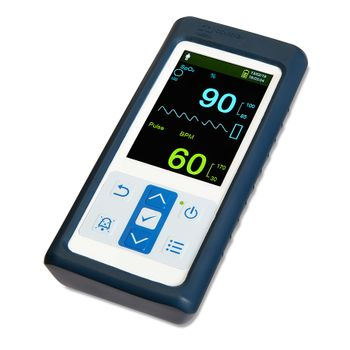
Nellcor Portable SpO2
 Nellcor · Model Portable SpO2
Small, lightweight, ergonomic handheld monitor for continuous and spot-check pulse oximetry monitoring Supports a robust data set, including real-time SpO2 and PR values, SatSeconds alarm management, pleth waveform, blip bar and tabular trend data Supports standard and home-care modes for use in hospital, hospital-type facilities, transport, mobile environments and home-care environments Supports Sleep Study Mode, which enables the clinician to dim the LCD display and silence alarms to prevent disruption of patients’ sleep Nellcor™ advanced signal processing technology delivers reliable operation even in difficult monitoring conditions LoSat expanded accuracy range (60% to 100% SpO2) when used with Nellcor™ adhesive sensors with OxiMax™ technology Compatible with the complete line of Nellcor™ single-patient-use, reusable and specialty sensors with OxiMax™ technology 80 hours of data storage capability Supports data export to an external personal computer for data analysis and printing functions.
Key tips
- ·A no-signal/flatline alarm gets checked on the patient first, not the monitor - rule out a real clinical event before troubleshooting.
- ·Recalibrate NIBP against a reference manometer, not just a self-test pass.
- ·Reused patient cables (SpO2, ECG leads) are a common source of intermittent-fault complaints - swap the cable before the module.
Typical Failure Modes
Compiled for this model from its own documentation and established engineering knowledge for this equipment class - not from a verified service record. Confirm against the manufacturer's service manual.
No SpO2 / pulse reading or poor signal
HighSymptoms: No saturation / pulse value, "pulse search", low signal quality, implausible values.
Root cause: Worn or wrong SpO2 sensor, a damaged cable, poor site / perfusion, or motion.
Sensor / cable connector fault
MediumSymptoms: Reading drops when the cable is moved, sensor not recognised.
Root cause: Broken conductors in the sensor / extension cable, or a worn connector.
Inaccurate SpO2 vs a co-oximeter
MediumSymptoms: SpO2 consistently biased vs an arterial reference.
Root cause: Sensor degradation, or a monitor calibration / module fault.
Alarm / audio fault
MediumSymptoms: No or quiet audible alarm.
Root cause: Speaker or audio-board fault - a safety-critical failure.
Battery / power fault
MediumSymptoms: Short battery run time, will not power on.
Root cause: Aged battery.
Serviceable Parts & Consumables
Serviceable items for this model, compiled from its documentation and engineering knowledge for this equipment class. Service class and relative cost are estimates, not manufacturer figures; no part numbers are given. Confirm intervals and pricing against the manufacturer.
SpO2 sensor (reusable / disposable)
Class Frequent wear itemRel. cost $$R&R Easy
Pulse-oximetry extension cable
Class Frequent wear itemRel. cost $$R&R Easy
Battery
Class Periodic replacementRel. cost $$R&R Fairly easy
SpO2 module / board
Class Major service partRel. cost $$$R&R Moderate
Alarm speaker / audio board
Class Major service partRel. cost $$R&R Moderate
| Part | Service class | Relative cost | R&R difficulty |
|---|---|---|---|
| SpO2 sensor (reusable / disposable) | Frequent wear item | $$ | Easy |
| Pulse-oximetry extension cable | Frequent wear item | $$ | Easy |
| Battery | Periodic replacement | $$ | Fairly easy |
| SpO2 module / board | Major service part | $$$ | Moderate |
| Alarm speaker / audio board | Major service part | $$ | Moderate |
Relative cost: $ lowest · $$$$ highest service-part cost for this equipment class. Not a price.
PM Checklist
Preventive-maintenance tasks typical of this equipment class. Perform to the manufacturer's procedure and your facility's policy - this is general reference, not a schedule for this specific unit.
- ·Routine cable and lead-wire inspection for fraying/wear
- ·Battery conditioning cycle
- ·NIBP calibration check against a reference manometer
- ·ECG / SpO2 accuracy verification against a patient simulator
- ·Annual electrical safety test
Error Codes
Extracted directly from this unit's own service manual.
001SpO 2 front end RAM error
002SpO 2 front end ROM/code integrity error
004SpO 2 front end reports command not allowed.
005SpO 2 front end reports illegal value sent by SpO 2 back end.
006SpO 2 front end reports calibration (offset) failure.
010Over-current limit in SpO 2 front end has tripped.
012SpO 2 front end reports other hardware problem.
017SpO 2 front end reports other hardware problem.
018SpO 2 front end reports internal register modified from expected value.
048SpO 2 front end reports spurious interrupt detected.
050SpO 2 front end reports internal software consistency check failed.
051SpO 2 front end reports DigiCAL communications error.
256SpO 2 back end reports beginning of packet missing.
257SpO 2 back end reports packet state ID (SID) missing.
258SpO 2 back end reports packet length error.
259SpO 2 back end reports message length error.
260SpO 2 back end reports packet contains unsupported Key.
261SpO 2 back end reports packet CRC error.
262SpO 2 back end reports end of packet missing.
263SpO 2 back end reports packet contains undefined Key.
264SpO 2 back end reports corrupted variable.
265SpO 2 back end reports memory overflow.
266SpO 2 back end reports bad pointer.
267SpO 2 back end reports parameter value out-of-range.
268SpO 2 back end reports reset detected.
269SpO 2 back end reports unexpected value.
270SpO 2 back end reports timeout.
271SpO 2 back end reports not ready/not initialized.
272SpO 2 back end reports double fault.
273SpO 2 back end reports data out of range error.
274SpO 2 back end reports incompatible software version.
275SpO 2 back end reports incorrect registration number.
276SpO 2 back end reports sensor read failure.
277SpO 2 back end reports sensor signature verification fails.
280SpO 2 back end reports does not support feature required by sensor.
281SpO 2 back end reports overflow/underflow.
282SpO 2 back end reports sensor activation failure.
283SpO 2 back end reports sensor write failure.
284Host is providing both HW and SW ECG triggers.
285Host attempted Read or Close of Sensor Event before successful Open.
286Host attempted redundant Open of Sensor Event.
287An error occurred with the Sensor Event data and is unavailable for reading by the Host.
288No more Sensor Event data available for reading by Host, i.e., Host has read all available Sensor Event data.
289Sensor Private Label/Host Sensor Key incompatible; will not operate sensor.
512SpO 2 back end reports internal software consistency check failed.
513SpO 2 back end reports software functions executed before initialization completed.
514SpO 2 back end reports internal memory buffer overflow.
516SpO 2 back end ROM/code integrity error
517SpO 2 back end RAM error
518SpO 2 back end reports internal software consistency check failed.
519SpO 2 back end reports a state machine is in an unexpected state.
520SpO 2 back end reports memory corruption detected.
521SpO 2 back end reports spurious interrupt detected.
522SpO 2 back end reports unable to issue commands to SpO 2 front end.
523SpO 2 back end reports unable to write to external Flash.
524SpO 2 back end reports that communication with SpO 2 front end lost.
525SpO 2 back end reports internal register modified from expected value.
701Flash writing transaction error
901SpO 2 module communication error/setting value mismatch error between host and SpO 2 module
902Program memory error
Troubleshooting Approach
A starting sequence for this model, compiled from its documentation and engineering knowledge for this equipment class. Follow the manufacturer's service documentation for the actual procedure.
Symptom: No SpO2 / pulse reading or poor signal
- Fit a fresh, correct-size sensor on a warm, well-perfused, still site.
- Swap the SpO2 extension cable.
- Confirm the pleth / signal-quality indicator improves.
- Test the monitor with an SpO2 simulator across several saturations.
- Replace the sensor / cable, or refer the SpO2 module if the simulator also fails.
Symptom: Reading drops when the cable is moved / sensor not recognised
- Flex the sensor and extension cable along their length while watching the trace.
- Inspect the connectors for damage and clean them.
- Try a known-good cable and sensor.
- Confirm the sensor type matches the module.
- Replace the cable; refer the module connector if it persists.
Symptom: SpO2 biased vs a co-oximeter / accuracy concern
- Compare to an arterial co-oximetry result where clinically indicated.
- Try a known-good sensor of the correct type.
- Verify against an SpO2 simulator at 80 / 90 / 97 %.
- Check the module software / calibration revision.
- Refer the module for calibration if it fails the simulator.
Symptom: No or quiet audible alarm
- Confirm alarm volume is not set to minimum and alarms are not paused.
- Trigger a test alarm (remove the sensor) and listen.
- Check the speaker and its connector.
- Replace the speaker / audio board - a failed alarm is a safety fault.
- Verify the alarm at the set volume before returning to service.
Typical Location
Where this class of equipment is typically deployed - general reference, not this unit's own placement record.
- ICU / CCU
- Emergency Department
- OR / PACU
- General med-surg floors
- Step-down units
- Telemetry units
Documents & Manuals
Troubleshoot this device with Bio
Describe a symptom or error code. Bio answers from this device's own documented error codes, failure modes, parts, and guides.
Ask Bio