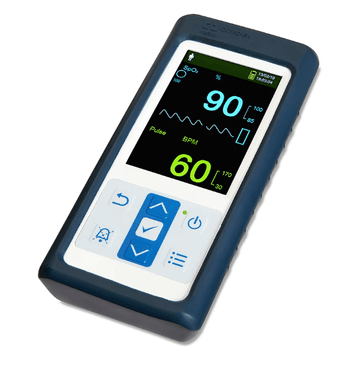
Nellcor PM10N
 Nellcor · Model PM10N
Portable and Handheld Design: Lightweight and easy to carry, this pulse oximeter is ideal for spot-checks and continuous monitoring, offering flexibility in both clinical and home care environments. Accurate SpO2 and Pulse Rate Readings: Offers reliable oxygen saturation (SpO2) and pulse rate measurements for consistent patient monitoring. Versatile Usage: Whether for hospital settings, home care, or on-the-go, this device is a perfect fit for patients needing regular monitoring or healthcare professionals conducting quick assessments. Easy-to-Use Interface: Simple design ensures that healthcare providers and caregivers can quickly access vital information without technical complexity. With reliable performance, a portable design, and user-friendly features, the handheld pulse oximeter is an essential tool for biomedical engineers, healthcare providers, and patients seeking accurate monitoring in both clinical and home settings. (Generated by AI)
Key tips
- ·A no-signal/flatline alarm gets checked on the patient first, not the monitor - rule out a real clinical event before troubleshooting.
- ·Recalibrate NIBP against a reference manometer, not just a self-test pass.
- ·Reused patient cables (SpO2, ECG leads) are a common source of intermittent-fault complaints - swap the cable before the module.
Typical Failure Modes
Compiled for this model from its own documentation and established engineering knowledge for this equipment class - not from a verified service record. Confirm against the manufacturer's service manual.
No SpO2 / pulse reading or poor signal
HighSymptoms: No saturation / pulse value, "pulse search", low signal quality, implausible values.
Root cause: Worn or wrong SpO2 sensor, a damaged cable, poor site / perfusion, or motion.
Sensor / cable connector fault
MediumSymptoms: Reading drops when the cable is moved, sensor not recognised.
Root cause: Broken conductors in the sensor / extension cable, or a worn connector.
Inaccurate SpO2 vs a co-oximeter
MediumSymptoms: SpO2 consistently biased vs an arterial reference.
Root cause: Sensor degradation, or a monitor calibration / module fault.
Alarm / audio fault
MediumSymptoms: No or quiet audible alarm.
Root cause: Speaker or audio-board fault - a safety-critical failure.
Battery / power fault
MediumSymptoms: Short battery run time, will not power on.
Root cause: Aged battery.
Serviceable Parts & Consumables
Serviceable items for this model, compiled from its documentation and engineering knowledge for this equipment class. Service class and relative cost are estimates, not manufacturer figures; no part numbers are given. Confirm intervals and pricing against the manufacturer.
SpO2 sensor (reusable / disposable)
Class Frequent wear itemRel. cost $$R&R Easy
Pulse-oximetry extension cable
Class Frequent wear itemRel. cost $$R&R Easy
Battery
Class Periodic replacementRel. cost $$R&R Fairly easy
SpO2 module / board
Class Major service partRel. cost $$$R&R Moderate
Alarm speaker / audio board
Class Major service partRel. cost $$R&R Moderate
| Part | Service class | Relative cost | R&R difficulty |
|---|---|---|---|
| SpO2 sensor (reusable / disposable) | Frequent wear item | $$ | Easy |
| Pulse-oximetry extension cable | Frequent wear item | $$ | Easy |
| Battery | Periodic replacement | $$ | Fairly easy |
| SpO2 module / board | Major service part | $$$ | Moderate |
| Alarm speaker / audio board | Major service part | $$ | Moderate |
Relative cost: $ lowest · $$$$ highest service-part cost for this equipment class. Not a price.
PM Checklist
Preventive-maintenance tasks typical of this equipment class. Perform to the manufacturer's procedure and your facility's policy - this is general reference, not a schedule for this specific unit.
- ·Routine cable and lead-wire inspection for fraying/wear
- ·Battery conditioning cycle
- ·NIBP calibration check against a reference manometer
- ·ECG / SpO2 accuracy verification against a patient simulator
- ·Annual electrical safety test
Troubleshooting Approach
A starting sequence for this model, compiled from its documentation and engineering knowledge for this equipment class. Follow the manufacturer's service documentation for the actual procedure.
Symptom: No SpO2 or poor signal
- Fit a fresh, correct-size sensor on a well-perfused, still site.
- Swap the extension cable.
- Confirm the signal-quality / pleth indicator improves.
- Test the monitor with an SpO2 simulator.
- Replace the sensor / cable, or refer the monitor if the simulator also fails.
Symptom: Accuracy or alarm concern
- Compare SpO2 to a co-oximeter blood gas where clinically indicated.
- Try a known-good sensor.
- Verify against an SpO2 simulator at several saturations.
- Test the audible alarm at the set volume.
- Refer for module / audio service if it fails the simulator or alarm test.
Typical Location
Where this class of equipment is typically deployed - general reference, not this unit's own placement record.
- ICU / CCU
- Emergency Department
- OR / PACU
- General med-surg floors
- Step-down units
- Telemetry units
Documents & Manuals
Troubleshoot this device with Bio
Describe a symptom or error code. Bio answers from this device's own documented error codes, failure modes, parts, and guides.
Ask Bio