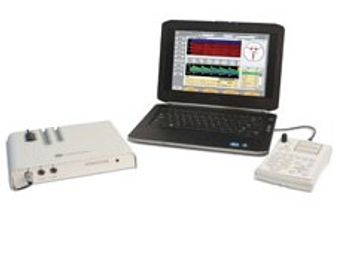
Natus SONARA/tek
 Natus · Model SONARA/tek
High Quality Doppler Signal. Customized Protocols and Reporting. Unilateral Monitoring Options. Single channel Emboli Detection with Variable Thresholds. Speciality Tests: VMR and BHI. Multi-button Advanced Remote Control. Multiple Languages Capability. Statistics and Trending Packages. M-mode and Multi-Depth Displays in Diagnostic and Monitoring Modes. DICOM Compatible TCD is a useful tool for the evaluation of numerous neurovascular conditions in adult and pediatric patients. Diagnostic cerebrovascular and extracranial investigation. Extended-term unilateral cerebrovascular monitoring The systems may be used in vascular labs, operating rooms, intensive care units, emergency departments and physician offices for the following applications. Detection of intracranial stenosis. Detection of vasospasm due to subarachnoid hemorrhage. Detection of arteriovenous malformations (AVMs). Assessment of collateral pathways. Detection of embolic events. Detection of PFO (Patent Foramen Ovale) with bubble test. Track and establish trends of blood flow velocities. Help assess surgical techniques through immediate feedback of the results of interventional procedures. Breath Hold and Vasomotor Reactivity (VMR) tests.
Key tips
- ·Electrode impedance drives data quality more than almost any other single factor - check it before assuming an amplifier fault.
- ·Pre-case verification of intraoperative monitoring equipment isn't optional - a mid-case failure has direct surgical-decision consequences.
Typical Failure Modes
Compiled for this model from its own documentation and established engineering knowledge for this equipment class - not from a verified service record. Confirm against the manufacturer's service manual.
Excessive noise / poor signal on a channel
HighSymptoms: 50/60 Hz or broadband noise, flat or noisy trace on one or more channels, high electrode impedance.
Root cause: Electrode / lead-wire fault, a headbox / amplifier input fault, or a grounding / environment problem.
Stimulator output fault
MediumSymptoms: No or weak electrical stimulation, no patient response, stimulator-error message.
Root cause: Stimulator probe / bar-electrode fault, its cable, or the stimulator output stage.
Headbox / amplifier fault
MediumSymptoms: One or more channels dead or saturated on all inputs, calibration fails.
Root cause: Headbox / amplifier module fault.
Acquisition PC / software fault
MediumSymptoms: Acquisition hangs, studies will not save or export, license / dongle error.
Root cause: Workstation PC, software, or the license key.
Audio / stim-artefact / trigger fault
LowSymptoms: No audio monitor, trigger not registering (evoked potentials).
Root cause: Speaker / audio board or the trigger input.
Serviceable Parts & Consumables
Serviceable items for this model, compiled from its documentation and engineering knowledge for this equipment class. Service class and relative cost are estimates, not manufacturer figures; no part numbers are given. Confirm intervals and pricing against the manufacturer.
Patient lead set / electrode leads
Class Frequent wear itemRel. cost $$R&R Easy
Stimulator probe / bar electrode & cable
Class Frequent wear itemRel. cost $$R&R Fairly easy
Headbox / amplifier module
Class Major service partRel. cost $$$R&R Moderate
Acquisition PC
Class Major service partRel. cost $$$R&R Moderate
Audio / speaker board
Class Major service partRel. cost $R&R Moderate
| Part | Service class | Relative cost | R&R difficulty |
|---|---|---|---|
| Patient lead set / electrode leads | Frequent wear item | $$ | Easy |
| Stimulator probe / bar electrode & cable | Frequent wear item | $$ | Fairly easy |
| Headbox / amplifier module | Major service part | $$$ | Moderate |
| Acquisition PC | Major service part | $$$ | Moderate |
| Audio / speaker board | Major service part | $ | Moderate |
Relative cost: $ lowest · $$$$ highest service-part cost for this equipment class. Not a price.
PM Checklist
Preventive-maintenance tasks typical of this equipment class. Perform to the manufacturer's procedure and your facility's policy - this is general reference, not a schedule for this specific unit.
- ·Electrode / lead impedance check
- ·Amplifier calibration
- ·Annual electrical safety test
Troubleshooting Approach
A starting sequence for this model, compiled from its documentation and engineering knowledge for this equipment class. Follow the manufacturer's service documentation for the actual procedure.
Symptom: Noisy channel or poor signal
- Check electrode impedances and re-prep the skin.
- Swap the lead wires and try a different headbox input.
- Move away from mains-powered equipment and confirm the ground / reference.
- Run the amplifier calibration / impedance check.
- Replace the lead set or headbox as isolated.
Symptom: Stimulator gives no response
- Confirm the stimulator settings and that intensity ramps.
- Swap the stimulator probe and cable.
- Test on a saline / test load per the manual.
- Check the stimulator output on a second channel.
- Refer the stimulator output stage if a good probe still gives nothing.
Typical Location
Where this class of equipment is typically deployed - general reference, not this unit's own placement record.
- Neurology / EEG lab
- ICU (continuous EEG monitoring)
- Operating Room (intraoperative monitoring)
Documents & Manuals
Troubleshoot this device with Bio
Describe a symptom or error code. Bio answers from this device's own documented error codes, failure modes, parts, and guides.
Ask Bio