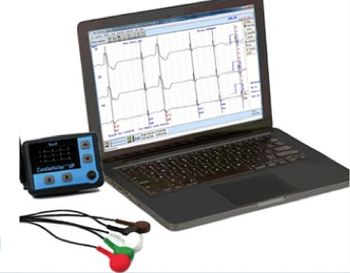
Nasiff CardioCard PC Based Holter ECG System
 Nasiff · Model CardioCard PC Based Holter ECG System
CardioHolter provides state-of-the art care during daily activities – we care about you and your patients. ONE (1) Flash Digital 24-48 hour Full Disclosure Recorder. Free Training and Toll-free Technical Support. One AA Alkaline Battery (disposable). Digital Recorder: 3.45"W x 2.6"H x.75"D (5 ounces with battery). Two-year Software Warranty, Two-year Recorder Warranty, Free Upgrades (during two-year warranty period). 3 Channels includes 5-, or 7- patient Leads. User Selectable Arrhythmia Variable Settings. On-screen Condensed/Zoom View: 1 or 10 minute, 2 or 4 second Intervals. Standard Reports to Screen or Printer: Summary of Test with Diagnostics, Event/Episode Reports, Full Disclosure of all ECG’s, Heart Rate Variability Histograms, R-R Dispersion Graphs, ST Graphs, VF Tables/Graphs, ST Severity Tables. Includes Software and Database Management System (no additional cost). Flash Recorder has 3 Channel Display, 5- leads, CF Card, Belt and User Manual. Storage of Patient ECG Records to Hard Drive, Floppy or any Storage Medium. Complex Classifications: PVC, VE Run, Couplet, Triplet, Bigeminy, Trigeminy, R on T, SVPB, SVE Run, Pauses, PE, AFib, Bradycardia, Tachycardia and more. For Flash Recorder: Removable COMPACT FLASH Memory Cards (standard CF compact flash card). Flash Uses CF Compact Flash Card Slot as Download Interface (we supply this).
Key tips
- ·A no-signal/flatline alarm gets checked on the patient first, not the monitor - rule out a real clinical event before troubleshooting.
- ·Recalibrate NIBP against a reference manometer, not just a self-test pass.
- ·Reused patient cables (SpO2, ECG leads) are a common source of intermittent-fault complaints - swap the cable before the module.
Typical Failure Modes
Compiled for this model from its own documentation and established engineering knowledge for this equipment class - not from a verified service record. Confirm against the manufacturer's service manual.
Noisy ECG / lead-off
HighSymptoms: Baseline wander, muscle or AC noise, "lead fail", poor 12-lead quality.
Root cause: Poor skin prep, dried or lifting electrodes, or a worn patient cable / lead set.
Will not acquire or analyse
MediumSymptoms: Acquisition hangs, no interpretation, or a self-test failure.
Root cause: Acquisition-module fault or a software issue.
Printer / recorder fault
MediumSymptoms: No or faint report, paper jam, misregistered grid.
Root cause: Thermal print head, paper handling, or (older units) the stylus.
Battery / power fault
MediumSymptoms: Short battery run time, will not hold charge, will not power on.
Root cause: Aged battery pack.
Connectivity fault
LowSymptoms: ECGs will not transmit to the ECG-management system / EMR.
Root cause: Network / Wi-Fi / modem configuration or the communication module.
Serviceable Parts & Consumables
Serviceable items for this model, compiled from its documentation and engineering knowledge for this equipment class. Service class and relative cost are estimates, not manufacturer figures; no part numbers are given. Confirm intervals and pricing against the manufacturer.
Patient cable / 10-lead set
Class Frequent wear itemRel. cost $$R&R Easy
Acquisition module
Class Major service partRel. cost $$$R&R Moderate
Thermal print head / paper
Class Periodic replacementRel. cost $R&R Fairly easy
Battery pack
Class Periodic replacementRel. cost $$R&R Fairly easy
Communication / modem module
Class Major service partRel. cost $$R&R Moderate
| Part | Service class | Relative cost | R&R difficulty |
|---|---|---|---|
| Patient cable / 10-lead set | Frequent wear item | $$ | Easy |
| Acquisition module | Major service part | $$$ | Moderate |
| Thermal print head / paper | Periodic replacement | $ | Fairly easy |
| Battery pack | Periodic replacement | $$ | Fairly easy |
| Communication / modem module | Major service part | $$ | Moderate |
Relative cost: $ lowest · $$$$ highest service-part cost for this equipment class. Not a price.
PM Checklist
Preventive-maintenance tasks typical of this equipment class. Perform to the manufacturer's procedure and your facility's policy - this is general reference, not a schedule for this specific unit.
- ·Routine cable and lead-wire inspection for fraying/wear
- ·Battery conditioning cycle
- ·NIBP calibration check against a reference manometer
- ·ECG / SpO2 accuracy verification against a patient simulator
- ·Annual electrical safety test
Troubleshooting Approach
A starting sequence for this model, compiled from its documentation and engineering knowledge for this equipment class. Follow the manufacturer's service documentation for the actual procedure.
Symptom: Noisy ECG
- Re-prep the skin and fit fresh electrodes.
- Secure the lead wires and route away from AC sources.
- Swap in a known-good patient cable / lead set.
- Check the acquisition-module connection.
- Confirm a clean 12-lead on a simulator.
Symptom: Will not print or transmit
- Check the paper and clean the print head.
- Print a test grid / pattern.
- Confirm the network / Wi-Fi / modem settings and send a test ECG.
- Reboot the cart.
- Escalate a persistent print or communication fault.
Typical Location
Where this class of equipment is typically deployed - general reference, not this unit's own placement record.
- ICU / CCU
- Emergency Department
- OR / PACU
- General med-surg floors
- Step-down units
- Telemetry units
Documents & Manuals
Related calculators
From BioLab, for work done with this kind of equipment.
Troubleshoot this device with Bio
Describe a symptom or error code. Bio answers from this device's own documented error codes, failure modes, parts, and guides.
Ask Bio