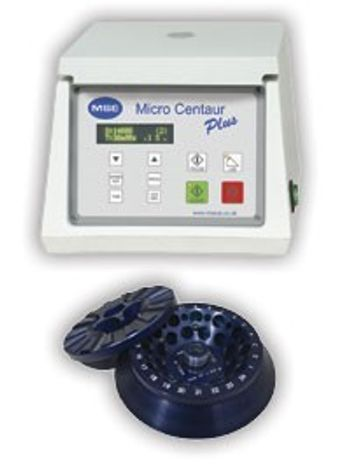
MSE Microcentaur
 MSE · Model Microcentaur
Convenient Top–Mounted Rotor - So much easier to load, empty or clean than rotors in wells. The rotor removes quickly for autoclaving. In case of an accident, spilled liquids or broken tubes remain in the rotor, not in the centrifuge. Timer or 'Pulse' Operation - For short spins or manual operation, simply press the ‘Pulse’ button. For automatically controlled spins of longer duration, the timer can be set for intervals of up to 99 minutes. Incredibly Light and Small - Weighs only 5 kg. So light and small (270 x 220 x 180mm when closed), it can be easily carried into a cold room, or another laboratory. 24 Tube Capacity - Choose which rotor best suits your needs- 24 x 2.2ml, 18 x 0.5ml rotor, PCR strip or haematocrit rotor. Alternatively, combine the 24 x 2.2ml rotor with a tube support for added flexibility. Smooth, Quiet Operation - The aerodynamically designed rotor spins smoothly and quietly, virtually without vibration, even at maximum speed. Safety Lid Lock - An electronic interlock prevents operation of the lid release button while the rotor is in motion. An indicator light signals when the rotor has come to rest and the lid may be opened safely. For emergency situations such as power failures, an override key is provided.
Key tips
- ·Run QC controls before trusting any repair - an analyzer that passes self-test can still report clinically wrong results.
- ·Rule out a reagent lot change before opening the instrument - it can look exactly like a hardware fault.
- ·Centrifuge rotors have a hard retirement age/cycle limit regardless of visible condition - don't eyeball it.
Typical Failure Modes
Compiled for this model from its own documentation and established engineering knowledge for this equipment class - not from a verified service record. Confirm against the manufacturer's service manual.
Will not start / error at start
HighSymptoms: Error code, run will not begin, or aborts shortly after start.
Root cause: Set speed exceeds the rotor maximum, an imbalanced load, the lid / door not locked, an unapproved rotor, or a drive / control fault.
Will not reach speed / excessive noise or vibration
MediumSymptoms: Slow spin-up, rumble, or vibration during a run.
Root cause: Load imbalance, worn drive / motor bearings, a worn drive coupling, or (older units) worn motor brushes.
Timer / speed inconsistency
MediumSymptoms: Run ends early / late, or RPM does not match the setting.
Root cause: Tacho / speed-sensor drift or a control-board fault.
Lid / door will not open or lock
MediumSymptoms: Lid-lock error, will not open after a run, or will not lock to start.
Root cause: Lid-lock solenoid / switch fault, or a run still winding down.
Rotor / bucket wear or corrosion
MediumSymptoms: Visible corrosion, cracks, or a bucket that will not swing; imbalance trips.
Root cause: Rotor / bucket ageing - a safety-critical wear item with a use-life limit.
Serviceable Parts & Consumables
Serviceable items for this model, compiled from its documentation and engineering knowledge for this equipment class. Service class and relative cost are estimates, not manufacturer figures; no part numbers are given. Confirm intervals and pricing against the manufacturer.
Drive / motor bearings & coupling
Class Major service partRel. cost $$$R&R Difficult
Lid-lock solenoid / switch
Class Major service partRel. cost $$R&R Moderate
Speed sensor / control board
Class Major service partRel. cost $$R&R Moderate
Motor brushes (older units)
Class Periodic replacementRel. cost $R&R Moderate
Rotor / bucket set & O-rings
Log rotor runs; retire per the manufacturer's rotor-life programme.
Class Major service partRel. cost $$$R&R Easy
| Part | Service class | Relative cost | R&R difficulty |
|---|---|---|---|
| Drive / motor bearings & coupling | Major service part | $$$ | Difficult |
| Lid-lock solenoid / switch | Major service part | $$ | Moderate |
| Speed sensor / control board | Major service part | $$ | Moderate |
| Motor brushes (older units) | Periodic replacement | $ | Moderate |
| Rotor / bucket set & O-rings Log rotor runs; retire per the manufacturer's rotor-life programme. | Major service part | $$$ | Easy |
Relative cost: $ lowest · $$$$ highest service-part cost for this equipment class. Not a price.
PM Checklist
Preventive-maintenance tasks typical of this equipment class. Perform to the manufacturer's procedure and your facility's policy - this is general reference, not a schedule for this specific unit.
- ·Daily QC controls run and reviewed
- ·Calibration verification per assay
- ·Routine cleaning and decontamination
- ·Scheduled reagent-path and pump-tubing maintenance
Troubleshooting Approach
A starting sequence for this model, compiled from its documentation and engineering knowledge for this equipment class. Follow the manufacturer's service documentation for the actual procedure.
Symptom: Will not start or errors at start
- Confirm the set speed does not exceed the fitted rotor's maximum and the rotor is approved and seated.
- Rebalance the load - opposing positions evenly loaded and paired.
- Confirm the lid / door latches and the lock engages.
- Look the fault code up in the manual and follow the remedy.
- Functional-check speed and timer after any repair.
Symptom: Noisy / vibrates / will not reach speed
- Rebalance and re-run empty to confirm.
- Spin the rotor by hand and feel for bearing roughness.
- Inspect the drive coupling and (older units) the motor brushes.
- Replace the worn component.
- Verify speed with a tachometer and confirm smooth running.
Technical Specs
- Height
- 180 mm
- Length
- 270 mm
- Orientation
- Benchtop
- Weight
- 5 kg
- Centrifuge Type
- Microcentrifuge
- Maximum Speed
- 14000 rpm
- Width
- 220 mm
Typical Location
Where this class of equipment is typically deployed - general reference, not this unit's own placement record.
- Central / core laboratory
- Point-of-care testing stations
- Blood bank
- Microbiology lab
Documents & Manuals
No documents available for this device yet.
Related calculators
From BioLab, for work done with this kind of equipment.
Troubleshoot this device with Bio
Describe a symptom or error code. Bio answers from this device's own documented error codes, failure modes, parts, and guides.
Ask Bio