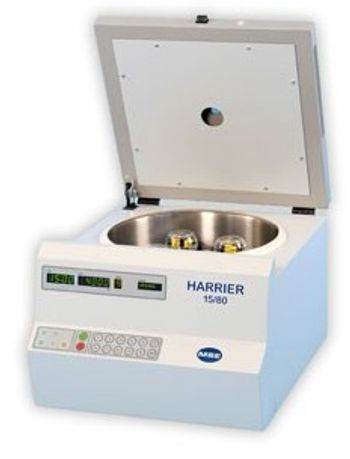
MSE Harrier 15/80
 MSE · Model Harrier 15/80
Intelligent Microprocessor Control. Inverter Controlled Brushless Motor. Automatic Rotor Identification System. Set And Run In RCF Or RPM. Key Lock Facility. Instant RCF Reading. Last Run Memory. Green Led Display. Overspeed Protection System. Full Lid Interlock. Imbalance Detection System. Self Diagnostics. Status Indicator. Removable Stainless Steel Inner Bowl (Harrier 15/80). Simple And Easy To Use. Easy To Service. Superior Lid Lock Mechanism. 9 Acceleration Rates. 9 Brake Rates. Wide Range Of Accessories. All Accessories Fully Autoclavable. Sealed Buckets With Porton Down Approval. Sealed 24 Place Microtube Rotor Available. Designed To Comply With Bs En 61010-2-020: 1995. Language Options Available.
Key tips
- ·Run QC controls before trusting any repair - an analyzer that passes self-test can still report clinically wrong results.
- ·Rule out a reagent lot change before opening the instrument - it can look exactly like a hardware fault.
- ·Centrifuge rotors have a hard retirement age/cycle limit regardless of visible condition - don't eyeball it.
Typical Failure Modes
Compiled for this model from its own documentation and established engineering knowledge for this equipment class - not from a verified service record. Confirm against the manufacturer's service manual.
Will not start / error at start
HighSymptoms: Error code, run will not begin, or aborts shortly after start.
Root cause: Set speed exceeds the rotor maximum, an imbalanced load, the lid / door not locked, an unapproved rotor, or a drive / control fault.
Will not reach speed / excessive noise or vibration
MediumSymptoms: Slow spin-up, rumble, or vibration during a run.
Root cause: Load imbalance, worn drive / motor bearings, a worn drive coupling, or (older units) worn motor brushes.
Timer / speed inconsistency
MediumSymptoms: Run ends early / late, or RPM does not match the setting.
Root cause: Tacho / speed-sensor drift or a control-board fault.
Lid / door will not open or lock
MediumSymptoms: Lid-lock error, will not open after a run, or will not lock to start.
Root cause: Lid-lock solenoid / switch fault, or a run still winding down.
Rotor / bucket wear or corrosion
MediumSymptoms: Visible corrosion, cracks, or a bucket that will not swing; imbalance trips.
Root cause: Rotor / bucket ageing - a safety-critical wear item with a use-life limit.
Serviceable Parts & Consumables
Serviceable items for this model, compiled from its documentation and engineering knowledge for this equipment class. Service class and relative cost are estimates, not manufacturer figures; no part numbers are given. Confirm intervals and pricing against the manufacturer.
Drive / motor bearings & coupling
Class Major service partRel. cost $$$R&R Difficult
Lid-lock solenoid / switch
Class Major service partRel. cost $$R&R Moderate
Speed sensor / control board
Class Major service partRel. cost $$R&R Moderate
Motor brushes (older units)
Class Periodic replacementRel. cost $R&R Moderate
Rotor / bucket set & O-rings
Log rotor runs; retire per the manufacturer's rotor-life programme.
Class Major service partRel. cost $$$R&R Easy
| Part | Service class | Relative cost | R&R difficulty |
|---|---|---|---|
| Drive / motor bearings & coupling | Major service part | $$$ | Difficult |
| Lid-lock solenoid / switch | Major service part | $$ | Moderate |
| Speed sensor / control board | Major service part | $$ | Moderate |
| Motor brushes (older units) | Periodic replacement | $ | Moderate |
| Rotor / bucket set & O-rings Log rotor runs; retire per the manufacturer's rotor-life programme. | Major service part | $$$ | Easy |
Relative cost: $ lowest · $$$$ highest service-part cost for this equipment class. Not a price.
PM Checklist
Preventive-maintenance tasks typical of this equipment class. Perform to the manufacturer's procedure and your facility's policy - this is general reference, not a schedule for this specific unit.
- ·Daily QC controls run and reviewed
- ·Calibration verification per assay
- ·Routine cleaning and decontamination
- ·Scheduled reagent-path and pump-tubing maintenance
Error Codes
Extracted directly from this unit's own service manual.
INVALIDThe parameter entered is not valid i.e. minutes >59
1. Press CE to clear error 2. Re-enter parameter
BAD IDRotor has not been identified or rotor not fitted
1. Press CE and open lid 2. Check rotor has been fitted 3. Remove rotor, clean drive head and top surface of motor 4. Clean and inspect rotor bore and underside of rotor
BADROTORRotor identified should not be fitted to machine
1. Check that the rotor is correct for the machine 2. Remove rotor, clean drive head and top surface of motor 3. Clean rotor bore and underside of rotor 4. Check rotor magnets are not missing or damaged
SET>MAXThe speed set is greater than is allowed for rotor
1. Press CE to clear error 2. Reset speed once run has ended
IMBALNCERotor assembly is not balanced within allowable limits
1. Press CE and open lid 2. Ensure rotor buckets pivot freely 3. See 5.4 Loading the rotor and 5.5 Balancing the rotor 4. Remove rotor and clean drive head and rotor bore
UNLOCKEDMalfunction of lid lock mechanism or interlock switch
1. Open lid (if lid is locked follow procedure on page 23) 2. Remove rotor 3. Disconnect from power supply DO NOT USE THE MACHINE UNTIL IT HAS BEEN CHECKED BY A SERVICE ENGINEER
SPEED +-.Set value has been exceeded
1. Press CE and open lid 2. Remove rotor 3. Disconnect the power supply DO NOT USE THE MACHINE UNTIL IT HAS BEEN CHECKED BY A SERVICE ENGINEER
SPEED -Set value has not been achieved
1. Press CE and open lid 2. Remove rotor 3. Disconnect the power supply DO NOT USE THE MACHINE UNTIL IT HAS BEEN CHECKED BY A SERVICE ENGINEER
HOT MOTORMotor has overheated
1. Press CE and open lid 2. Ensure that the inlet and outlet vents are not blocked
NO TACHOFault in tacho signal
1. Wait for 5 minutes or until the rotor has stopped turning 2. Follow the procedure on page 23 for opening the lid 3. Remove the rotor 4. Disconnect the power supply DO NOT USE THE MACHINE UNTIL IT HAS BEEN CHECKED BY A SERVICE ENGINEER
BAD STOPRotor is stationary when it should be running
Press CE
POW FAILThere has been an interruption of the power supply to the machine
1. Press CE and open lid 2. Check power supply
SER TOUTInverter is not responding to the software
1. Press CE and open lid 2. Remove rotor 3. Disconnect from power supply DO NOT USE THE MACHINE UNTIL IT HAS BEEN CHECKED BY A SERVICE ENGINEER
BAD CHKSLink to inverter is not functioning
1. Press CE and open lid 2. Remove rotor 3. Disconnect from power supply DO NOT USE THE MACHINE UNTIL IT HAS BEEN CHECKED BY A SERVICE ENGINEER
BAD MEMSoftware memory problem
1. Press CE and open lid 2. Remove rotor 3. Disconnect from power supply DO NOT USE THE MACHINE UNTIL IT HAS BEEN CHECKED BY A SERVICE ENGINEER
FRAMESoftware data not correctly synchronised
1. Press CE and open lid 2. Remove rotor 3. Disconnect from power supply DO NOT USE THE MACHINE UNTIL IT HAS BEEN CHECKED BY A SERVICE ENGINEER
LID OPENLid is open during Pre-cool
1. Close lid 2. Press CE
OVER 45°Bowl temperature is over 45°C
1. Press CE and open lid 2. Remove rotor 3. Disconnect the power supply DO NOT USE THE MACHINE UNTIL IT HAS BEEN CHECKED BY A SERVICE ENGINEER
BAD THERMMalfunction of temperature sensor
1. Press CE and open lid 2. Remove rotor 3. Disconnect the power supply DO NOT USE THE MACHINE UNTIL IT HAS BEEN CHECKED BY A SERVICE ENGINEER
HOT COMPCompressor has over-heated
1. Press CE and open lid 2. Ensure that the air filter and inlet vents are not blocked
TEMP LOWSet value has been exceeded
1. Press CE and open lid 2. Remove rotor 3. Disconnect the power supply DO NOT USE THE MACHINE UNTIL IT HAS BEEN CHECKED BY A SERVICE ENGINEER
TEMP HIGHSet value has not been achieved
1. Press CE and open lid 2. Remove rotor 3. Disconnect the power supply DO NOT USE THE MACHINE UNTIL IT HAS BEEN CHECKED BY A SERVICE ENGINEER
LID BARLid has been depressed
1. Press CE and allow machine to stop. 2. Switch off, to reset machine.0
Troubleshooting Approach
A starting sequence for this model, compiled from its documentation and engineering knowledge for this equipment class. Follow the manufacturer's service documentation for the actual procedure.
Symptom: Will not start / error at start
- Confirm mains power, the mains switch, and check the instrument fuse / circuit breaker - replace a blown fuse (a second blown fuse means an internal fault).
- Confirm the lid is fully closed and the lid interlock is engaging.
- Confirm a speed and time (and an approved rotor) are set.
- Note any displayed error code and look it up in the manual's error table.
- Re-balance the load if an imbalance is indicated.
Symptom: Lid will not open
- Confirm the rotor has fully stopped and mains power is present.
- Press down on the front of the lid while pressing the release button.
- If a power failure, use the mechanical emergency lid release per the manual.
- Inspect the lid-lock solenoid / latch and its micro-switch.
- Replace a jammed or faulty lid-lock assembly.
Symptom: Excess vibration / will not reach speed / noise
- Stop and re-load the rotor symmetrically - opposing positions equally loaded, all carriers fitted.
- Inspect the rotor pockets and chamber for debris or a broken tube.
- Confirm the rotor is fully seated and not corroded or cracked (retire per its use-life log).
- Turn the rotor by hand and feel the drive bearing; on belt-drive units check belt tension and, on older units, the motor brushes.
- Verify speed with a tachometer after any drive work.
Technical Specs
- Height
- 355 mm
- Length
- 58 mm
- Orientation
- Benchtop
- Weight
- 41 kg
- Maximum Speed
- 15000 rpm
- Width
- 470 mm
Typical Location
Where this class of equipment is typically deployed - general reference, not this unit's own placement record.
- Central / core laboratory
- Point-of-care testing stations
- Blood bank
- Microbiology lab
Documents & Manuals
Related calculators
From BioLab, for work done with this kind of equipment.
Troubleshoot this device with Bio
Describe a symptom or error code. Bio answers from this device's own documented error codes, failure modes, parts, and guides.
Ask Bio