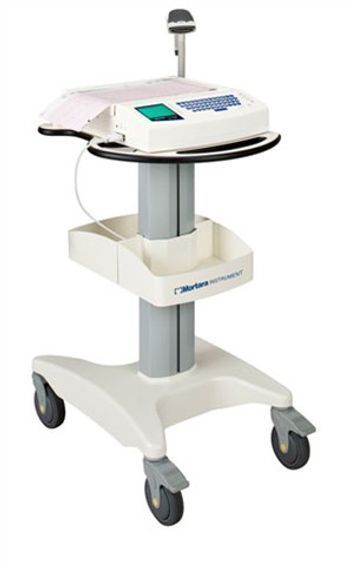
Mortara ELI 250
 Mortara · Model ELI 250
Full-featured electrocardiograph with a range of connectivity options [b]Backlit LCD Display – [/b] High-resolution display provides real-time preview of 12-lead ECG and post-acquisition review of acquired ECG. [b]Mortara VERITAS™ Resting ECG Interpretation Algorithm – [/b] Internationally recognized Mortara resting ECG interpretation algorithm using both age and gender specific criteria provides silent second opinion for 12-lead ECG interpretation. [b]Full Keyboard – [/b] Alphanumeric elastomer keyboard also includes dedicated “one-touch” buttons for ECG acquisition, rhythm printing, and ECG transmission. [b]Full-Size, Z-Fold Paper – [/b] Full-size paper (8.5" x 11" or A4 supported) output includes multiple standard or Cabrera print options including 3+1, 3+3, 6-channel, and 12-channel outputs. [b]Internal Storage – [/b] Internal storage for up to 60 digital ECG records. Optional expanded storage for up to 150 digital ECG records. [b]Connectivity Options –[/b] Bidirectional communication via serial port, internal modem, LAN, or wireless LAN with security for WEP, WPA-PSK, WPA2, and PEAP. [b]Information Exchange Interfaces –[/b] Patient demographics, ECG orders, and discrete and displayable results are exchanged with Mortara's E-Scribe™ and Athena products as well as third party EMR, HIS, and PACS systems via XML, PDF, UNIPRO, and DICOM®. [b]Barcode Reader –[/b] Optional barcode scanning for fast and accurate data entry.
Key tips
- ·A no-signal/flatline alarm gets checked on the patient first, not the monitor - rule out a real clinical event before troubleshooting.
- ·Recalibrate NIBP against a reference manometer, not just a self-test pass.
- ·Reused patient cables (SpO2, ECG leads) are a common source of intermittent-fault complaints - swap the cable before the module.
Typical Failure Modes
Compiled for this model from its own documentation and established engineering knowledge for this equipment class - not from a verified service record. Confirm against the manufacturer's service manual.
Noisy ECG / lead-off
HighSymptoms: Baseline wander, muscle or AC noise, "lead fail", poor 12-lead quality.
Root cause: Poor skin prep, dried or lifting electrodes, or a worn patient cable / lead set.
Will not acquire or analyse
MediumSymptoms: Acquisition hangs, no interpretation, or a self-test failure.
Root cause: Acquisition-module fault or a software issue.
Printer / recorder fault
MediumSymptoms: No or faint report, paper jam, misregistered grid.
Root cause: Thermal print head, paper handling, or (older units) the stylus.
Battery / power fault
MediumSymptoms: Short battery run time, will not hold charge, will not power on.
Root cause: Aged battery pack.
Connectivity fault
LowSymptoms: ECGs will not transmit to the ECG-management system / EMR.
Root cause: Network / Wi-Fi / modem configuration or the communication module.
Serviceable Parts & Consumables
Serviceable items for this model, compiled from its documentation and engineering knowledge for this equipment class. Service class and relative cost are estimates, not manufacturer figures; no part numbers are given. Confirm intervals and pricing against the manufacturer.
Patient cable / 10-lead set
Class Frequent wear itemRel. cost $$R&R Easy
Acquisition module
Class Major service partRel. cost $$$R&R Moderate
Thermal print head / paper
Class Periodic replacementRel. cost $R&R Fairly easy
Battery pack
Class Periodic replacementRel. cost $$R&R Fairly easy
Communication / modem module
Class Major service partRel. cost $$R&R Moderate
| Part | Service class | Relative cost | R&R difficulty |
|---|---|---|---|
| Patient cable / 10-lead set | Frequent wear item | $$ | Easy |
| Acquisition module | Major service part | $$$ | Moderate |
| Thermal print head / paper | Periodic replacement | $ | Fairly easy |
| Battery pack | Periodic replacement | $$ | Fairly easy |
| Communication / modem module | Major service part | $$ | Moderate |
Relative cost: $ lowest · $$$$ highest service-part cost for this equipment class. Not a price.
PM Checklist
Preventive-maintenance tasks typical of this equipment class. Perform to the manufacturer's procedure and your facility's policy - this is general reference, not a schedule for this specific unit.
- ·Routine cable and lead-wire inspection for fraying/wear
- ·Battery conditioning cycle
- ·NIBP calibration check against a reference manometer
- ·ECG / SpO2 accuracy verification against a patient simulator
- ·Annual electrical safety test
Troubleshooting Approach
A starting sequence for this model, compiled from its documentation and engineering knowledge for this equipment class. Follow the manufacturer's service documentation for the actual procedure.
Symptom: Noisy ECG / baseline wander / lead-fail
- Re-prep the skin (abrade, degrease) and fit fresh electrodes.
- Secure the lead wires and route them away from mains cables and other equipment.
- Swap in a known-good patient cable / 10-lead set.
- Check the acquisition-module connection at the cart.
- Confirm a clean 12-lead on an ECG simulator; replace the cable or refer the acquisition module.
Symptom: Will not acquire, analyse or print
- Confirm a lead set is connected and all leads are on.
- Check the thermal paper is loaded correctly and clean the print head.
- Print the internal test pattern / grid.
- Reboot the cart; note any self-test error.
- Refer the acquisition module or the writer / print head as isolated.
Symptom: ECGs will not transmit to the management system / EMR
- Confirm the Wi-Fi / LAN / modem settings and the destination address.
- Send a test ECG and read the error.
- Reseat the communication module / SIM.
- Confirm the ECG-management system is receiving from other carts.
- Escalate a server-side or account issue to IT / the vendor.
Symptom: Short battery run time / will not power on
- Charge fully and run a capacity test if supported.
- Check the charger and DC input.
- Replace the battery pack when below the service limit.
- Confirm run time and a full print cycle on battery after replacement.
- Refer the power supply if it will not power on with a good battery.
Technical Specs
- EKG/ECG Type
- Rest
Typical Location
Where this class of equipment is typically deployed - general reference, not this unit's own placement record.
- ICU / CCU
- Emergency Department
- OR / PACU
- General med-surg floors
- Step-down units
- Telemetry units
Documents & Manuals
Safety & Recalls
Synced live from the FDA openFDA API.
- RECALL
Mortara Instrument, Inc. has recently become aware of a potential safety hazard involving our ELI 380 electrocardiograph. When used in a particular workflow, acquired ECG waveforms for one patient may become associated with the patient demographics for a different patient when the record is transmitted to a records management system.
Related calculators
From BioLab, for work done with this kind of equipment.
Troubleshoot this device with Bio
Describe a symptom or error code. Bio answers from this device's own documented error codes, failure modes, parts, and guides.
Ask Bio