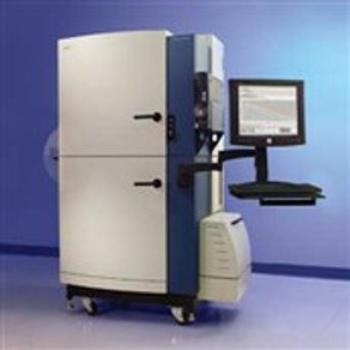
Molecular Devices FLIPR Tetra
 Molecular Devices · Model FLIPR Tetra
Flexible Platform for Cell-Based HTS The ability to configure instruments through varying stages of the drug discovery screening process is a challenge that requires instrument hardware flexibility and an easy-to-use software interface. Molecular Devices addresses these challenges with the FLIPRTETRA system for kinetic cell-based screening. Since its introduction, FLIPRTETRA has developed a reputation for reliability and ease-of-use. The system can be configured based on library size, detection mode, screening format, assay, and target, making the transition from assay development to lead optimization a seamless process. Increase Assay Flexibility Two camera options - standard for fluorescence only, or aequorin for both fluorescence and luminescence - allow the user to tailor the system to their needs. The aequorin camera can be adjusted to the appropriate signal window to detect signals from bright fluorescence or dim luminescence assays. User-exchangeable, proven LED banks and emission filters provide the flexibility to perform experiments using dyes that are most appropriate for selected assays, whether they are single wavelength or ratiometric. Rapidly Exchange Pipettors User-exchangeable pipettor heads - available in 96-, 384-, 1536-well formats, as well as pin tools in 384 and 1536 format - allow for the adjustment of screening rates based on throughput, material consumption, and assay requirements. The pipettor heads have a proven track record, with the 1536 pipettor utilizing the elastomeric positive displacement technology. Regardless of the format used, each pipettor can be exchanged by a system operator in minutes and can pipette reagents, compounds, or cells. Deliver Cells in Suspension Delivering cells in suspension is an important option that simplifies luminescence calcium mobilization assay protocols while increasing throughput. Spinner flasks maintain a uniform cell suspension to promote assay robustness. A variety of flask sizes are available to scale the volume for assay development or high throughput screening. FLIPR pipettor heads deliver cells in up to 1536 format from the user-installable, universal cell suspension reservoir, eliminating the need for cell plating. Cell handling can be optimized for different cell lines by adjusting the stir and pump speeds and pipetting parameters through ScreenWorks software. The cell suspension reservoir is autoclavable and user-defined protocols can include up to four wash solvents to automate system cleaning. Unique and Uniform Cell Dispensing The cell suspension module (left) and cell suspension reservoir (right) allow users to uniformly distribute cells into the read plate via FLIPRTETRA pipettor heads (96, 384, 1536). Continuous stirring keeps the cells in suspension, while flexible protocols and manual control of pump speed give room for assay optimization. Customize Protocols and Data Processing ScreenWorks is both flexible and user-friendly. During protocol set-up, only relevant options are displayed, based on the installed fluidics and optics hardware, making it easy to choose parameters that are right for each assay. Live and information-rich data in 96-, 384- or 1536-well plate format are displayed while testing. Specific wells can be grouped for analysis or data export purposes. Graphs and tables can be easily copied and pasted into documents, presentations or worksheets, and different reductions can be selected for group statistics, making results readily accessible. accelerate throughput The FLIPRTETRA system is just one example of the innovative, high-performance products from Molecular Devices that significantly enhance research productivity and effectiveness. Designed expressly to meet the needs of research professionals in drug discovery and other advanced research, FLIPRTETRA delivers the industry-leading capabilities required for accelerating our customers’ time-to-market for new products.
Key tips
- ·Run QC controls before trusting any repair - an analyzer that passes self-test can still report clinically wrong results.
- ·Rule out a reagent lot change before opening the instrument - it can look exactly like a hardware fault.
- ·Centrifuge rotors have a hard retirement age/cycle limit regardless of visible condition - don't eyeball it.
Typical Failure Modes
Compiled for this model from its own documentation and established engineering knowledge for this equipment class - not from a verified service record. Confirm against the manufacturer's service manual.
Will not power on or unexpected shutdown
HighSymptoms: The laboratory & diagnostics is dead, reboots, or shuts down mid-use.
Root cause: Mains lead / fuse, an aged battery, or a power-supply board fault.
Battery will not hold charge
MediumSymptoms: Short run time on battery; low-battery alarm soon after a full charge.
Root cause: Aged rechargeable battery pack or a charger fault.
Display / control-panel fault
MediumSymptoms: Blank, dim or distorted display; unresponsive keys or touchscreen.
Root cause: Display, backlight, or control-board fault.
Fails self-test or calibration
MediumSymptoms: Power-on self-test or the scheduled performance check fails or is out of tolerance.
Root cause: Sensor drift or an internal board fault; recalibration or repair needed.
Serviceable Parts & Consumables
Serviceable items for this model, compiled from its documentation and engineering knowledge for this equipment class. Service class and relative cost are estimates, not manufacturer figures; no part numbers are given. Confirm intervals and pricing against the manufacturer.
Rechargeable battery pack
Class Periodic replacementRel. cost $$R&R Fairly easy
Power supply / mains board
Class Major service partRel. cost $$$R&R Difficult
Display / control-panel assembly
Class Major service partRel. cost $$$R&R Moderate
Cooling fan
Class Major service partRel. cost $R&R Moderate
| Part | Service class | Relative cost | R&R difficulty |
|---|---|---|---|
| Rechargeable battery pack | Periodic replacement | $$ | Fairly easy |
| Power supply / mains board | Major service part | $$$ | Difficult |
| Display / control-panel assembly | Major service part | $$$ | Moderate |
| Cooling fan | Major service part | $ | Moderate |
Relative cost: $ lowest · $$$$ highest service-part cost for this equipment class. Not a price.
PM Checklist
Preventive-maintenance tasks typical of this equipment class. Perform to the manufacturer's procedure and your facility's policy - this is general reference, not a schedule for this specific unit.
- ·Daily QC controls run and reviewed
- ·Calibration verification per assay
- ·Routine cleaning and decontamination
- ·Scheduled reagent-path and pump-tubing maintenance
Troubleshooting Approach
A starting sequence for this model, compiled from its documentation and engineering knowledge for this equipment class. Follow the manufacturer's service documentation for the actual procedure.
Symptom: Will not power on
- Confirm the outlet, mains lead and fuse.
- Try on battery, then on mains only, to isolate the supply.
- Look for a power indicator or POST code.
- Replace the fuse / battery / power supply as isolated.
- Run the self-test after any repair.
Symptom: Fails self-test or calibration
- Note the exact failure message / code.
- Power-cycle and repeat the self-test.
- Verify against a reference / simulator where one applies.
- Recalibrate per the service manual.
- Refer the affected board for service if it will not hold calibration.
Typical Location
Where this class of equipment is typically deployed - general reference, not this unit's own placement record.
- Central / core laboratory
- Point-of-care testing stations
- Blood bank
- Microbiology lab
Documents & Manuals
Troubleshoot this device with Bio
Describe a symptom or error code. Bio answers from this device's own documented error codes, failure modes, parts, and guides.
Ask Bio