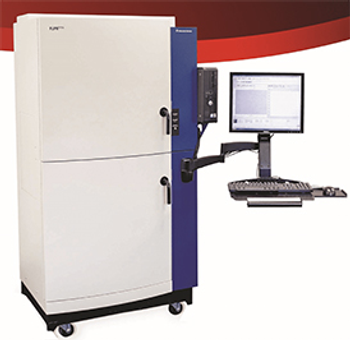
Molecular Devices FLIPR Penta
 Molecular Devices · Model FLIPR Penta
Complex event analysis ScreenWorks Peak Pro 2 software analysis, powered by pCLAMP 11, gives you the unique ability to characterize calcium oscillation peak data in one software program. Compounds can be flagged that cause waveform irregularities that may indicate hazards for arrhythmia, seizures, or other toxicity effects quickly and without having to export data. Distinctly different calcium oscillations in neurons can also be characterized. Configurable optics The FLIPR Penta system can be matched to user needs starting with a standard EMCCD camera, a more cost-effective solution that is perfect for GPCR and Membrane Potential assays, or with the new HS EMCCD that can capture up to 100 images per second and offers exceptional luminescence performance. The camera, LEDs, and filters can be configured at the time of purchase or later when assay needs change. User-changeable pipette modules Pipette heads can be changed in minutes without the use of tools from 96, 384, or 1536 channels to accommodate assay throughput needs. Ease of use ScreenWorks software seamlessly incorporates drag-and-drop protocols, intuitive buttons, and color-coded plate layout to simplify workflows. View signal traces, EC50 curves, and Z factors on-the-fly without having to export data to another software program. Validated solution Purchasing a FLIPR system from Molecular Devices assures users that they are investing in a technology that can grow with them. Hardware, software, and assay kits have been validated on the system by an industry-renowned leader with over 40 years of experience. Custom automation options* The drug discovery process has shared methods, yet each project is unique. The Advanced Workflow Engineering Solutions Team offers a variety of customized services from automated compound plate delivery to fully integrated workstations with automated incubation.
Key tips
- ·Run QC controls before trusting any repair - an analyzer that passes self-test can still report clinically wrong results.
- ·Rule out a reagent lot change before opening the instrument - it can look exactly like a hardware fault.
- ·Centrifuge rotors have a hard retirement age/cycle limit regardless of visible condition - don't eyeball it.
Typical Failure Modes
Compiled for this model from its own documentation and established engineering knowledge for this equipment class - not from a verified service record. Confirm against the manufacturer's service manual.
Will not power on or unexpected shutdown
HighSymptoms: The laboratory & diagnostics is dead, reboots, or shuts down mid-use.
Root cause: Mains lead / fuse, an aged battery, or a power-supply board fault.
Battery will not hold charge
MediumSymptoms: Short run time on battery; low-battery alarm soon after a full charge.
Root cause: Aged rechargeable battery pack or a charger fault.
Display / control-panel fault
MediumSymptoms: Blank, dim or distorted display; unresponsive keys or touchscreen.
Root cause: Display, backlight, or control-board fault.
Fails self-test or calibration
MediumSymptoms: Power-on self-test or the scheduled performance check fails or is out of tolerance.
Root cause: Sensor drift or an internal board fault; recalibration or repair needed.
Serviceable Parts & Consumables
Serviceable items for this model, compiled from its documentation and engineering knowledge for this equipment class. Service class and relative cost are estimates, not manufacturer figures; no part numbers are given. Confirm intervals and pricing against the manufacturer.
Rechargeable battery pack
Class Periodic replacementRel. cost $$R&R Fairly easy
Power supply / mains board
Class Major service partRel. cost $$$R&R Difficult
Display / control-panel assembly
Class Major service partRel. cost $$$R&R Moderate
Cooling fan
Class Major service partRel. cost $R&R Moderate
| Part | Service class | Relative cost | R&R difficulty |
|---|---|---|---|
| Rechargeable battery pack | Periodic replacement | $$ | Fairly easy |
| Power supply / mains board | Major service part | $$$ | Difficult |
| Display / control-panel assembly | Major service part | $$$ | Moderate |
| Cooling fan | Major service part | $ | Moderate |
Relative cost: $ lowest · $$$$ highest service-part cost for this equipment class. Not a price.
PM Checklist
Preventive-maintenance tasks typical of this equipment class. Perform to the manufacturer's procedure and your facility's policy - this is general reference, not a schedule for this specific unit.
- ·Daily QC controls run and reviewed
- ·Calibration verification per assay
- ·Routine cleaning and decontamination
- ·Scheduled reagent-path and pump-tubing maintenance
Troubleshooting Approach
A starting sequence for this model, compiled from its documentation and engineering knowledge for this equipment class. Follow the manufacturer's service documentation for the actual procedure.
Symptom: Will not power on
- Confirm the outlet, mains lead and fuse.
- Try on battery, then on mains only, to isolate the supply.
- Look for a power indicator or POST code.
- Replace the fuse / battery / power supply as isolated.
- Run the self-test after any repair.
Symptom: Fails self-test or calibration
- Note the exact failure message / code.
- Power-cycle and repeat the self-test.
- Verify against a reference / simulator where one applies.
- Recalibrate per the service manual.
- Refer the affected board for service if it will not hold calibration.
Typical Location
Where this class of equipment is typically deployed - general reference, not this unit's own placement record.
- Central / core laboratory
- Point-of-care testing stations
- Blood bank
- Microbiology lab
Documents & Manuals
No documents available for this device yet.
Troubleshoot this device with Bio
Describe a symptom or error code. Bio answers from this device's own documented error codes, failure modes, parts, and guides.
Ask Bio