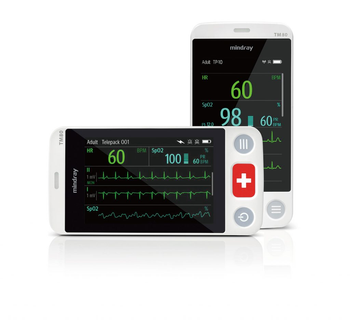
Mindray BeneVision TM80
Mindray · Model BeneVision TM80
3.5″ color touchscreen LCD Enables continuous monitoring with bidirectional local alarms TM80 via ADT integration provides positive patient identification with patient demographics at the TM80 Supports a complete patient record with comprehensive backfill capability to BeneVision DMS telemetry 8.1 oz (229 g) with rechargeable lithium-ion battery Waterproof rated IPX7 Rugged, validated to 1.5 m hard surface drop test Durable, chemical-resistant materials, compatible with a broad range of commonly used disinfectants Clear, easy to read HR, respiration, and SpO2 numerics ECG, respiration, and SpO2 waveforms at the patient Pairs with N-Series bedside monitors to positively impact patient care by facilitating patient ambulation Multi-vector arrhythmia analysis with atrial fibrillation detection, continuous ST analysis, and continuous QT/QTc monitoring at BeneVision DMS Offers choice Masimo SET® Pulse Oximetry with RD Sensors or Nellcor Pulse Oximetry with OxiMax Non-invasive blood pressure provided by patient-worn BP10 (optional); measurements sent to BeneVision DMS via wireless pairing with TM80 Operates in 802.11 a/n/ac at 5 GHz Flexible power choices include 3 AA or rechargeable lithium-ion battery packs Run time up to 36 hours.
Key tips
- ·A no-signal/flatline alarm gets checked on the patient first, not the monitor - rule out a real clinical event before troubleshooting.
- ·Recalibrate NIBP against a reference manometer, not just a self-test pass.
- ·Reused patient cables (SpO2, ECG leads) are a common source of intermittent-fault complaints - swap the cable before the module.
Typical Failure Modes
Compiled for this model from its own documentation and established engineering knowledge for this equipment class - not from a verified service record. Confirm against the manufacturer's service manual.
One or more telemetry transmitters drop / no waveform
HighSymptoms: A bed shows no ECG or dropped beats at the central station, noisy trace, frequent leads-off.
Root cause: Worn transmitter lead set, a weak transmitter battery, or antenna / receiver coverage.
Antenna / RF coverage fault
MediumSymptoms: Dropout in specific areas of the unit, multiple beds affected in one zone.
Root cause: Antenna cabling, a splitter / amplifier, or a receiver-module fault.
Central-station application / server fault
HighSymptoms: Central station hangs, will not admit, alarms not annunciating, display frozen.
Root cause: Central-station PC / server, the application, or the network link.
Printer / recorder fault
LowSymptoms: No strip on alarm or on demand.
Root cause: Central recorder / network printer fault.
Time / network sync fault
LowSymptoms: Timestamps wrong or drifting, full-disclosure gaps.
Root cause: Network time source or connectivity.
Serviceable Parts & Consumables
Serviceable items for this model, compiled from its documentation and engineering knowledge for this equipment class. Service class and relative cost are estimates, not manufacturer figures; no part numbers are given. Confirm intervals and pricing against the manufacturer.
Telemetry transmitter lead set
Class Frequent wear itemRel. cost $$R&R Easy
Transmitter battery (per pack)
Class ConsumableRel. cost $R&R Easy
Receiver module / antenna components
Class Major service partRel. cost $$$R&R Difficult
Central-station PC / server
Class Major service partRel. cost $$$$R&R Difficult
Network printer / recorder
Class Major service partRel. cost $$R&R Fairly easy
| Part | Service class | Relative cost | R&R difficulty |
|---|---|---|---|
| Telemetry transmitter lead set | Frequent wear item | $$ | Easy |
| Transmitter battery (per pack) | Consumable | $ | Easy |
| Receiver module / antenna components | Major service part | $$$ | Difficult |
| Central-station PC / server | Major service part | $$$$ | Difficult |
| Network printer / recorder | Major service part | $$ | Fairly easy |
Relative cost: $ lowest · $$$$ highest service-part cost for this equipment class. Not a price.
PM Checklist
Preventive-maintenance tasks typical of this equipment class. Perform to the manufacturer's procedure and your facility's policy - this is general reference, not a schedule for this specific unit.
- ·Routine cable and lead-wire inspection for fraying/wear
- ·Battery conditioning cycle
- ·NIBP calibration check against a reference manometer
- ·ECG / SpO2 accuracy verification against a patient simulator
- ·Annual electrical safety test
Error Codes
Extracted directly from this unit's own service manual.
ECG XX** Lead OffThe electrode has become detached from the patient or the lead wire has become disconnected from the adapter cable.
Check the connections of the electrodes and leadwires.
ECG Module ErrorAn error occurred to the ECG module. There is a problem with the communications between the module and the TM80.
Restart the TM80. If the problem persists, contact your service personnel.
ECG NoiseThe ECG signal is noisy.
Check for any possible sources of signal noise around the cable and electrode, and check the patient for great motion.
ECG Cable Type ErrorConnect wrong ECG leadwire.
Reconnect the 3 or 5 lead ECG leadwire.
HR OverrangeHR exceeds the measurement limit.
Contact Mindray or your service personnel.
Resp Electrode Poor ContactThe electrode has been used for a long time or the electrode contact is poor.
Check the electrode application. Reposition or replace the electrodes if necessary.
SpO2 Sensor OffThe SpO2 sensor has become detached from the patient or the module. There is a fault with the SpO2 sensor. An unspecified SpO2 sensor has been used.
Check the sensor application site and the sensor type, and make sure the sensor is not damaged. Reconnect the sensor or use a new sensor.
SpO2 Sensor FaultSpO2 No Sensor
SpO2 No SensorSpO2 Module Error
SpO2 Too Much LightThere is too much light on the SpO2 sensor.
Move the sensor to a place with lower level of ambient light or cover the sensor to minimize the ambient light.
SpO2 No PulseSpO2 sensor failed to obtain pulse signal.
Move the sensor to a site with better perfusion.
SpO2 UnpluggedSpO2 module connector is disconnected from the TM80.
Reconnect the SpO2 module to the TM80.
PR OverrangeThe measured PR value exceeds the measurement range.
Contact Mindray or your service personnel.
NIBP MPAN DisconnectedThe MAPN is disconnected.
Enable the MPAN switch.
NIBP ErrorAn error occurred to the NIBP module. There is a problem with communication between the TM80 and BP10.
Restart the BP10.
NIBP Cuff LooseThe NIBP cuff is not properly connected. There is a leak in the airway.
Check the patient's condition and verify patient category. Replace with an appropriate cuff and connect it correctly.
NIBP Airway ErrorAn airway error occurs.
Check the airway.
NIBP Weak SignalThe patient's pulse is weak or the cuff is loose.
Check the patient's condition and change the cuff application site. If the error persists, replace the cuff.
NIBP OverrangeThe measured NIBP value is not within the specified range.
Contact your service personnel.
NIBP Excessive MotionPatient's arm moves too much.
Check the patient's condition and reduce the patient motion.
NIBP Cuff OverpressureThe NIBP airway may be occluded.
Check the airway and measure again.
Cuff or Airway LeakThe NIBP airway may leak air.
Verify that the cuff is properly connected. Verify that the airway does not leak air.
NIBP TimeoutTime is out. The measurement time is over 120 seconds.
Check the patient's condition and NIBP connections. Replace the cuff.
NIBP Cuff and Patient MismatchThe cuff type applied mismatches the patient category.
Check the patient's category. Replace the cuff.
Intervals Not SetThe interval in Sequence mode is not set.
Set the intervals.
NIBP-S OverrangeThe measured NIBP value is not within the measurement range.
Contact your service personnel.
NIBP Battery ErrorThe lithium-ion battery communication has an error.
Replace with a known good battery.
NIBP Battery DepletedThe battery charge is almost depleted.
NIBP Voltage ErrorThe battery voltage is abnormal.
NIBP Battery Maintenance RequiredThe lithium-ion battery is aging.
Power Low BatteryThe battery charge is low.
Replace with a known good battery.
Critically Low BatteryThe battery charge is almost depleted.
Battery Maintenance RequiredThe lithium-ion battery is aging.
Battery ErrorThe lithium-ion battery communication is error.
Replace with a known good battery.
Battery Type ErrorThe battery contacts are in bad contact.
System Device ErrorThe self-test error occurs to the TM80 main board. The self-test error occurs to the parameter module, wireless module or Mindray PAN module. The self-test error occurs to the parameter module communication or initialization.
Restart the TM80. If the problem persists, contact your service personnel.
Restoring Last Defaults FailedRestoring the last default configuration is error.
Loading the default configuration is error.
No CMSThe battery of the TM80 is used up and the TM80 is powered off automatically. The patient has walked out of the Wi-Fi signal coverage area. The Wi-Fi antenna of the TM80 fails. The patient is not admitted by the CMS. Serious WLAN interference and AP failure make the TM80 unable to connect the network on the CMS.
Replace the battery with a fully charged lithium-ion battery or new AA battery. Make sure that the patient is within the signal coverage area. Access the system maintenance screen and make sure that the RSSI of network signal is displayed normally. Admit the patient on the CMS or discharge the patient at the TM80. Make sure that the network signal interface is normal. Make sure the IP address of the TM80 is unique.
Searching for signalThe Wi-Fi signal of the TM80 is poor. Wi-Fi signal interference occurs.
Check whether the patient is at the edge of signal coverage. It is recommended to check whether network interference signal exceeds the limit by using a signal survey tool. If APs in hospital support 5G band, configure the TM80 to work in the 5Gband.
Troubleshooting Approach
A starting sequence for this model, compiled from its documentation and engineering knowledge for this equipment class. Follow the manufacturer's service documentation for the actual procedure.
Symptom: A parameter drops out or reads wrong (ECG / IBP / SpO2 / temp / CO2 / CO)
- Reseat the patient cable at the module and at the monitor.
- Swap in a known-good cable / sensor for that parameter and re-test.
- Move the module to another host or slot to tell module from host.
- Inspect the module docking connector for bent or recessed pins.
- Verify against a patient simulator; replace the cable, or refer the parameter module / input board if the fault stays with it.
Symptom: NIBP will not measure or is inaccurate
- Leak-test the cuff and hose (occlude and watch for pressure decay).
- Run the monitor's NIBP calibration-verification against a calibrated manometer.
- Confirm correct cuff size and placement and check for a kinked hose.
- Verify against a NIBP simulator at several pressures.
- Refer the monitor for internal pump / valve service if it still fails.
Symptom: Blank / dim / frozen display or unresponsive touchscreen
- Power-cycle the monitor fully (mains removed, battery out where possible).
- Check the display backlight and the display / touchscreen cable.
- Note any boot or self-test error code.
- Re-calibrate the touchscreen if the touch offset is the issue.
- Replace the display / touchscreen assembly or refer the main board.
Symptom: Not shown at the central station / network dropout
- Confirm the wired drop or Wi-Fi settings and that other monitors on that segment are online.
- Check the monitor's network address / unit-bed assignment and re-admit.
- Reseat the network card / cable.
- Restart the monitor's network interface.
- Escalate a whole-unit outage to the central-station server / IT.
Typical Location
Where this class of equipment is typically deployed - general reference, not this unit's own placement record.
- ICU / CCU
- Emergency Department
- OR / PACU
- General med-surg floors
- Step-down units
- Telemetry units
Documents & Manuals
Safety & Recalls
Synced live from the FDA openFDA API.
- RECALL
Telepack may not power on when using the 3AA battery cradle.
Troubleshoot this device with Bio
Describe a symptom or error code. Bio answers from this device's own documented error codes, failure modes, parts, and guides.
Ask Bio