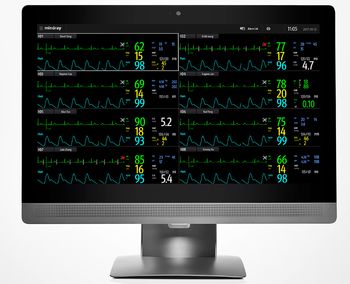
Mindray BeneVision DMS
Mindray · Model BeneVision DMS
Single server supports 32 beds/sectors; Enterprise server supports 128 beds/sectors Enterprise server provides system and network redundancy for maximum uptime and performance 23″ widescreen HD displays presents up to 36 patients across clinical units Gesture-driven, PCT touchscreen interface Multiple views including tabular trends and events, full disclosure, 12-lead ECG and bedside view Scalable WorkStations, from fully-interactive to view-only, with over 20 configurable functions Up to 32 scalable WorkStations per server configured as fully active to view-only, maximum 120 WorkStations on the network Remote and mobile access via Microsoft® Windows®, iOS or Android-based smartphones, tablets and PCs via the CMS Viewer or CMS Mobile application software Bi-directional communication with N-Series, Passport monitors and TM80 telemetry for enhanced patient care Provides up to 240 hours of full disclosure waveforms Historical database enables review of over 1000 discharged patients (typical) Documentation options include PDF export, network printer, and dual trace recorder Using Mindray’s Internet of Things (M-IoT) management console, perform event notification, asset management, and centralized configuration through the intuitive, remote console.
Key tips
- ·A no-signal/flatline alarm gets checked on the patient first, not the monitor - rule out a real clinical event before troubleshooting.
- ·Recalibrate NIBP against a reference manometer, not just a self-test pass.
- ·Reused patient cables (SpO2, ECG leads) are a common source of intermittent-fault complaints - swap the cable before the module.
Typical Failure Modes
Compiled for this model from its own documentation and established engineering knowledge for this equipment class - not from a verified service record. Confirm against the manufacturer's service manual.
Will not power on or unexpected shutdown
HighSymptoms: The patient monitoring is dead, reboots, or shuts down mid-use.
Root cause: Mains lead / fuse, an aged battery, or a power-supply board fault.
Battery will not hold charge
MediumSymptoms: Short run time on battery; low-battery alarm soon after a full charge.
Root cause: Aged rechargeable battery pack or a charger fault.
Display / control-panel fault
MediumSymptoms: Blank, dim or distorted display; unresponsive keys or touchscreen.
Root cause: Display, backlight, or control-board fault.
Fails self-test or calibration
MediumSymptoms: Power-on self-test or the scheduled performance check fails or is out of tolerance.
Root cause: Sensor drift or an internal board fault; recalibration or repair needed.
Serviceable Parts & Consumables
Serviceable items for this model, compiled from its documentation and engineering knowledge for this equipment class. Service class and relative cost are estimates, not manufacturer figures; no part numbers are given. Confirm intervals and pricing against the manufacturer.
Rechargeable battery pack
Class Periodic replacementRel. cost $$R&R Fairly easy
Power supply / mains board
Class Major service partRel. cost $$$R&R Difficult
Display / control-panel assembly
Class Major service partRel. cost $$$R&R Moderate
Cooling fan
Class Major service partRel. cost $R&R Moderate
| Part | Service class | Relative cost | R&R difficulty |
|---|---|---|---|
| Rechargeable battery pack | Periodic replacement | $$ | Fairly easy |
| Power supply / mains board | Major service part | $$$ | Difficult |
| Display / control-panel assembly | Major service part | $$$ | Moderate |
| Cooling fan | Major service part | $ | Moderate |
Relative cost: $ lowest · $$$$ highest service-part cost for this equipment class. Not a price.
PM Checklist
Preventive-maintenance tasks typical of this equipment class. Perform to the manufacturer's procedure and your facility's policy - this is general reference, not a schedule for this specific unit.
- ·Routine cable and lead-wire inspection for fraying/wear
- ·Battery conditioning cycle
- ·NIBP calibration check against a reference manometer
- ·ECG / SpO2 accuracy verification against a patient simulator
- ·Annual electrical safety test
Troubleshooting Approach
A starting sequence for this model, compiled from its documentation and engineering knowledge for this equipment class. Follow the manufacturer's service documentation for the actual procedure.
Symptom: Will not power on
- Confirm the outlet, mains lead and fuse.
- Try on battery, then on mains only, to isolate the supply.
- Look for a power indicator or POST code.
- Replace the fuse / battery / power supply as isolated.
- Run the self-test after any repair.
Symptom: Fails self-test or calibration
- Note the exact failure message / code.
- Power-cycle and repeat the self-test.
- Verify against a reference / simulator where one applies.
- Recalibrate per the service manual.
- Refer the affected board for service if it will not hold calibration.
Typical Location
Where this class of equipment is typically deployed - general reference, not this unit's own placement record.
- ICU / CCU
- Emergency Department
- OR / PACU
- General med-surg floors
- Step-down units
- Telemetry units
Documents & Manuals
Safety & Recalls
Synced live from the FDA openFDA API.
- RECALL
When the Worstation of the BeneVision DMS has a specific hardware configuration, the computer may experience audio playback failure or screen freezing.
- RECALL
BeneVision DMS may intermittently freeze and require a manual reboot after which normal operation resumes. If a freeze occur, patients monitored on a telemetry transmitter will no longer communicate data to the BeneVision DMS
- RECALL
The firm has identified performance anomalies with the device caused when more than 64 TD60 telemetry transmitters have been connected to a central station. The anomaly causes some ECG waveforms to appear as a flat line at the centralized viewing station and will manifest if more than 64 TD60 transmitters have been connected to a given central station server. Each central station supports only 32 transmitters at a time. For the issue to manifest, the BeneVision DMS needs to be configured to use flexible device assignment, have more than 64 TD60 transmitters, and the workflow must allow 64 TD60s to move around between multiple central stations in the same care area.
Troubleshoot this device with Bio
Describe a symptom or error code. Bio answers from this device's own documented error codes, failure modes, parts, and guides.
Ask Bio