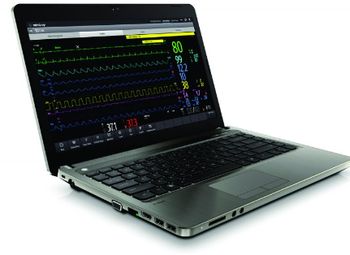
Mindray BeneVision CMS
Mindray · Model BeneVision CMS
Supported 3-layer network infrastructure and flexible combination of Central Station, View Station and Work Station makes you establish your own dedicated monitoring network which could accommodate as many as 1200 patient devices in single network. Devices may be combination of wired, wireless, and telemetry transmitters on any station. Both 19" TFT LCD and touchscreen display supported can present 16 patients simultaneously. Each station can support up to four displays. Supports up to 64 monitored beds per station. Enables bi-directional communication with bedside monitors for enhanced patient care. Supports all Mindray patient monitors including BeneVision N Series and TM80 Telemetry. Supports up to 240 hours full disclosure waveforms. Historical patient database enables data review for up to 20,000 discharged patients. Documentation options include network printer and dual trace recorder. Connectivity to ECG management systems for 12-lead ECG reports. Connectivity to eGateway for centralized HL7 IHE PCD v2 export. Clinical mobility supported with smartphone interface.
Key tips
- ·A no-signal/flatline alarm gets checked on the patient first, not the monitor - rule out a real clinical event before troubleshooting.
- ·Recalibrate NIBP against a reference manometer, not just a self-test pass.
- ·Reused patient cables (SpO2, ECG leads) are a common source of intermittent-fault complaints - swap the cable before the module.
Typical Failure Modes
Compiled for this model from its own documentation and established engineering knowledge for this equipment class - not from a verified service record. Confirm against the manufacturer's service manual.
Will not power on or unexpected shutdown
HighSymptoms: The patient monitoring is dead, reboots, or shuts down mid-use.
Root cause: Mains lead / fuse, an aged battery, or a power-supply board fault.
Battery will not hold charge
MediumSymptoms: Short run time on battery; low-battery alarm soon after a full charge.
Root cause: Aged rechargeable battery pack or a charger fault.
Display / control-panel fault
MediumSymptoms: Blank, dim or distorted display; unresponsive keys or touchscreen.
Root cause: Display, backlight, or control-board fault.
Fails self-test or calibration
MediumSymptoms: Power-on self-test or the scheduled performance check fails or is out of tolerance.
Root cause: Sensor drift or an internal board fault; recalibration or repair needed.
Serviceable Parts & Consumables
Serviceable items for this model, compiled from its documentation and engineering knowledge for this equipment class. Service class and relative cost are estimates, not manufacturer figures; no part numbers are given. Confirm intervals and pricing against the manufacturer.
Rechargeable battery pack
Class Periodic replacementRel. cost $$R&R Fairly easy
Power supply / mains board
Class Major service partRel. cost $$$R&R Difficult
Display / control-panel assembly
Class Major service partRel. cost $$$R&R Moderate
Cooling fan
Class Major service partRel. cost $R&R Moderate
| Part | Service class | Relative cost | R&R difficulty |
|---|---|---|---|
| Rechargeable battery pack | Periodic replacement | $$ | Fairly easy |
| Power supply / mains board | Major service part | $$$ | Difficult |
| Display / control-panel assembly | Major service part | $$$ | Moderate |
| Cooling fan | Major service part | $ | Moderate |
Relative cost: $ lowest · $$$$ highest service-part cost for this equipment class. Not a price.
PM Checklist
Preventive-maintenance tasks typical of this equipment class. Perform to the manufacturer's procedure and your facility's policy - this is general reference, not a schedule for this specific unit.
- ·Routine cable and lead-wire inspection for fraying/wear
- ·Battery conditioning cycle
- ·NIBP calibration check against a reference manometer
- ·ECG / SpO2 accuracy verification against a patient simulator
- ·Annual electrical safety test
Troubleshooting Approach
A starting sequence for this model, compiled from its documentation and engineering knowledge for this equipment class. Follow the manufacturer's service documentation for the actual procedure.
Symptom: No or poor video image / recording will not start / files corrupt
- Confirm a valid input signal on each source (SDI / HDMI / DVI / composite).
- Swap the input cable and try another input.
- Clean the scope lens / coupler and re-white-balance (endoscopy camera).
- Swap the camera head and cable to isolate head from CCU.
- Replace the camera head or the capture board as isolated.
Symptom: Storage / media fault / export fails
- Check free space and the internal drive health.
- Test export to USB and to the network share separately.
- Confirm the PACS / share settings and credentials.
- Replace a failing internal or optical drive.
- Verify an exported study opens on another workstation.
Symptom: Capture will not trigger / footswitch or camera-button fault
- Test the footswitch and its cable.
- Test the camera-head buttons.
- Check the trigger input configuration.
- Replace the footswitch or trigger cable.
- Confirm capture from each trigger source.
Typical Location
Where this class of equipment is typically deployed - general reference, not this unit's own placement record.
- ICU / CCU
- Emergency Department
- OR / PACU
- General med-surg floors
- Step-down units
- Telemetry units
Documents & Manuals
Safety & Recalls
Synced live from the FDA openFDA API.
- RECALL
When the Worstation of the BeneVision DMS has a specific hardware configuration, the computer may experience audio playback failure or screen freezing.
- RECALL
There is a software anomaly with the DPM Central Monitoring System where the trend data of one patient maybe replaced with the trend data of a second patient.
Troubleshoot this device with Bio
Describe a symptom or error code. Bio answers from this device's own documented error codes, failure modes, parts, and guides.
Ask Bio