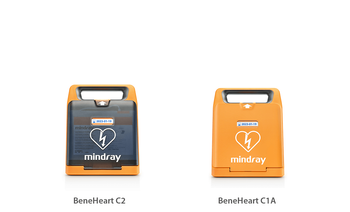
Mindray BeneHeart C series
Mindray · Model BeneHeart C series
Higher energy for subsequent shocks is recommend to increase the termination rates of refibrillation in the 2015 AHA Guidelines for CPR and ECC, and the ERC Guidelines for Resuscitation 2015. BeneHeart C Series features the 360J biphasic technology, meeting the needs of individual SCA patients. Reliable AED: Rigorously tested, BeneHeart C Series has been rated with 1.5-meter drop endurance and IP55 level of dust and water resistance, giving the confidence of addressing different challenges in various demanding environments. With the flexible network connection solution, the integrated AED-Alert™ System provides a quick and efficient way to remotely manage AEDs and reduces your management cost.
Key tips
- ·Never skip the daily/shift ready-check - a defibrillator found dead during a code is a real, repeated root-cause finding.
- ·Pads and batteries have real expiration dates - check them on every PM, not just at annual service.
- ·Verify energy-delivery accuracy with a real defibrillator analyzer, not just a self-test pass.
Typical Failure Modes
Compiled for this model from its own documentation and established engineering knowledge for this equipment class - not from a verified service record. Confirm against the manufacturer's service manual.
Fails the delivered-energy / discharge test
HighSymptoms: Delivered energy outside tolerance on the analyser, will not charge, or charges slowly.
Root cause: HV capacitor / charging-circuit ageing, or an output-relay fault.
Battery will not hold charge / fails readiness
HighSymptoms: Short standby, readiness indicator shows service, unit fails the self-test on battery.
Root cause: Aged battery pack or a charging fault.
Therapy cable / pads or paddles fault
MediumSymptoms: "Check pads", "connect electrodes", no ECG through pads, poor paceing capture.
Root cause: Worn therapy cable, expired pads, or a paddle / connector fault.
ECG / SpO2 / NIBP / CO2 parameter fault (defib-monitors)
MediumSymptoms: A monitoring parameter drops or is implausible.
Root cause: Patient cable / sensor or the parameter module.
Recorder / data fault
LowSymptoms: No printout, event data will not transfer.
Root cause: Thermal recorder or the data / Wi-Fi interface.
Serviceable Parts & Consumables
Serviceable items for this model, compiled from its documentation and engineering knowledge for this equipment class. Service class and relative cost are estimates, not manufacturer figures; no part numbers are given. Confirm intervals and pricing against the manufacturer.
Battery pack
Class Periodic replacementRel. cost $$R&R Easy
Therapy / defib cable
Class Periodic replacementRel. cost $$R&R Fairly easy
Multifunction pads
Class Frequent wear itemRel. cost $R&R Easy
HV / charging board
Class Major service partRel. cost $$$$R&R Difficult
Thermal recorder / print head
Class Periodic replacementRel. cost $$R&R Fairly easy
| Part | Service class | Relative cost | R&R difficulty |
|---|---|---|---|
| Battery pack | Periodic replacement | $$ | Easy |
| Therapy / defib cable | Periodic replacement | $$ | Fairly easy |
| Multifunction pads | Frequent wear item | $ | Easy |
| HV / charging board | Major service part | $$$$ | Difficult |
| Thermal recorder / print head | Periodic replacement | $$ | Fairly easy |
Relative cost: $ lowest · $$$$ highest service-part cost for this equipment class. Not a price.
PM Checklist
Preventive-maintenance tasks typical of this equipment class. Perform to the manufacturer's procedure and your facility's policy - this is general reference, not a schedule for this specific unit.
- ·Daily/shift visual and self-test check (AAMI EQ56 daily-ready standard)
- ·Battery and pad expiration-date tracking
- ·Energy-delivery accuracy test against a defibrillator analyzer
- ·Paddle/cable continuity check
- ·Annual full PM
Troubleshooting Approach
A starting sequence for this model, compiled from its documentation and engineering knowledge for this equipment class. Follow the manufacturer's service documentation for the actual procedure.
Symptom: Fails the discharge / energy test
- Run the full delivered-energy test at several settings with a defib analyser.
- Test synchronised cardioversion and, if fitted, pacing.
- Check the therapy cable and paddles.
- If energy is out of tolerance or charge time is long, remove from service.
- Refer the HV / charging board to the OEM.
Symptom: Fails readiness or dies on battery
- Fit a fully charged battery and repeat the self-test.
- Run a battery capacity test / calibration.
- Confirm the charger and charging contacts.
- Replace the battery pack when capacity is low.
- Log the readiness self-test result before returning to service.
Typical Location
Where this class of equipment is typically deployed - general reference, not this unit's own placement record.
- Crash carts (every unit)
- Emergency Department
- ICU
- OR
- Code-blue response areas
Documents & Manuals
No documents available for this device yet.
Safety & Recalls
Synced live from the FDA openFDA API.
- RECALL
A software issue may result in the previous settings being applied instead of the default settings or the unit may skip the startup leak test.
- RECALL
Mindray has identified a potential leakage issue with the CO2 Module's Dryline II Water Trap used with the Passport Series Patient Monitor.
- RECALL
Mindray DS USA Inc. initiated a voluntary field corrective action for V-Series Patient Monitor because there is an issue with the V-Series Drug Calculator function.
- RECALL
ECG interpretation feature issues. False measurements reported when the algorithm cannot determine P wave or QRS axis. The Median Complex Report displays the representative beat 25% larger than actual signal input. When a patient date of birth is imported from an external source, the ECG interpretation algorithm uses the default age of 50, and interpretive statements may be incorrect.
- RECALL
Mindray has identified an issue with V Series Monitor where the V Dock power pins connecting the V Series Monitor to the V Dock may lose spring tension, potentially causing the screen to temporarily go blank, lose communication with the central station monitor (when one is in use) or shut down. No patient related events have been reported to Mindray concerning the issue.
- RECALL
Mindray has identified an issue with the V Series Monitor where the monitors touch screen may stop responding to touch.
- RECALL
Mindray has identified two software anomalies contained in the V Series Monitoring System. There have been no reports of injuries associated with these anomalies. These anomalies affect V Series Systems distributed between September 31, 2010 and January 9, 2012.
- RECALL
A system database corruption may occur that causes the V Series Monitor to reset.
Troubleshoot this device with Bio
Describe a symptom or error code. Bio answers from this device's own documented error codes, failure modes, parts, and guides.
Ask Bio