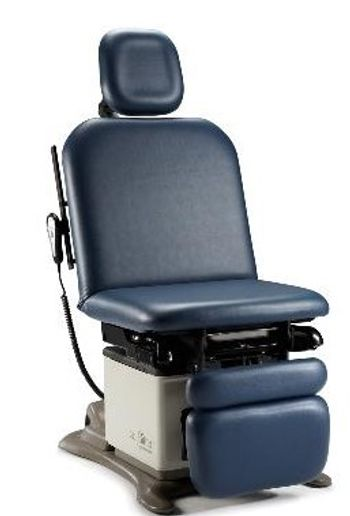
Midmark Ritter 230
 Midmark · Model Ritter 230
Lithotomy: Extending the stirrups and treatment pan, lowering the foot support, and slightly tilting the table, provide the perfect lithotomy position for OB/GYN examinations and procedures. Flat: The table supports examinations and procedures requiring supine, prone, left lateral, or right lateral positioning, when in the flat position. Knee-Chest: The foot support can be easily reconfigured, and the table properly positioned, to set up the knee-chest position for colon and rectal examinations and procedures. Trendelenburg: offers a full 30° of tilt. The simple touch of a pedal on either side of the table offers 350 degrees of rotation; touch the pedal again to lock the table in place. The optional adjustable arm system accessory offers a sense of security for patients and a stable and secure platform to assist them in getting on and off the table. With the simple touch of a lever, the arms can be rotated and locked into one of three positions, so the arms are in the right place for you.
Key tips
- ·When no category-specific guidance fits, default to the manufacturer's own service manual and the general troubleshooting method in the Engineer's Guide.
- ·Run an incoming and annual electrical safety test regardless of how niche the device is.
Typical Failure Modes
Compiled for this model from its own documentation and established engineering knowledge for this equipment class - not from a verified service record. Confirm against the manufacturer's service manual.
No power / no table functions
HighSymptoms: Nothing operates from the hand or foot control; power light off or on.
Root cause: Power light OFF = no power to the PC board (facility supply, inlet, F1/F2 fuse, transformer); power light ON = board has power, fault is downstream.
One actuator function not working (base / back / tilt / foot)
MediumSymptoms: Base, back, tilt or foot support will not move, moves one direction only, or stops with a beep and an error-code LED flash.
Root cause: Worn linear actuator, limit switch or position sensor fault, or a specific voltage rail issue (48-54 VAC base/back, 34-37 VAC tilt/foot).
PC board error codes (flashing LED sequence)
MediumSymptoms: Function stops, beep, two error-code LEDs flash a sequence; last five codes recallable via S2.
Root cause: Electrical malfunction detected in a function circuit - actuator, sensor, switch, or wiring.
Hand / foot control fault
MediumSymptoms: A button does no function, intermittent response, works from one control only.
Root cause: Worn membrane or foot switch, or a damaged control cable / connector (P9-P12).
Position-sensor calibration drift
LowSymptoms: Table does not stop at limits, positions inaccurate, Trendelenburg angle off.
Root cause: Potentiometer position sensors out of the expected voltage window (e.g. BASE up 1.7-2.1 VDC, BACK up 2.4-2.6 VDC).
Serviceable Parts & Consumables
Serviceable items for this model, compiled from its documentation and engineering knowledge for this equipment class. Service class and relative cost are estimates, not manufacturer figures; no part numbers are given. Confirm intervals and pricing against the manufacturer.
Linear actuator (base / back / tilt / foot)
Class Major service partRel. cost $$$R&R Moderate
Main PC board
Class Major service partRel. cost $$$R&R Moderate
Main system transformer / fuses (F1, F2)
Class Major service partRel. cost $$R&R Moderate
Hand control / corded foot control
Class Periodic replacementRel. cost $$R&R Fairly easy
Position sensor / potentiometer
Class Major service partRel. cost $R&R Moderate
| Part | Service class | Relative cost | R&R difficulty |
|---|---|---|---|
| Linear actuator (base / back / tilt / foot) | Major service part | $$$ | Moderate |
| Main PC board | Major service part | $$$ | Moderate |
| Main system transformer / fuses (F1, F2) | Major service part | $$ | Moderate |
| Hand control / corded foot control | Periodic replacement | $$ | Fairly easy |
| Position sensor / potentiometer | Major service part | $ | Moderate |
Relative cost: $ lowest · $$$$ highest service-part cost for this equipment class. Not a price.
PM Checklist
Preventive-maintenance tasks typical of this equipment class. Perform to the manufacturer's procedure and your facility's policy - this is general reference, not a schedule for this specific unit.
- ·Follow the manufacturer's PM schedule
- ·Perform incoming and annual electrical safety testing per facility biomedical program
Troubleshooting Approach
A starting sequence for this model, compiled from its documentation and engineering knowledge for this equipment class. Follow the manufacturer's service documentation for the actual procedure.
Symptom: No power, no functions operate
- Check the Power Light: OFF means no power reaching the PC board, ON means the board has power and the fault is downstream.
- If OFF, work back from the board: verify facility supply voltage, the power inlet, F1/F2 fuses and the main transformer (expect 8-10 VAC at the board input).
- Confirm 48-54 VAC on the black/white wires (base & back circuitry) and 34-37 VAC on the red/orange wires (tilt, foot, controls, sensors).
- Reset the board by unplugging and re-plugging the table.
- Restore MODE SELECT switches to their normal position after any diagnostics.
Symptom: A specific function stops with a beep and error code
- Remove the PC board cover and locate the two Error Code LEDs.
- Press the hand/foot control button for the suspect function and read the flashed error-code sequence.
- To recall history, set both MODE SELECT switches ON, power-cycle the table, then press S2 to display the last five codes.
- Use the code to target the actuator, limit switch, sensor or wiring for that function.
- Clear stored codes by holding S2 until three beeps, then re-test and confirm normal operation.
Technical Specs
- Patient Weight Capacity
- 450 lbs
Typical Location
Where this class of equipment is typically deployed - general reference, not this unit's own placement record.
- Varies by device - check the unit's own manual for facility placement guidance
Documents & Manuals
Troubleshoot this device with Bio
Describe a symptom or error code. Bio answers from this device's own documented error codes, failure modes, parts, and guides.
Ask Bio