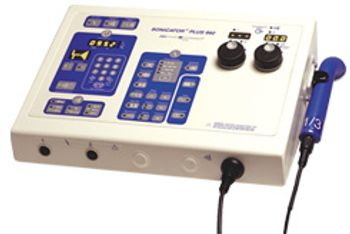
Mettler Toldeo Sonicator Plus 992
 Mettler Toldeo · Model Sonicator Plus 992
Ultrasound/electrical stimulation therapy unit. Sonicator Plus combination therapy units combine ultrasound with electrical stimulation in one compact package. These units combine the quality and ease of use embodied by the Sonicator therapeutic ultrasound and Sys*Stim stimulator products. Multiple stimulation waveforms and dual frequency applicators for therapeutic ultrasound have been included in these units to increase their utility.
Key tips
- ·Most "no output" stim-unit complaints are cable-side - check electrode/lead continuity before assuming a unit fault.
- ·Frame and strap wear on mechanical rehab equipment is a real fall/injury risk - don't defer it as cosmetic.
Typical Failure Modes
Compiled for this model from its own documentation and established engineering knowledge for this equipment class - not from a verified service record. Confirm against the manufacturer's service manual.
No or low output on a modality / channel
HighSymptoms: Ultrasound, e-stim, shortwave or laser channel delivers no or weak output, error on that channel, patient feels nothing.
Root cause: Applicator / electrode / handpiece fault, a lead / cable fault, dried electrodes, or an output-stage fault on that module.
Therapeutic-ultrasound applicator fault
MediumSymptoms: Low or no ultrasound output, applicator-contact / BNR error, no warmth on a water-bath test.
Root cause: Worn or cracked applicator crystal, or a cable fault.
Electrode / lead-wire wear
MediumSymptoms: Intermittent stim, open-circuit error, uneven sensation.
Root cause: Worn lead wires or exhausted / dried self-adhesive electrodes.
Touchscreen / control fault
MediumSymptoms: Unresponsive or erratic touchscreen, parameters will not set.
Root cause: Touchscreen or controller fault.
Power / battery / cooling fault
LowSymptoms: Will not power on, short battery life, or shuts down on temperature.
Root cause: Power supply / fuse, an aged battery, or a cooling-fan fault.
Serviceable Parts & Consumables
Serviceable items for this model, compiled from its documentation and engineering knowledge for this equipment class. Service class and relative cost are estimates, not manufacturer figures; no part numbers are given. Confirm intervals and pricing against the manufacturer.
Therapeutic-ultrasound applicator
Class Periodic replacementRel. cost $$R&R Easy
Electrotherapy lead wires
Class Frequent wear itemRel. cost $R&R Easy
Self-adhesive / carbon electrodes
Class ConsumableRel. cost $R&R Easy
Output board / module
Class Major service partRel. cost $$$R&R Difficult
Touchscreen / control assembly
Class Major service partRel. cost $$R&R Moderate
| Part | Service class | Relative cost | R&R difficulty |
|---|---|---|---|
| Therapeutic-ultrasound applicator | Periodic replacement | $$ | Easy |
| Electrotherapy lead wires | Frequent wear item | $ | Easy |
| Self-adhesive / carbon electrodes | Consumable | $ | Easy |
| Output board / module | Major service part | $$$ | Difficult |
| Touchscreen / control assembly | Major service part | $$ | Moderate |
Relative cost: $ lowest · $$$$ highest service-part cost for this equipment class. Not a price.
PM Checklist
Preventive-maintenance tasks typical of this equipment class. Perform to the manufacturer's procedure and your facility's policy - this is general reference, not a schedule for this specific unit.
- ·Frame and strap wear inspection
- ·Electrode lead continuity check
- ·Annual electrical safety test
Troubleshooting Approach
A starting sequence for this model, compiled from its documentation and engineering knowledge for this equipment class. Follow the manufacturer's service documentation for the actual procedure.
Symptom: No or low output on a modality / channel
- Fit a fresh applicator / handpiece / electrodes for that modality.
- Substitute a known-good lead / cable.
- Test therapeutic-ultrasound output into a water bath (visible cavitation / warmth) and run the applicator-contact / BNR self-test.
- Try the modality on another unit if available.
- Escalate a confirmed output-stage fault to the OEM.
Symptom: Patient feels nothing / open-circuit on an e-stim channel
- Fit fresh self-adhesive electrodes on well-prepped skin.
- Swap the lead wires.
- Confirm the current ramps and there is no open-electrode alarm.
- Test the channel into a resistive load per the manual.
- Refer the output stage if a good lead set still gives nothing.
Symptom: Unresponsive or erratic touchscreen / parameters will not set
- Power-cycle the unit.
- Recalibrate / re-seat the touchscreen if the touch is offset.
- Check the mains fuse and power supply.
- Confirm the cooling fan runs and the vents are clear.
- Replace the touchscreen or power supply as isolated.
Typical Location
Where this class of equipment is typically deployed - general reference, not this unit's own placement record.
- Physical therapy / rehab gym
- Outpatient rehab clinic
- Sports medicine
Documents & Manuals
Troubleshoot this device with Bio
Describe a symptom or error code. Bio answers from this device's own documented error codes, failure modes, parts, and guides.
Ask Bio