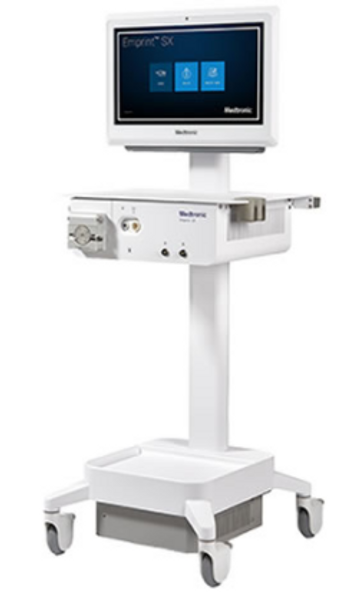
Medtronic Emprint SX
 Medtronic · Model Emprint SX
Navigation software improves successful antenna placement versus standard ultrasound guidance upon first attempt Advanced 3-D tracking shows the position of the Emprint™ SX ablation antenna and ultrasound transducer relative to the surgeon’s perspective in real-time Projected antenna path allows trajectory planning prior to antenna placement 3-D visualization of the predicted ablation zone helps ensure complete coverage of the target Thermosphere™ technology creates predictable spherical ablation zones Intuitive interface with a step-by-step guided setup and context-sensitive troubleshooting, makes the system easy to use.
Key tips
- ·Never defeat or bypass a return-electrode monitoring (REM) alarm to finish a case - it's a direct burn risk.
- ·Verify OR table battery backup - a table that loses power mid-procedure is a real, documented incident type.
- ·Track surgical light lamp-hours rather than waiting for failure - a sudden failure mid-case is avoidable.
Typical Failure Modes
Compiled for this model from its own documentation and established engineering knowledge for this equipment class - not from a verified service record. Confirm against the manufacturer's service manual.
No or low RF output / high-impedance cut-out
HighSymptoms: No cut / coag effect, "high impedance" or output-error message, output shuts down.
Root cause: Poor electrode contact or a dry field, a damaged handpiece / cable, a return-electrode (REM/NESSY) fault, or an output-stage fault.
Return-electrode (patient-plate) contact-quality alarm
MediumSymptoms: REM / NESSY / plate alarm, monopolar output inhibited.
Root cause: Poorly applied or dried split dispersive pad, a pad-cable fault, or the contact-quality-monitor circuit.
Bipolar / vessel-sealing output fault
MediumSymptoms: Bipolar or sealing output weak, seal cycle will not complete, instrument not recognised.
Root cause: Bipolar cable / instrument fault or the sealing output stage.
Fails calibration / output drifts after a repair
MediumSymptoms: Output power or the REM circuit outside tolerance on the analyser.
Root cause: Output board or REM circuit needs recalibration - anti-static handling required.
Footswitch / handswitch fault
MediumSymptoms: Output will not activate from the pedal or the handpiece.
Root cause: Footswitch or handswitch / cable fault.
Touchscreen / display / boot fault
LowSymptoms: Unresponsive touchscreen, will not power on or boot, fan / thermal alarm.
Root cause: Display, power supply, control board, or a cooling-fan fault.
Serviceable Parts & Consumables
Serviceable items for this model, compiled from its documentation and engineering knowledge for this equipment class. Service class and relative cost are estimates, not manufacturer figures; no part numbers are given. Confirm intervals and pricing against the manufacturer.
Reusable instrument / handpiece cables
Class Periodic replacementRel. cost $$R&R Easy
Split dispersive (return) pads
Class ConsumableRel. cost $R&R Easy
Footswitch
Class Periodic replacementRel. cost $$R&R Fairly easy
Bipolar / sealing cable
Class Periodic replacementRel. cost $$R&R Easy
RF output board
Recalibration required after replacement; anti-static handling.
Class Major service partRel. cost $$$$R&R Difficult
Cooling fan
Class Major service partRel. cost $R&R Moderate
| Part | Service class | Relative cost | R&R difficulty |
|---|---|---|---|
| Reusable instrument / handpiece cables | Periodic replacement | $$ | Easy |
| Split dispersive (return) pads | Consumable | $ | Easy |
| Footswitch | Periodic replacement | $$ | Fairly easy |
| Bipolar / sealing cable | Periodic replacement | $$ | Easy |
| RF output board Recalibration required after replacement; anti-static handling. | Major service part | $$$$ | Difficult |
| Cooling fan | Major service part | $ | Moderate |
Relative cost: $ lowest · $$$$ highest service-part cost for this equipment class. Not a price.
PM Checklist
Preventive-maintenance tasks typical of this equipment class. Perform to the manufacturer's procedure and your facility's policy - this is general reference, not a schedule for this specific unit.
- ·Pre-case functional check
- ·Electrosurgical return-electrode cable inspection
- ·Table hydraulic / mechanical inspection
- ·Annual electrical safety test and full PM
Troubleshooting Approach
A starting sequence for this model, compiled from its documentation and engineering knowledge for this equipment class. Follow the manufacturer's service documentation for the actual procedure.
Symptom: No or low RF output / high-impedance cut-out
- Confirm good electrode-tissue contact and an adequately wetted field.
- Inspect the handpiece / instrument and its cable for damage; substitute a known-good one.
- Check the split dispersive (return) pad is well applied over well-perfused muscle with a sound cable.
- Verify output into a resistive test load with an electrosurgical analyser.
- Replace the RF output board and recalibrate on a non-conductive surface if output is confirmed absent (anti-static handling).
Symptom: Return-electrode (REM / NESSY / CQM) contact-quality alarm
- Re-apply a fresh split dispersive pad with full skin contact.
- Check the pad cable and its connector.
- Try a known-good pad.
- Run the contact-quality-monitor calibration with a good pad fitted.
- Refer the CQM circuit if it still alarms.
Symptom: Output will not activate from the footswitch or handswitch
- Test the other activation method to isolate the pedal from the handpiece.
- Inspect the footswitch and its cable / connector for damage or moisture.
- Check the handswitch leads on the handpiece.
- Substitute a known-good footswitch.
- Refer the activation input board if both methods fail.
Symptom: Fails calibration / output drifts after a repair
- Verify cut and coag output at several settings into a test load with an analyser.
- Verify the REM / CQM circuit against its spec.
- Recalibrate per the service manual on a non-conductive bench with anti-static precautions.
- Check the cooling fan and thermal path.
- Re-verify all outputs and the REM alarm before returning to service.
Typical Location
Where this class of equipment is typically deployed - general reference, not this unit's own placement record.
- Operating rooms
- Procedure rooms
- Interventional suites
Documents & Manuals
Troubleshoot this device with Bio
Describe a symptom or error code. Bio answers from this device's own documented error codes, failure modes, parts, and guides.
Ask Bio