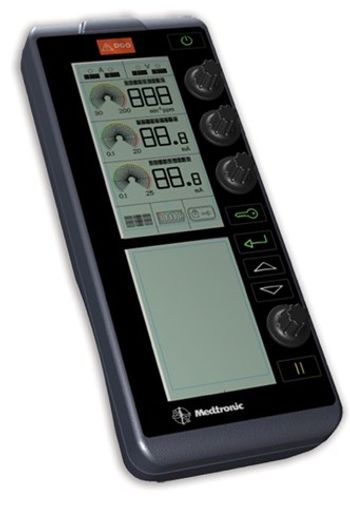
Medtronic 5392
 Medtronic · Model 5392
Single and dual chamber pacing capability Simplified device set up and use Improved low battery indicator Extended operating time during battery change Increased resistance to mechanical damage Enhanced user interface with improved visibility and increased responsiveness Added security of battery latching mechanism and IV hook Elimination of temporary heart wire connectors and side bails Meets new government standards - RoHS and 60601-1 (3rd edition)
Key tips
- ·Never skip the daily/shift ready-check - a defibrillator found dead during a code is a real, repeated root-cause finding.
- ·Pads and batteries have real expiration dates - check them on every PM, not just at annual service.
- ·Verify energy-delivery accuracy with a real defibrillator analyzer, not just a self-test pass.
Typical Failure Modes
Failure patterns typical of this equipment class - general BMET reference, not verified against this exact unit's own service history unless flagged. Severity is a category-level estimate.
Paddle / electrode fault
HighSymptoms: No shock delivered, pad error.
Root cause: Worn paddles or expired pads.
Charge / discharge relay fault
HighSymptoms: Won't charge or discharges unexpectedly.
Root cause: Relay/contactor wear.
SELV / patient isolation fault
MediumSymptoms: Leakage alarm, self-test fail.
Root cause: Failed isolation components.
High-voltage capacitor failure
HighSymptoms: Charge fails or sluggish, low-energy delivery.
Root cause: Capacitor aging / leakage.
Serviceable Parts & Consumables
The parts a BMET typically services on this class of equipment. Service class and relative cost are general engineering estimates for the category, not figures from this unit's documentation. Part numbers appear only when pulled from this unit's own service manual. Always confirm intervals and pricing against the manufacturer.
Rechargeable battery pack
Critical, keep charged spares.
Class Periodic replacementRel. cost $$$R&R Fairly easy
HV energy storage capacitor
Class Major service partRel. cost $$$$R&R Expert-level
Defibrillation electrodes / pads
Expiration-dated consumable.
Class ConsumableRel. cost $$R&R Easy
Charge relay / contactor
Class Periodic replacementRel. cost $$$R&R Difficult
| Part | Service class | Relative cost | R&R difficulty |
|---|---|---|---|
| Rechargeable battery pack Critical, keep charged spares. | Periodic replacement | $$$ | Fairly easy |
| HV energy storage capacitor | Major service part | $$$$ | Expert-level |
| Defibrillation electrodes / pads Expiration-dated consumable. | Consumable | $$ | Easy |
| Charge relay / contactor | Periodic replacement | $$$ | Difficult |
Relative cost: $ lowest · $$$$ highest service-part cost for this equipment class. Not a price.
PM Checklist
Preventive-maintenance tasks typical of this equipment class. Perform to the manufacturer's procedure and your facility's policy - this is general reference, not a schedule for this specific unit.
- ·Daily/shift visual and self-test check (AAMI EQ56 daily-ready standard)
- ·Battery and pad expiration-date tracking
- ·Energy-delivery accuracy test against a defibrillator analyzer
- ·Paddle/cable continuity check
- ·Annual full PM
Troubleshooting Approach
A structured starting point derived from the failure modes above. Follow the manufacturer's service documentation for the actual procedure.
Symptom: High-voltage capacitor failure
- Confirm the presentation - typically charge fails or sluggish, low-energy delivery - and note the exact alarm or message and the conditions when it occurs.
- Check the most likely cause first: capacitor aging / leakage.
- Isolate the affected subsystem using the manufacturer's functional check or self-test, where one is provided.
- If the fault is confirmed and not a field adjustment, service or replace the rechargeable battery pack per the manufacturer's service documentation.
- Return the device to service only after the manufacturer's functional and applicable electrical-safety checks pass.
- Record the findings, any parts used, and the verification results in the maintenance history.
Symptom: Battery degradation
- Confirm the presentation - typically short charge-hold, low-battery on readiness test - and note the exact alarm or message and the conditions when it occurs.
- Check the most likely cause first: aged battery pack.
- Isolate the affected subsystem using the manufacturer's functional check or self-test, where one is provided.
- If the fault is confirmed and not a field adjustment, service or replace the hV energy storage capacitor per the manufacturer's service documentation.
- Return the device to service only after the manufacturer's functional and applicable electrical-safety checks pass.
- Record the findings, any parts used, and the verification results in the maintenance history.
Technical Specs
- Height
- 20.3 cm
- Length
- 4.45 cm
- Weight
- 680 g
- Width
- 8.6 cm
Typical Location
Where this class of equipment is typically deployed - general reference, not this unit's own placement record.
- Crash carts (every unit)
- Emergency Department
- ICU
- OR
- Code-blue response areas
Documents & Manuals
Troubleshoot this device with Bio
Describe a symptom or error code. Bio answers from this device's own documented error codes, failure modes, parts, and guides.
Ask Bio