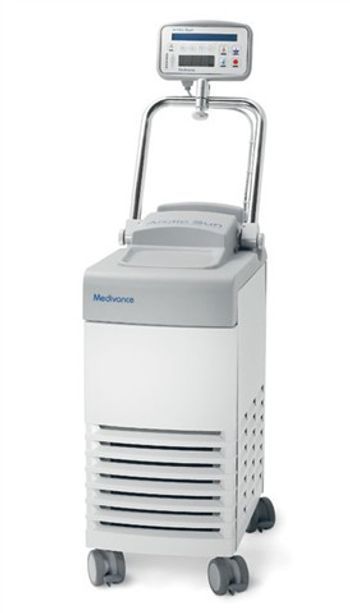
Medivance Arctic Sun
 Medivance · Model Arctic Sun
Induction: Treatment can begin within minutes. Once the patented ArcticGel Pads and the patient temperature probe are in place the target temperature is set and the Arctic Sun does the rest. (Roll over chart above to view this phase.) Maintenance: Once the Arctic Sun senses that the body is approaching the target temperature, the water temperature in the pads begins to increase in order to maintain the target temperature for the prescribed period of time. (Roll over chart above to view this phase.) Re-warming: The re-warming rate can be programmed as degrees per hour or set to be accomplished over a pre-set duration. The Arctic Sun can rewarm a patient as slow as 0.1°C per hour. (Roll over chart above to view this phase.) Hydrogel-based ArcticGel Pads similar material to that used in wound dressings Non-invasive: does not pose additional patient risks of infection or DVT Pads can remain in place during MRI, CT Scan, and X-ray procedures - time and nursing labor are optimized No leaks: Through patented technology, water flows through the ArcticGel pads under negative pressure. Inadvertent punctures do not leak water into the critical care environment.
Key tips
- ·Never skip temperature-accuracy verification to save time - it's the one check that directly prevents burns.
- ·Hose/blanket connector wear is the most common real fault and the easiest to miss on a quick visual check.
Typical Failure Modes
Compiled for this model from its own documentation and established engineering knowledge for this equipment class - not from a verified service record. Confirm against the manufacturer's service manual.
Will not reach or hold set patient / water temperature
HighSymptoms: Water temperature drifts from setpoint, patient temperature not tracking, over/under-temp alarm.
Root cause: Heater / thermoelectric or refrigeration fault, a temperature-probe fault, or a circulation-pump / flow fault.
Circulation-pump / flow fault
MediumSymptoms: Low-flow alarm, blanket not filling, pump noisy.
Root cause: Worn pump, an air-locked circuit, or a kinked / disconnected hose.
Patient-probe fault
MediumSymptoms: Patient temperature implausible or open-probe alarm, auto-control will not regulate.
Root cause: Damaged patient temperature probe or its connector.
Leak / reservoir fault
MediumSymptoms: Low-water alarm, water on the floor, air in the lines.
Root cause: Reservoir low, a hose / fitting leak, or a blanket leak.
Refrigeration fault (cooling units)
MediumSymptoms: Cannot cool water, compressor not running.
Root cause: Compressor, condenser fan, or a sealed-system fault.
Serviceable Parts & Consumables
Serviceable items for this model, compiled from its documentation and engineering knowledge for this equipment class. Service class and relative cost are estimates, not manufacturer figures; no part numbers are given. Confirm intervals and pricing against the manufacturer.
Circulation pump
Class Periodic replacementRel. cost $$$R&R Difficult
Patient temperature probe
Class Frequent wear itemRel. cost $$R&R Easy
Heater / thermoelectric module
Class Major service partRel. cost $$$R&R Difficult
Hoses / quick-connectors
Class Periodic replacementRel. cost $$R&R Easy
Refrigeration components (cooling units)
Class Major service partRel. cost $$$R&R Difficult
| Part | Service class | Relative cost | R&R difficulty |
|---|---|---|---|
| Circulation pump | Periodic replacement | $$$ | Difficult |
| Patient temperature probe | Frequent wear item | $$ | Easy |
| Heater / thermoelectric module | Major service part | $$$ | Difficult |
| Hoses / quick-connectors | Periodic replacement | $$ | Easy |
| Refrigeration components (cooling units) | Major service part | $$$ | Difficult |
Relative cost: $ lowest · $$$$ highest service-part cost for this equipment class. Not a price.
PM Checklist
Preventive-maintenance tasks typical of this equipment class. Perform to the manufacturer's procedure and your facility's policy - this is general reference, not a schedule for this specific unit.
- ·Hose / blanket connector inspection
- ·Temperature-accuracy verification
- ·Annual electrical safety test
Troubleshooting Approach
A starting sequence for this model, compiled from its documentation and engineering knowledge for this equipment class. Follow the manufacturer's service documentation for the actual procedure.
Symptom: Will not hold set temperature
- Confirm the reservoir is filled and the blanket circuit is primed (no air).
- Verify the water temperature against an independent thermometer.
- Check the patient probe against a reference and swap it.
- Confirm the circulation pump delivers flow.
- Replace the probe, pump or heater / refrigeration components as isolated.
Symptom: Low-flow or leak alarm
- Check the hoses for kinks and confirm the quick-connectors are seated.
- Top up the reservoir and bleed air from the circuit.
- Inspect the blanket and hoses for leaks.
- Replace a leaking hose / blanket.
- Confirm the flow alarm clears and temperature control is stable.
Technical Specs
- Height
- 30 to 39.5 inches
- Length
- 22 in
- Weight
- 105 lbs
- Width
- 12.5 in
Typical Location
Where this class of equipment is typically deployed - general reference, not this unit's own placement record.
- Operating Room
- PACU
- Emergency Department
- Labor & Delivery
- NICU
Documents & Manuals
Safety & Recalls
Synced live from the FDA openFDA API.
- RECALL
If temperature management system fails to reach correct target water temperature while device is operating in patient control mode, due to sudden patient temperature changes/interruption in water flow/blockage of air flow by an obstruction or dirty filter, then system may not alert, and alarm absence may lead to hypothermia or hyperthermia, so a software update will be released to correct issue.
- RECALL
Potential for an inaccuracy of the primary patient temperature reading that is used to monitor and control patient temperature.
Troubleshoot this device with Bio
Describe a symptom or error code. Bio answers from this device's own documented error codes, failure modes, parts, and guides.
Ask Bio