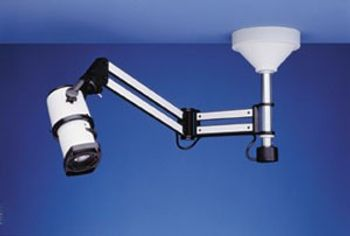
Medical Illumination MEDI-SPOT SPOTLIGHT
 Medical Illumination · Model MEDI-SPOT SPOTLIGHT
Spot size ranges from 3" (76mm) to 16" (406mm) diameter. 2,000 ft candles (21,500lux) at 36" (914mm) distance. 3,200º Kelvin color temperature. Sharply focused, high intensity light pattern. Extremely cool light output. Dichroic quartz/halogen bulb. Available in wall, portable floor, single and dual ceiling mounts, combination ceiling mounts w/ Medi-Lite or E-Z Glide ceiling track mounts.
Key tips
- ·Never defeat or bypass a return-electrode monitoring (REM) alarm to finish a case - it's a direct burn risk.
- ·Verify OR table battery backup - a table that loses power mid-procedure is a real, documented incident type.
- ·Track surgical light lamp-hours rather than waiting for failure - a sudden failure mid-case is avoidable.
Typical Failure Modes
Compiled for this model from its own documentation and established engineering knowledge for this equipment class - not from a verified service record. Confirm against the manufacturer's service manual.
Lamp / LED failure or reduced illuminance
MediumSymptoms: One or more heads / LED segments out, dim head, uneven or discoloured light field.
Root cause: Halogen lamp at end of life or a failed LED module / driver, a lamp-changeover fault, or a power-supply fault.
Spring-arm / suspension drift
HighSymptoms: Light head drifts up or down, will not stay positioned.
Root cause: Spring-arm counterbalance out of adjustment or worn friction brakes.
Intensity / focus control fault
MediumSymptoms: Brightness or spot size will not adjust from the wall panel or sterile handle.
Root cause: Control PCB, the wall-plate keypad, or the handle switch.
Sterilizable handle fault
LowSymptoms: Handle loose or not detected.
Root cause: Worn handle mount / contacts.
Power-supply fault
MediumSymptoms: Whole head dark, flicker, or will not power on.
Root cause: Failed lamp / LED power supply.
Serviceable Parts & Consumables
Serviceable items for this model, compiled from its documentation and engineering knowledge for this equipment class. Service class and relative cost are estimates, not manufacturer figures; no part numbers are given. Confirm intervals and pricing against the manufacturer.
Light-head lamp / LED module
Class Frequent wear itemRel. cost $$R&R Fairly easy
Lamp / LED power supply
Class Major service partRel. cost $$R&R Moderate
Spring-arm counterbalance / friction-brake kit
Class Major service partRel. cost $$$R&R Difficult
Control PCB / wall-plate keypad
Class Major service partRel. cost $$R&R Moderate
Sterilizable handle
Class Periodic replacementRel. cost $$R&R Easy
| Part | Service class | Relative cost | R&R difficulty |
|---|---|---|---|
| Light-head lamp / LED module | Frequent wear item | $$ | Fairly easy |
| Lamp / LED power supply | Major service part | $$ | Moderate |
| Spring-arm counterbalance / friction-brake kit | Major service part | $$$ | Difficult |
| Control PCB / wall-plate keypad | Major service part | $$ | Moderate |
| Sterilizable handle | Periodic replacement | $$ | Easy |
Relative cost: $ lowest · $$$$ highest service-part cost for this equipment class. Not a price.
PM Checklist
Preventive-maintenance tasks typical of this equipment class. Perform to the manufacturer's procedure and your facility's policy - this is general reference, not a schedule for this specific unit.
- ·Pre-case functional check
- ·Electrosurgical return-electrode cable inspection
- ·Table hydraulic / mechanical inspection
- ·Annual electrical safety test and full PM
Troubleshooting Approach
A starting sequence for this model, compiled from its documentation and engineering knowledge for this equipment class. Follow the manufacturer's service documentation for the actual procedure.
Symptom: Light out or dim / uneven
- Confirm mains power to the light and the wall-plate control.
- Replace the lamp / LED module (let a halogen head cool) and check the changeover mechanism.
- Replace the power supply if the head is unpowered.
- Verify even, full-illuminance output.
- Check the handle detection.
Symptom: Head will not hold position
- Adjust the spring-arm counterbalance for the head weight per the manual.
- Check the friction brakes at each joint.
- Replace the counterbalance / friction-brake kit if adjustment does not hold.
- Cycle the arm through its range.
- Confirm the head stays put at several positions.
Technical Specs
- Bulb Life
- 175 hr
- Color Temperature
- 3200 K
- Lighthead Diameter
- 5 in
- Field Diameter
- 36 in
Typical Location
Where this class of equipment is typically deployed - general reference, not this unit's own placement record.
- Operating rooms
- Procedure rooms
- Interventional suites
Documents & Manuals
Troubleshoot this device with Bio
Describe a symptom or error code. Bio answers from this device's own documented error codes, failure modes, parts, and guides.
Ask Bio