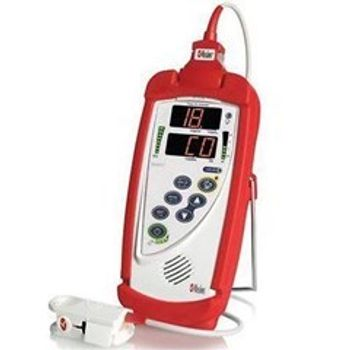
Masimo Rad-57
 Masimo · Model Rad-57
Continuous monitoring. Portable. Quick and easy to use. Low Signal I.Q. (SIQ) Indicator: Identifies conditions of low measurement confidence. Parameters: Measurement parameters can be added on after purchase, and come in the form of a software upgrade. Pleth Variability Index (PVI): Helps assess fluid responsiveness in mechanically ventilated patients, aiding fluid management. Total Hemoglobin (SpHb): Helps with quick, spot-check assessment. Methemoglobin (SpMet): Helps identify methemoglobinemia, a dangerous and deadly reaction caused by many drugs routinely administered in clinical settings. Carboxyhemoglobin (SpCO): Helps detects carbon monoxide (CO) poisoning. Oxygen Content (SpOC): By calculating hemoglobin and oxygen saturation, SpOC provides a more complete picture of your patients' oxygenation status. Sensor and Cable Options: The Rad-57 can be used with the following. Rainbow sensors and cables (such as the rainbow RC Cable, rainbow DCI Adult Sensor, and rainbow DCI-P Pediatric Sensor). Rainbow sensors must be used when measuring Total Hemoglobin (SpHb), Carboxyhemoglobin (SpCO), Methemoglobin (SpMet), and Total Arterial Oxygen Content (SpOC). Red reusable sensors. RD, LNCS, and M-LNCS adhesive sensors.
Key tips
- ·A no-signal/flatline alarm gets checked on the patient first, not the monitor - rule out a real clinical event before troubleshooting.
- ·Recalibrate NIBP against a reference manometer, not just a self-test pass.
- ·Reused patient cables (SpO2, ECG leads) are a common source of intermittent-fault complaints - swap the cable before the module.
Typical Failure Modes
Compiled for this model from its own documentation and established engineering knowledge for this equipment class - not from a verified service record. Confirm against the manufacturer's service manual.
No SpO2 / pulse reading or poor signal
HighSymptoms: No saturation / pulse value, "pulse search", low signal quality, implausible values.
Root cause: Worn or wrong SpO2 sensor, a damaged cable, poor site / perfusion, or motion.
Sensor / cable connector fault
MediumSymptoms: Reading drops when the cable is moved, sensor not recognised.
Root cause: Broken conductors in the sensor / extension cable, or a worn connector.
Inaccurate SpO2 vs a co-oximeter
MediumSymptoms: SpO2 consistently biased vs an arterial reference.
Root cause: Sensor degradation, or a monitor calibration / module fault.
Alarm / audio fault
MediumSymptoms: No or quiet audible alarm.
Root cause: Speaker or audio-board fault - a safety-critical failure.
Battery / power fault
MediumSymptoms: Short battery run time, will not power on.
Root cause: Aged battery.
Serviceable Parts & Consumables
Serviceable items for this model, compiled from its documentation and engineering knowledge for this equipment class. Service class and relative cost are estimates, not manufacturer figures; no part numbers are given. Confirm intervals and pricing against the manufacturer.
SpO2 sensor (reusable / disposable)
Class Frequent wear itemRel. cost $$R&R Easy
Pulse-oximetry extension cable
Class Frequent wear itemRel. cost $$R&R Easy
Battery
Class Periodic replacementRel. cost $$R&R Fairly easy
SpO2 module / board
Class Major service partRel. cost $$$R&R Moderate
Alarm speaker / audio board
Class Major service partRel. cost $$R&R Moderate
| Part | Service class | Relative cost | R&R difficulty |
|---|---|---|---|
| SpO2 sensor (reusable / disposable) | Frequent wear item | $$ | Easy |
| Pulse-oximetry extension cable | Frequent wear item | $$ | Easy |
| Battery | Periodic replacement | $$ | Fairly easy |
| SpO2 module / board | Major service part | $$$ | Moderate |
| Alarm speaker / audio board | Major service part | $$ | Moderate |
Relative cost: $ lowest · $$$$ highest service-part cost for this equipment class. Not a price.
PM Checklist
Preventive-maintenance tasks typical of this equipment class. Perform to the manufacturer's procedure and your facility's policy - this is general reference, not a schedule for this specific unit.
- ·Routine cable and lead-wire inspection for fraying/wear
- ·Battery conditioning cycle
- ·NIBP calibration check against a reference manometer
- ·ECG / SpO2 accuracy verification against a patient simulator
- ·Annual electrical safety test
Troubleshooting Approach
A starting sequence for this model, compiled from its documentation and engineering knowledge for this equipment class. Follow the manufacturer's service documentation for the actual procedure.
Symptom: No SpO2 / pulse reading or poor signal
- Fit a fresh, correct-size sensor on a warm, well-perfused, still site.
- Swap the SpO2 extension cable.
- Confirm the pleth / signal-quality indicator improves.
- Test the monitor with an SpO2 simulator across several saturations.
- Replace the sensor / cable, or refer the SpO2 module if the simulator also fails.
Symptom: Reading drops when the cable is moved / sensor not recognised
- Flex the sensor and extension cable along their length while watching the trace.
- Inspect the connectors for damage and clean them.
- Try a known-good cable and sensor.
- Confirm the sensor type matches the module.
- Replace the cable; refer the module connector if it persists.
Symptom: SpO2 biased vs a co-oximeter / accuracy concern
- Compare to an arterial co-oximetry result where clinically indicated.
- Try a known-good sensor of the correct type.
- Verify against an SpO2 simulator at 80 / 90 / 97 %.
- Check the module software / calibration revision.
- Refer the module for calibration if it fails the simulator.
Symptom: No or quiet audible alarm
- Confirm alarm volume is not set to minimum and alarms are not paused.
- Trigger a test alarm (remove the sensor) and listen.
- Check the speaker and its connector.
- Replace the speaker / audio board - a failed alarm is a safety fault.
- Verify the alarm at the set volume before returning to service.
Technical Specs
- Height
- 6.2 in
- Length
- 1.4
- Weight
- 0.8 lbs
- Memory
- 72 hr
- Width
- 3 in
Typical Location
Where this class of equipment is typically deployed - general reference, not this unit's own placement record.
- ICU / CCU
- Emergency Department
- OR / PACU
- General med-surg floors
- Step-down units
- Telemetry units
Documents & Manuals
Troubleshoot this device with Bio
Describe a symptom or error code. Bio answers from this device's own documented error codes, failure modes, parts, and guides.
Ask Bio