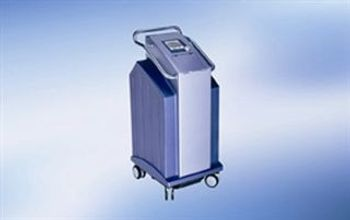
MAQUET HEATER-COOLER UNIT HCU 30
 MAQUET · Model HEATER-COOLER UNIT HCU 30
Modern Exterior Design - The HCU 30 has an elegant and easy to clean Polyurethane top cover and a user-friendly full graphic display. It is revolutionary in design and simplicity. Extremely High Cooling Capacity - The HCU 30 offers exceptional cooling capacity through its fast ice building technique and powerful compressor. The ice accumulates an initial cooling effect almost three times as high as the classic heater-cooler systems, resulting in reduced patient cooling times. This method also allows the machine to be operated in most cases without a running compressor, eliminating disturbing noise and draught from the compressor and the fan. Moreover, ice can easily be added for rapid extra cooling in an emergency situation. Effective Heating - The large capacity heater incorporates smooth and precise electronic control. This technique optimizes the efficiency and minimizes patient re-warming time. The automatically controlled mixing valve enables very fast switching from cooling to heating and back to cooling again. Unique Pressure and Flow Control - The machine also features a unique pressure and flow control. The maximum outlet pressure can be set to avoid damaging external devices. The perfusionist has the possibility to adjust the flow directly from the display. Reducing the flow provides a more silent operation. Fast priming and automatic de-airing - Key features include effective fast priming and automatic de-airing. A smart interior design allows air to be dispelled from the external and internal circulation very effectively, resulting in extremely short set-up times and smoothly running pumps. Effective emptying of external circuits - The HCU 30 offers really unique and effective emptying of external circuits. The device regains water by sucking it back from heat exchangers and water supply tubing, saving time and effort. This convenient emptying procedure almost eliminates water spillage, reducing the risk of wet slippery floors. Integrated cleaning technique - The HCU 30 has the most effective integrated cleaning technique available. The fuid and inner water path can be heated up to 90°C, in order to clean the water and prevent the growth of bacteria and other microbes. Remote Control - The HCU 30 can also be controlled by an optional Remote Control Unit.
Key tips
- ·Never skip temperature-accuracy verification to save time - it's the one check that directly prevents burns.
- ·Hose/blanket connector wear is the most common real fault and the easiest to miss on a quick visual check.
Typical Failure Modes
Compiled for this model from its own documentation and established engineering knowledge for this equipment class - not from a verified service record. Confirm against the manufacturer's service manual.
Will not reach or hold set patient / water temperature
HighSymptoms: Water temperature drifts from setpoint, patient temperature not tracking, over/under-temp alarm.
Root cause: Heater / thermoelectric or refrigeration fault, a temperature-probe fault, or a circulation-pump / flow fault.
Circulation-pump / flow fault
MediumSymptoms: Low-flow alarm, blanket not filling, pump noisy.
Root cause: Worn pump, an air-locked circuit, or a kinked / disconnected hose.
Patient-probe fault
MediumSymptoms: Patient temperature implausible or open-probe alarm, auto-control will not regulate.
Root cause: Damaged patient temperature probe or its connector.
Leak / reservoir fault
MediumSymptoms: Low-water alarm, water on the floor, air in the lines.
Root cause: Reservoir low, a hose / fitting leak, or a blanket leak.
Refrigeration fault (cooling units)
MediumSymptoms: Cannot cool water, compressor not running.
Root cause: Compressor, condenser fan, or a sealed-system fault.
Serviceable Parts & Consumables
Serviceable items for this model, compiled from its documentation and engineering knowledge for this equipment class. Service class and relative cost are estimates, not manufacturer figures; no part numbers are given. Confirm intervals and pricing against the manufacturer.
Circulation pump
Class Periodic replacementRel. cost $$$R&R Difficult
Patient temperature probe
Class Frequent wear itemRel. cost $$R&R Easy
Heater / thermoelectric module
Class Major service partRel. cost $$$R&R Difficult
Hoses / quick-connectors
Class Periodic replacementRel. cost $$R&R Easy
Refrigeration components (cooling units)
Class Major service partRel. cost $$$R&R Difficult
| Part | Service class | Relative cost | R&R difficulty |
|---|---|---|---|
| Circulation pump | Periodic replacement | $$$ | Difficult |
| Patient temperature probe | Frequent wear item | $$ | Easy |
| Heater / thermoelectric module | Major service part | $$$ | Difficult |
| Hoses / quick-connectors | Periodic replacement | $$ | Easy |
| Refrigeration components (cooling units) | Major service part | $$$ | Difficult |
Relative cost: $ lowest · $$$$ highest service-part cost for this equipment class. Not a price.
PM Checklist
Preventive-maintenance tasks typical of this equipment class. Perform to the manufacturer's procedure and your facility's policy - this is general reference, not a schedule for this specific unit.
- ·Hose / blanket connector inspection
- ·Temperature-accuracy verification
- ·Annual electrical safety test
Troubleshooting Approach
A starting sequence for this model, compiled from its documentation and engineering knowledge for this equipment class. Follow the manufacturer's service documentation for the actual procedure.
Symptom: Will not hold set temperature
- Confirm the reservoir is filled and the blanket circuit is primed (no air).
- Verify the water temperature against an independent thermometer.
- Check the patient probe against a reference and swap it.
- Confirm the circulation pump delivers flow.
- Replace the probe, pump or heater / refrigeration components as isolated.
Symptom: Low-flow or leak alarm
- Check the hoses for kinks and confirm the quick-connectors are seated.
- Top up the reservoir and bleed air from the circuit.
- Inspect the blanket and hoses for leaks.
- Replace a leaking hose / blanket.
- Confirm the flow alarm clears and temperature control is stable.
Technical Specs
- Height
- 160 mm
- Length
- 525 mm
- Weight
- 95 kg
- Width
- 465 mm
Typical Location
Where this class of equipment is typically deployed - general reference, not this unit's own placement record.
- Operating Room
- PACU
- Emergency Department
- Labor & Delivery
- NICU
Documents & Manuals
No documents available for this device yet.
Troubleshoot this device with Bio
Describe a symptom or error code. Bio answers from this device's own documented error codes, failure modes, parts, and guides.
Ask Bio