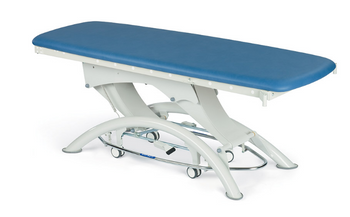
Lojer Group Capre E1/E2
 Lojer Group · Model Capre E1/E2
Examination Table with one or two sections. The E1 examination table is designed for general use and features a one-piece table top. Its exceptionally low minimum height and quiet motor add to ts appeal in small examination room environments, such as workplace healthcare. The E2 examination table is designed for general use and features a two-piece table top.
Key tips
- ·When no category-specific guidance fits, default to the manufacturer's own service manual and the general troubleshooting method in the Engineer's Guide.
- ·Run an incoming and annual electrical safety test regardless of how niche the device is.
Typical Failure Modes
Compiled for this model from its own documentation and established engineering knowledge for this equipment class - not from a verified service record. Confirm against the manufacturer's service manual.
One actuator does not work
HighSymptoms: A single table section will not move; other sections still work.
Root cause: Damaged or loose wiring to that actuator, a defective foot control, a defective actuator, or a defective control box.
No actuator works / no power
HighSymptoms: Table completely dead, no section moves.
Root cause: Power cord not plugged in properly, a defective power cord, or a defective relay in the control box.
Device is making noise
MediumSymptoms: Squeak or grinding during movement.
Root cause: Joint lubrication worn out, or an actuator that is worn out or overloaded.
Foot control unresponsive
MediumSymptoms: Intermittent or dead response from the foot control / free bar.
Root cause: Defective foot control or place-free bar.
Serviceable Parts & Consumables
Serviceable items for this model, compiled from its documentation and engineering knowledge for this equipment class. Service class and relative cost are estimates, not manufacturer figures; no part numbers are given. Confirm intervals and pricing against the manufacturer.
Linear actuator
Order via Lojer service with the type-plate serial number.
Class Major service partRel. cost $$$R&R Moderate
Foot control / place-free bar
Class Periodic replacementRel. cost $$R&R Fairly easy
Control box
Class Major service partRel. cost $$$R&R Moderate
Power cord
Class Major service partRel. cost $R&R Easy
| Part | Service class | Relative cost | R&R difficulty |
|---|---|---|---|
| Linear actuator Order via Lojer service with the type-plate serial number. | Major service part | $$$ | Moderate |
| Foot control / place-free bar | Periodic replacement | $$ | Fairly easy |
| Control box | Major service part | $$$ | Moderate |
| Power cord | Major service part | $ | Easy |
Relative cost: $ lowest · $$$$ highest service-part cost for this equipment class. Not a price.
PM Checklist
Preventive-maintenance tasks typical of this equipment class. Perform to the manufacturer's procedure and your facility's policy - this is general reference, not a schedule for this specific unit.
- ·Follow the manufacturer's PM schedule
- ·Perform incoming and annual electrical safety testing per facility biomedical program
Troubleshooting Approach
A starting sequence for this model, compiled from its documentation and engineering knowledge for this equipment class. Follow the manufacturer's service documentation for the actual procedure.
Symptom: One actuator does not work
- Check the fastening and condition of the wiring to that actuator.
- Test with a similar working foot control; change the foot control if that fixes it.
- If the wiring and foot control are good, contact Lojer service for the actuator.
- If still faulty, the control box is suspect - contact service.
- Perform the EN 62353 electrical checks after any repair.
Symptom: No power
- Check that the power cord is properly plugged in.
- Inspect the cord for damage and contact service if defective.
- A defective relay in the control box is otherwise likely - contact service.
- Confirm all sections move after the fix.
- Lubricate the joints if the device is noisy.
Typical Location
Where this class of equipment is typically deployed - general reference, not this unit's own placement record.
- Varies by device - check the unit's own manual for facility placement guidance
Documents & Manuals
Troubleshoot this device with Bio
Describe a symptom or error code. Bio answers from this device's own documented error codes, failure modes, parts, and guides.
Ask Bio