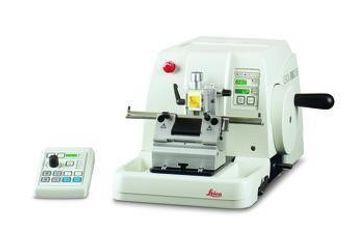
Leica Microsystems RM2265
 Leica Microsystems · Model RM2265
The Leica RM2265 is Leica Microsystems’ fully motorized and programmable rotary microtome designed primarily to satisfy the requirements. The Leica RM2265 is Leica Microsystems’ top-of-the-line fully motorized and programmable rotary microtome designed primarily to satisfy the requirements of biomedical research sectioning hard to semi-soft materials and customers needing to section industrial materials for quality assurance and materials defects analysis. The RM2265 is also the instrument of choice for sectioning at ultra-low temperatures ( -150 °C) in combination with the Leica LN22 liquid nitrogen freezing attachment.
Key tips
- ·Run QC controls before trusting any repair - an analyzer that passes self-test can still report clinically wrong results.
- ·Rule out a reagent lot change before opening the instrument - it can look exactly like a hardware fault.
- ·Centrifuge rotors have a hard retirement age/cycle limit regardless of visible condition - don't eyeball it.
Typical Failure Modes
Compiled for this model from its own documentation and established engineering knowledge for this equipment class - not from a verified service record. Confirm against the manufacturer's service manual.
Poor / uneven sections
HighSymptoms: Thick-thin sectioning, chatter, ribbons that will not form, scoring lines.
Root cause: Dull or nicked blade, incorrect clearance angle, a loose specimen / blade clamp, or worn feed mechanism.
Feed / advance mechanism fault
MediumSymptoms: Section thickness inconsistent or drifting, coarse feed will not advance / retract.
Root cause: Worn micro-feed mechanism, a stepper / clutch fault (motorised), or backlash.
Handwheel / drive fault
MediumSymptoms: Handwheel binds, the brake will not hold, or motorised sectioning stalls.
Root cause: Worn bearings, a brake fault, or the drive motor / belt (motorised).
Cryostat temperature / defrost fault (cryostat)
MediumSymptoms: Chamber or specimen head will not reach temperature, heavy frost.
Root cause: Refrigeration fault, a temperature-sensor fault, or a failed defrost cycle.
Specimen orientation / clamp fault
LowSymptoms: Block moves during sectioning, orientation will not lock.
Root cause: Worn specimen clamp or orientation mechanism.
Serviceable Parts & Consumables
Serviceable items for this model, compiled from its documentation and engineering knowledge for this equipment class. Service class and relative cost are estimates, not manufacturer figures; no part numbers are given. Confirm intervals and pricing against the manufacturer.
Blade holder / clamp assembly
Class Major service partRel. cost $$R&R Moderate
Micro-feed mechanism
Class Major service partRel. cost $$$R&R Difficult
Handwheel bearings / brake
Class Major service partRel. cost $$R&R Difficult
Cryostat refrigeration / temp sensor (cryostat)
Class Major service partRel. cost $$$R&R Difficult
Specimen clamp / orientation head
Class Major service partRel. cost $$R&R Moderate
| Part | Service class | Relative cost | R&R difficulty |
|---|---|---|---|
| Blade holder / clamp assembly | Major service part | $$ | Moderate |
| Micro-feed mechanism | Major service part | $$$ | Difficult |
| Handwheel bearings / brake | Major service part | $$ | Difficult |
| Cryostat refrigeration / temp sensor (cryostat) | Major service part | $$$ | Difficult |
| Specimen clamp / orientation head | Major service part | $$ | Moderate |
Relative cost: $ lowest · $$$$ highest service-part cost for this equipment class. Not a price.
PM Checklist
Preventive-maintenance tasks typical of this equipment class. Perform to the manufacturer's procedure and your facility's policy - this is general reference, not a schedule for this specific unit.
- ·Daily QC controls run and reviewed
- ·Calibration verification per assay
- ·Routine cleaning and decontamination
- ·Scheduled reagent-path and pump-tubing maintenance
Troubleshooting Approach
A starting sequence for this model, compiled from its documentation and engineering knowledge for this equipment class. Follow the manufacturer's service documentation for the actual procedure.
Symptom: Poor or uneven sections
- Fit a fresh blade and set the correct clearance angle.
- Check the specimen and blade clamps are fully tight.
- Confirm the block is properly faced and cold enough.
- Cut a range of thicknesses to check feed consistency.
- Service the micro-feed mechanism if thickness still drifts.
Symptom: Feed or thickness inconsistent
- Verify section thickness with a set of test blocks / measured ribbons.
- Check for backlash in the feed mechanism.
- On motorised units, check the stepper / clutch.
- Re-lubricate or replace the micro-feed mechanism.
- Confirm consistent thickness after service.
Typical Location
Where this class of equipment is typically deployed - general reference, not this unit's own placement record.
- Central / core laboratory
- Point-of-care testing stations
- Blood bank
- Microbiology lab
Documents & Manuals
No documents available for this device yet.
Troubleshoot this device with Bio
Describe a symptom or error code. Bio answers from this device's own documented error codes, failure modes, parts, and guides.
Ask Bio