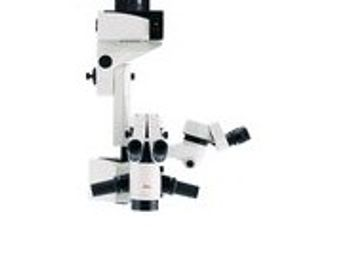
Leica Microsystems M844
 Leica Microsystems · Model M844
Leica Optics have superior light gathering ability. Sharp, brilliant, true anatomical color images with excellent depth of field are obtained under limited or even no microscope illumination. The result: better detail recognition, added patient safety, and fatigue-free viewing for the surgeon. QuadZoom: The teaching solution Only Leica's QuadZoom technology features four separate beam paths in the same zoom system. No manual adjustment by the teacher is necessary. Leica's Double Wing furthermore allows two students/assistants to have full stereo view at the same magnification. Work in comfort The Leica M844 F40 offers various features to enhance the surgeon's and assistant's comfort and to support an ergonomical workflow. For example: individually adjustable binocular tubes such as the UltraLow II binocular tubes, Leica Wireless Footswitch, Two-in-One display, StepCycle, and Auto Reset function. High-definition documentation The Med X Change HDMD All-in-One (AIO), a compact, integrated HD digital recording system, provides stunning, high-quality videos, and still images. The system is exclusively available from Leica Microsystems. Additionally, surgical cases can be wirelessly transfered to an Apple device with Med X Mobile. Integration of retinal accessories Leica Microsystems' surgical microscopes are designed to integrate the most commonly used wide-angle observation systems and stereo image inverters. They are also provided with a quick mount interface to comfortably and quickly install and remove e.g. the Leica slit lamp. True Red Reflex The double beam stereo illumination and Leica's large OttoFlex II illumination diameter enable true three-dimensional vision, and better Red Reflex stability and brightness. The result: increased depth of field, less XY-centering and refocusing required, brightness adjustable where it is needed most.
Typical Failure Modes
Compiled for this model from its own documentation and established engineering knowledge for this equipment class - not from a verified service record. Confirm against the manufacturer's service manual.
Illumination fault
MediumSymptoms: Lamp / LED out, flickering, uneven or dim field, colour-temperature shift.
Root cause: Halogen bulb or LED module at end of life, a lamp-power-supply fault, or a bad connection.
Focus mechanism fault
MediumSymptoms: Coarse / fine focus slips, drifts, binds, or the stage will not hold height.
Root cause: Worn focus-drive gears or slipping tension clutch.
Stage / condenser movement fault
LowSymptoms: Mechanical stage or condenser will not move smoothly or hold position.
Root cause: Worn stage rack-and-pinion or a loose condenser mount.
Optical contamination / poor image
MediumSymptoms: Haze, spots or debris in the field of view that rotate with an element.
Root cause: Dirty objectives, eyepieces, condenser or camera port.
Camera / imaging fault (if fitted)
LowSymptoms: No image, poor colour, software will not connect.
Root cause: Camera, its cable, or the imaging software.
Serviceable Parts & Consumables
Serviceable items for this model, compiled from its documentation and engineering knowledge for this equipment class. Service class and relative cost are estimates, not manufacturer figures; no part numbers are given. Confirm intervals and pricing against the manufacturer.
Illumination bulb / LED module
Class Frequent wear itemRel. cost $$R&R Fairly easy
Lamp power supply
Class Major service partRel. cost $$R&R Moderate
Focus-drive gear / clutch kit
Class Major service partRel. cost $$R&R Difficult
Stage rack-and-pinion
Class Major service partRel. cost $$R&R Difficult
Objective / eyepiece (as damaged)
Class Major service partRel. cost $$$R&R Fairly easy
| Part | Service class | Relative cost | R&R difficulty |
|---|---|---|---|
| Illumination bulb / LED module | Frequent wear item | $$ | Fairly easy |
| Lamp power supply | Major service part | $$ | Moderate |
| Focus-drive gear / clutch kit | Major service part | $$ | Difficult |
| Stage rack-and-pinion | Major service part | $$ | Difficult |
| Objective / eyepiece (as damaged) | Major service part | $$$ | Fairly easy |
Relative cost: $ lowest · $$$$ highest service-part cost for this equipment class. Not a price.
Troubleshooting Approach
A starting sequence for this model, compiled from its documentation and engineering knowledge for this equipment class. Follow the manufacturer's service documentation for the actual procedure.
Symptom: Dim, uneven or no illumination
- Replace the bulb / LED module (correct type and wattage).
- Check the lamp power supply and connections.
- Re-set Kohler illumination (field and condenser diaphragms, condenser height).
- Clean the collector lens and diffuser.
- Replace the lamp power supply if output is still low.
Symptom: Focus slips or binds
- Adjust the coarse-focus tension clutch per the manual.
- Check for debris or dried grease on the focus ways.
- Inspect the focus-drive gears for wear.
- Re-lubricate or replace the focus-drive kit.
- Confirm the stage holds height under a heavy slide.
Technical Specs
- Field of view
- 7 to 80 mm
- Focus range
- 54mm
- Focusing
- Motorized
- Magnification
- 6:1
- Magnification Range
- 3.5× – 21× WD 175mm, 10× eyepieces
Documents & Manuals
Troubleshoot this device with Bio
Describe a symptom or error code. Bio answers from this device's own documented error codes, failure modes, parts, and guides.
Ask Bio