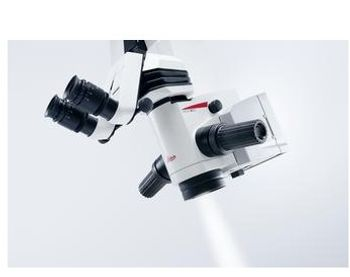
Leica Microsystems M822
 Leica Microsystems · Model M822
With Leica's coaxial OttoFlex technology, the Leica M822 provides brilliant and stable Red Reflex in all steps of cataract surgery. The smallest cortical fragments can be clearly seen even at low light levels. With the large OttoFlex diameter, the Red Reflex stays stable also during phaco. The Leica M822 combines high transmission optics with a dual illumination system consisting of LED plus halogen. The result: a reliable, safer, eco-friendly, and cost-saving system to perform both cataract and retinal surgery under optimal light conditions for the patient and the surgeon. See better, work better, feel better. Working in comfort allows the surgeon to focus on the patient and surgery. The Leica M822 has the largest selection of ergonomic binoculars available and give surgeons the best possible view, in a natural comfortable position. The controls and interfaces of the Leica M822 are designed for easy use, logical workflow, and personal preferences. Product features and accessories such as the StepCycle function, Wireless Footswitch, and Rotatable Beamsplitter support the surgeon and staff during surgery. Share what is seen in high-definition quality. The Leica M822 OpenArchitecture allows HD recording with the Med X Change HDMD All-in-One, wireless transfer of videos to a mobile device with the Med X Mobile app, and intra-operative fine focus of videos with various Leica Video Adapters. More than one model stand configuration is available. Also, the Leica M822 includes mechanical and electronic interfaces to accept and easily mount a wide range of retinal and cataract accessories such as the Leica RUV800, Oculus SDI/BIOM, and the Leica ToricEyePiece. Flexibility today and compatibility tomorrow add up to a smart long-term investment.
Typical Failure Modes
Compiled for this model from its own documentation and established engineering knowledge for this equipment class - not from a verified service record. Confirm against the manufacturer's service manual.
Illumination fault
MediumSymptoms: Lamp / LED out, flickering, uneven or dim field, colour-temperature shift.
Root cause: Halogen bulb or LED module at end of life, a lamp-power-supply fault, or a bad connection.
Focus mechanism fault
MediumSymptoms: Coarse / fine focus slips, drifts, binds, or the stage will not hold height.
Root cause: Worn focus-drive gears or slipping tension clutch.
Stage / condenser movement fault
LowSymptoms: Mechanical stage or condenser will not move smoothly or hold position.
Root cause: Worn stage rack-and-pinion or a loose condenser mount.
Optical contamination / poor image
MediumSymptoms: Haze, spots or debris in the field of view that rotate with an element.
Root cause: Dirty objectives, eyepieces, condenser or camera port.
Camera / imaging fault (if fitted)
LowSymptoms: No image, poor colour, software will not connect.
Root cause: Camera, its cable, or the imaging software.
Serviceable Parts & Consumables
Serviceable items for this model, compiled from its documentation and engineering knowledge for this equipment class. Service class and relative cost are estimates, not manufacturer figures; no part numbers are given. Confirm intervals and pricing against the manufacturer.
Illumination bulb / LED module
Class Frequent wear itemRel. cost $$R&R Fairly easy
Lamp power supply
Class Major service partRel. cost $$R&R Moderate
Focus-drive gear / clutch kit
Class Major service partRel. cost $$R&R Difficult
Stage rack-and-pinion
Class Major service partRel. cost $$R&R Difficult
Objective / eyepiece (as damaged)
Class Major service partRel. cost $$$R&R Fairly easy
| Part | Service class | Relative cost | R&R difficulty |
|---|---|---|---|
| Illumination bulb / LED module | Frequent wear item | $$ | Fairly easy |
| Lamp power supply | Major service part | $$ | Moderate |
| Focus-drive gear / clutch kit | Major service part | $$ | Difficult |
| Stage rack-and-pinion | Major service part | $$ | Difficult |
| Objective / eyepiece (as damaged) | Major service part | $$$ | Fairly easy |
Relative cost: $ lowest · $$$$ highest service-part cost for this equipment class. Not a price.
Troubleshooting Approach
A starting sequence for this model, compiled from its documentation and engineering knowledge for this equipment class. Follow the manufacturer's service documentation for the actual procedure.
Symptom: Dim, uneven or no illumination
- Replace the bulb / LED module (correct type and wattage).
- Check the lamp power supply and connections.
- Re-set Kohler illumination (field and condenser diaphragms, condenser height).
- Clean the collector lens and diffuser.
- Replace the lamp power supply if output is still low.
Symptom: Focus slips or binds
- Adjust the coarse-focus tension clutch per the manual.
- Check for debris or dried grease on the focus ways.
- Inspect the focus-drive gears for wear.
- Re-lubricate or replace the focus-drive kit.
- Confirm the stage holds height under a heavy slide.
Technical Specs
- Weight
- 270 kg as a fully configured system
- Focus range
- 54mm
- Focusing
- Motorized
- Magnification
- 6:1
- Magnification Range
- 3.5× – 21× WD 175mm, 10× eyepieces
Documents & Manuals
Troubleshoot this device with Bio
Describe a symptom or error code. Bio answers from this device's own documented error codes, failure modes, parts, and guides.
Ask Bio