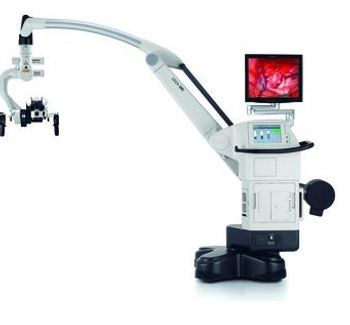
Leica Microsystems M720 OH5
 Leica Microsystems · Model M720 OH5
The innovative Horizontal Optics Technology reduces the size of the optical head and gives surgeons more room to work, dramatically increasing their comfort level. Leica Butterfly-Binoculars ensure comfortable positioning for all surgeons during surgery. SpeedSpot, the fast and accurate microscope positioning feature, allows one reference point for all surgeons and video, resulting in optimal parafocality, sharp images, and increased comfort for surgeons.
Typical Failure Modes
Compiled for this model from its own documentation and established engineering knowledge for this equipment class - not from a verified service record. Confirm against the manufacturer's service manual.
Illumination fault
MediumSymptoms: Lamp / LED out, flickering, uneven or dim field, colour-temperature shift.
Root cause: Halogen bulb or LED module at end of life, a lamp-power-supply fault, or a bad connection.
Focus mechanism fault
MediumSymptoms: Coarse / fine focus slips, drifts, binds, or the stage will not hold height.
Root cause: Worn focus-drive gears or slipping tension clutch.
Stage / condenser movement fault
LowSymptoms: Mechanical stage or condenser will not move smoothly or hold position.
Root cause: Worn stage rack-and-pinion or a loose condenser mount.
Optical contamination / poor image
MediumSymptoms: Haze, spots or debris in the field of view that rotate with an element.
Root cause: Dirty objectives, eyepieces, condenser or camera port.
Camera / imaging fault (if fitted)
LowSymptoms: No image, poor colour, software will not connect.
Root cause: Camera, its cable, or the imaging software.
Serviceable Parts & Consumables
Serviceable items for this model, compiled from its documentation and engineering knowledge for this equipment class. Service class and relative cost are estimates, not manufacturer figures; no part numbers are given. Confirm intervals and pricing against the manufacturer.
Illumination bulb / LED module
Class Frequent wear itemRel. cost $$R&R Fairly easy
Lamp power supply
Class Major service partRel. cost $$R&R Moderate
Focus-drive gear / clutch kit
Class Major service partRel. cost $$R&R Difficult
Stage rack-and-pinion
Class Major service partRel. cost $$R&R Difficult
Objective / eyepiece (as damaged)
Class Major service partRel. cost $$$R&R Fairly easy
| Part | Service class | Relative cost | R&R difficulty |
|---|---|---|---|
| Illumination bulb / LED module | Frequent wear item | $$ | Fairly easy |
| Lamp power supply | Major service part | $$ | Moderate |
| Focus-drive gear / clutch kit | Major service part | $$ | Difficult |
| Stage rack-and-pinion | Major service part | $$ | Difficult |
| Objective / eyepiece (as damaged) | Major service part | $$$ | Fairly easy |
Relative cost: $ lowest · $$$$ highest service-part cost for this equipment class. Not a price.
Troubleshooting Approach
A starting sequence for this model, compiled from its documentation and engineering knowledge for this equipment class. Follow the manufacturer's service documentation for the actual procedure.
Symptom: Dim, uneven or no illumination
- Replace the bulb / LED module (correct type and wattage).
- Check the lamp power supply and connections.
- Re-set Kohler illumination (field and condenser diaphragms, condenser height).
- Clean the collector lens and diffuser.
- Replace the lamp power supply if output is still low.
Symptom: Focus slips or binds
- Adjust the coarse-focus tension clutch per the manual.
- Check for debris or dried grease on the focus ways.
- Inspect the focus-drive gears for wear.
- Re-lubricate or replace the focus-drive kit.
- Confirm the stage holds height under a heavy slide.
Technical Specs
- Weight
- 310 kg
- Field of view
- 12.5 to 143 mm
- Focusing
- Motorized or manual
- Magnification
- 6:1
- Magnification Range
- 1.5× to 17.0× with 10× eyepiece
Documents & Manuals
Troubleshoot this device with Bio
Describe a symptom or error code. Bio answers from this device's own documented error codes, failure modes, parts, and guides.
Ask Bio