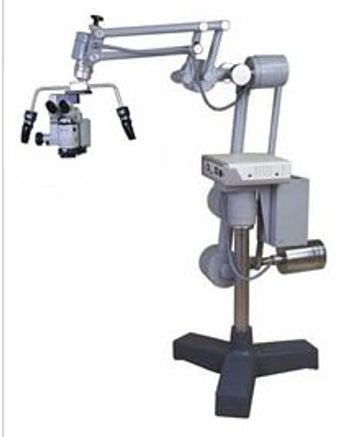
Leica Microsystems M695
 Leica Microsystems · Model M695
Manually Controlled Spot Illumination Variable Spot Illumination Widefield, Inclinable 0-180 Degree Binocular Widefield 10.5X 21 Eyepieces Hand and/or Foot Control Available for Motorized Features Manual Override Knobs for Motorized Features Dual Surgeon, Assistant and Video Accessories Available Cool, Homogenous Illumination 300 Watt Bulb Xenon Arc Lamp for Daylight Color Halogen Back-Up Bulb Varying Shutter for Illumination Level Selector for 110V or 220V Mounting System Type: Contraves NC-1 56" horizontal reach 66" vertical reach Rotation angle with a possible operating field of 360º.
Typical Failure Modes
Compiled for this model from its own documentation and established engineering knowledge for this equipment class - not from a verified service record. Confirm against the manufacturer's service manual.
Illumination fault
MediumSymptoms: Lamp / LED out, flickering, uneven or dim field, colour-temperature shift.
Root cause: Halogen bulb or LED module at end of life, a lamp-power-supply fault, or a bad connection.
Focus mechanism fault
MediumSymptoms: Coarse / fine focus slips, drifts, binds, or the stage will not hold height.
Root cause: Worn focus-drive gears or slipping tension clutch.
Stage / condenser movement fault
LowSymptoms: Mechanical stage or condenser will not move smoothly or hold position.
Root cause: Worn stage rack-and-pinion or a loose condenser mount.
Optical contamination / poor image
MediumSymptoms: Haze, spots or debris in the field of view that rotate with an element.
Root cause: Dirty objectives, eyepieces, condenser or camera port.
Camera / imaging fault (if fitted)
LowSymptoms: No image, poor colour, software will not connect.
Root cause: Camera, its cable, or the imaging software.
Serviceable Parts & Consumables
Serviceable items for this model, compiled from its documentation and engineering knowledge for this equipment class. Service class and relative cost are estimates, not manufacturer figures; no part numbers are given. Confirm intervals and pricing against the manufacturer.
Illumination bulb / LED module
Class Frequent wear itemRel. cost $$R&R Fairly easy
Lamp power supply
Class Major service partRel. cost $$R&R Moderate
Focus-drive gear / clutch kit
Class Major service partRel. cost $$R&R Difficult
Stage rack-and-pinion
Class Major service partRel. cost $$R&R Difficult
Objective / eyepiece (as damaged)
Class Major service partRel. cost $$$R&R Fairly easy
| Part | Service class | Relative cost | R&R difficulty |
|---|---|---|---|
| Illumination bulb / LED module | Frequent wear item | $$ | Fairly easy |
| Lamp power supply | Major service part | $$ | Moderate |
| Focus-drive gear / clutch kit | Major service part | $$ | Difficult |
| Stage rack-and-pinion | Major service part | $$ | Difficult |
| Objective / eyepiece (as damaged) | Major service part | $$$ | Fairly easy |
Relative cost: $ lowest · $$$$ highest service-part cost for this equipment class. Not a price.
Troubleshooting Approach
A starting sequence for this model, compiled from its documentation and engineering knowledge for this equipment class. Follow the manufacturer's service documentation for the actual procedure.
Symptom: No or low RF output / high-impedance cut-out
- Confirm good electrode-tissue contact and an adequately wetted field.
- Inspect the handpiece / instrument and its cable for damage; substitute a known-good one.
- Check the split dispersive (return) pad is well applied over well-perfused muscle with a sound cable.
- Verify output into a resistive test load with an electrosurgical analyser.
- Replace the RF output board and recalibrate on a non-conductive surface if output is confirmed absent (anti-static handling).
Symptom: Return-electrode (REM / NESSY / CQM) contact-quality alarm
- Re-apply a fresh split dispersive pad with full skin contact.
- Check the pad cable and its connector.
- Try a known-good pad.
- Run the contact-quality-monitor calibration with a good pad fitted.
- Refer the CQM circuit if it still alarms.
Symptom: Output will not activate from the footswitch or handswitch
- Test the other activation method to isolate the pedal from the handpiece.
- Inspect the footswitch and its cable / connector for damage or moisture.
- Check the handswitch leads on the handpiece.
- Substitute a known-good footswitch.
- Refer the activation input board if both methods fail.
Symptom: Fails calibration / output drifts after a repair
- Verify cut and coag output at several settings into a test load with an analyser.
- Verify the REM / CQM circuit against its spec.
- Recalibrate per the service manual on a non-conductive bench with anti-static precautions.
- Check the cooling fan and thermal path.
- Re-verify all outputs and the REM alarm before returning to service.
Technical Specs
- Weight
- 440 lbs shipping weight
- Field of view
- 50 to 140 mm
- Focusing
- Motorized
Documents & Manuals
Troubleshoot this device with Bio
Describe a symptom or error code. Bio answers from this device's own documented error codes, failure modes, parts, and guides.
Ask Bio