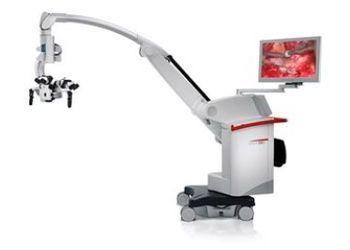
Leica Microsystems M530 OHX
 Leica Microsystems · Model M530 OHX
Superior overhead clearance and 36% longer reach than competitive products, for positioning flexibility and space to work Compact footprint to maximize OR space Easily maneuver instruments thanks to market-leading 600 mm working distance Fast stabilization at all angles keeps workflow interruptions to a minimum Bright, true-to-life color visualization with 400-Watt xenon light Small Angle Illumination (SAI) for optimal view to the bottom of deep, narrow cavities Clear, sharply focused image thanks to apochromatic optics Leica Magnification Multiplier with 40% magnification boost (optional)
Typical Failure Modes
Compiled for this model from its own documentation and established engineering knowledge for this equipment class - not from a verified service record. Confirm against the manufacturer's service manual.
Illumination fault
MediumSymptoms: Lamp / LED out, flickering, uneven or dim field, colour-temperature shift.
Root cause: Halogen bulb or LED module at end of life, a lamp-power-supply fault, or a bad connection.
Focus mechanism fault
MediumSymptoms: Coarse / fine focus slips, drifts, binds, or the stage will not hold height.
Root cause: Worn focus-drive gears or slipping tension clutch.
Stage / condenser movement fault
LowSymptoms: Mechanical stage or condenser will not move smoothly or hold position.
Root cause: Worn stage rack-and-pinion or a loose condenser mount.
Optical contamination / poor image
MediumSymptoms: Haze, spots or debris in the field of view that rotate with an element.
Root cause: Dirty objectives, eyepieces, condenser or camera port.
Camera / imaging fault (if fitted)
LowSymptoms: No image, poor colour, software will not connect.
Root cause: Camera, its cable, or the imaging software.
Serviceable Parts & Consumables
Serviceable items for this model, compiled from its documentation and engineering knowledge for this equipment class. Service class and relative cost are estimates, not manufacturer figures; no part numbers are given. Confirm intervals and pricing against the manufacturer.
Illumination bulb / LED module
Class Frequent wear itemRel. cost $$R&R Fairly easy
Lamp power supply
Class Major service partRel. cost $$R&R Moderate
Focus-drive gear / clutch kit
Class Major service partRel. cost $$R&R Difficult
Stage rack-and-pinion
Class Major service partRel. cost $$R&R Difficult
Objective / eyepiece (as damaged)
Class Major service partRel. cost $$$R&R Fairly easy
| Part | Service class | Relative cost | R&R difficulty |
|---|---|---|---|
| Illumination bulb / LED module | Frequent wear item | $$ | Fairly easy |
| Lamp power supply | Major service part | $$ | Moderate |
| Focus-drive gear / clutch kit | Major service part | $$ | Difficult |
| Stage rack-and-pinion | Major service part | $$ | Difficult |
| Objective / eyepiece (as damaged) | Major service part | $$$ | Fairly easy |
Relative cost: $ lowest · $$$$ highest service-part cost for this equipment class. Not a price.
Troubleshooting Approach
A starting sequence for this model, compiled from its documentation and engineering knowledge for this equipment class. Follow the manufacturer's service documentation for the actual procedure.
Symptom: Dim, uneven or no illumination
- Replace the bulb / LED module (correct type and wattage).
- Check the lamp power supply and connections.
- Re-set Kohler illumination (field and condenser diaphragms, condenser height).
- Clean the collector lens and diffuser.
- Replace the lamp power supply if output is still low.
Symptom: Focus slips or binds
- Adjust the coarse-focus tension clutch per the manual.
- Check for debris or dried grease on the focus ways.
- Inspect the focus-drive gears for wear.
- Re-lubricate or replace the focus-drive kit.
- Confirm the stage holds height under a heavy slide.