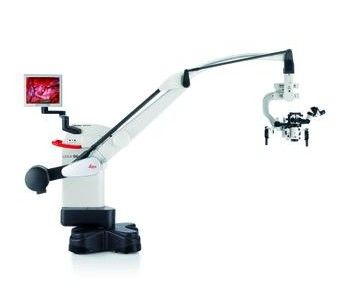
Leica Microsystems M525 OH4
 Leica Microsystems · Model M525 OH4
High degree of light transmission with OptiChrome technology, provides better patient safety by allowing the surgeon to use lower degrees of illumination. The most overhead room and longest reach of any surgical microscope on the market allows the microscope to be conveniently located behind the surgeon in the overhead position, or easily positioned anywhere around or across the operating table, resulting in greater flexibility and comfortable working conditions for the surgeon. Two completely independent, primary 300W xenon arc-lamp illumination systems. The second 300W system automatically and immediately switches on in the event of one lamp’s failure, which gives the surgeon confidence to know that surgery will not be jeopardized by lamp failure.
Typical Failure Modes
Compiled for this model from its own documentation and established engineering knowledge for this equipment class - not from a verified service record. Confirm against the manufacturer's service manual.
Illumination failure or dim / uneven light
HighSymptoms: No or dim light, sudden loss during a procedure, colour shift, uneven field.
Root cause: LED light engine or its driver / power supply at end of life.
Suspension / swing-arm drift
HighSymptoms: Microscope head drifts or will not hold position, worse after an accessory change.
Root cause: Arm not re-balanced after adding/removing a camera, tube or splitter, or worn magnetic / friction brakes.
Motorised zoom / focus fault
MediumSymptoms: Zoom or focus will not run or is erratic from the foot control or handgrips.
Root cause: Zoom/focus motor, foot-control switch, handgrip, or cabling.
Optics contamination / fogging
LowSymptoms: Hazy or low-contrast image, spots in the field.
Root cause: Dust or fingerprints on the objective protective glass or oculars, or condensation.
Integrated video / camera fault
LowSymptoms: No or poor video output, will not white-balance.
Root cause: Camera module or video cable fault.
Serviceable Parts & Consumables
Serviceable items for this model, compiled from its documentation and engineering knowledge for this equipment class. Service class and relative cost are estimates, not manufacturer figures; no part numbers are given. Confirm intervals and pricing against the manufacturer.
LED light engine
Class Major service partRel. cost $$$R&R Moderate
LED driver / power supply
Class Major service partRel. cost $$R&R Moderate
Swing-arm magnetic / friction brake & balance assembly
Class Major service partRel. cost $$$R&R Difficult
Zoom / focus motor assembly
Class Major service partRel. cost $$$R&R Difficult
Objective protective glass
Class Periodic replacementRel. cost $R&R Easy
Mains fuse
Class Major service partRel. cost $R&R Fairly easy
| Part | Service class | Relative cost | R&R difficulty |
|---|---|---|---|
| LED light engine | Major service part | $$$ | Moderate |
| LED driver / power supply | Major service part | $$ | Moderate |
| Swing-arm magnetic / friction brake & balance assembly | Major service part | $$$ | Difficult |
| Zoom / focus motor assembly | Major service part | $$$ | Difficult |
| Objective protective glass | Periodic replacement | $ | Easy |
| Mains fuse | Major service part | $ | Fairly easy |
Relative cost: $ lowest · $$$$ highest service-part cost for this equipment class. Not a price.
Troubleshooting Approach
A starting sequence for this model, compiled from its documentation and engineering knowledge for this equipment class. Follow the manufacturer's service documentation for the actual procedure.
Symptom: No or dim light
- Confirm mains power and the illuminator switch.
- Check the LED driver / power-supply output.
- Replace the driver if the LED engine is unpowered, or the engine for a failed emitter.
- Confirm the lamp / engine is fully seated.
- Verify even, full-brightness illumination and correct colour temperature.
Symptom: Head will not hold position
- Re-balance the swing arm for the current accessory load per the manual - never over the operating field.
- Adjust the arm brakes.
- Replace the brake / balance assembly if it will not hold.
- Return the arm to the transport position when moving the stand.
- Confirm the head stays put across the working range.
Technical Specs
- Height
- 1945 mm In parked position
- Weight
- 320 kg without load
- Field of view
- 16.5 to 180 mm
- Focusing
- Motorized or manual
- Magnification
- 6:1
- Magnification Range
- 1.2× to 12.8× with 10× eyepiece
Documents & Manuals
Troubleshoot this device with Bio
Describe a symptom or error code. Bio answers from this device's own documented error codes, failure modes, parts, and guides.
Ask Bio