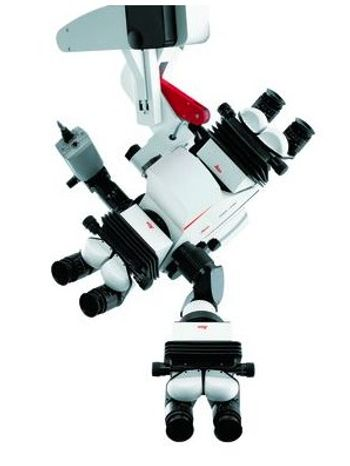
Leica Microsystems DI C500
 Leica Microsystems · Model DI C500
The Leica Dual Imaging allows the integration of all important intra-operative data into the surgical microscope; both correlated IGS structures and non-correlated information can be displayed to the surgeon and assistant with the highest resolution. The 45° tube adaptation for different Leica tubes results in a shorter height from eyepieces to operative site which can support every surgery situation, even special ones such as posterior fossa. The new Leica Dual Imaging Color Module offers perfect light management of the observation beam paths without loss of light.
Typical Failure Modes
Compiled for this model from its own documentation and established engineering knowledge for this equipment class - not from a verified service record. Confirm against the manufacturer's service manual.
Illumination failure or dim / uneven light
HighSymptoms: No or dim light, sudden loss during a procedure, colour shift, uneven field.
Root cause: Xenon or halogen lamp at end of life, a lamp-turret fault, or a fibre-optic cable break; the onboard spare lamp may not have switched in.
Suspension / swing-arm drift
HighSymptoms: Microscope head drifts or will not hold position, worse after an accessory change.
Root cause: Arm not re-balanced after adding/removing a camera, tube or splitter, or worn magnetic / friction brakes.
Motorised zoom / focus fault
MediumSymptoms: Zoom or focus will not run or is erratic from the foot control or handgrips.
Root cause: Zoom/focus motor, foot-control switch, handgrip, or cabling.
Optics contamination / fogging
LowSymptoms: Hazy or low-contrast image, spots in the field.
Root cause: Dust or fingerprints on the objective protective glass or oculars, or condensation.
Integrated video / camera fault
LowSymptoms: No or poor video output, will not white-balance.
Root cause: Camera module or video cable fault.
Serviceable Parts & Consumables
Serviceable items for this model, compiled from its documentation and engineering knowledge for this equipment class. Service class and relative cost are estimates, not manufacturer figures; no part numbers are given. Confirm intervals and pricing against the manufacturer.
Xenon / halogen lamp
Let the lamp and mount cool before changing.
Class Frequent wear itemRel. cost $$R&R Fairly easy
Fibre-optic light cable
Class Periodic replacementRel. cost $$R&R Fairly easy
Swing-arm magnetic / friction brake & balance assembly
Class Major service partRel. cost $$$R&R Difficult
Zoom / focus motor assembly
Class Major service partRel. cost $$$R&R Difficult
Objective protective glass
Class Periodic replacementRel. cost $R&R Easy
Mains fuse
Class Major service partRel. cost $R&R Fairly easy
| Part | Service class | Relative cost | R&R difficulty |
|---|---|---|---|
| Xenon / halogen lamp Let the lamp and mount cool before changing. | Frequent wear item | $$ | Fairly easy |
| Fibre-optic light cable | Periodic replacement | $$ | Fairly easy |
| Swing-arm magnetic / friction brake & balance assembly | Major service part | $$$ | Difficult |
| Zoom / focus motor assembly | Major service part | $$$ | Difficult |
| Objective protective glass | Periodic replacement | $ | Easy |
| Mains fuse | Major service part | $ | Fairly easy |
Relative cost: $ lowest · $$$$ highest service-part cost for this equipment class. Not a price.
Troubleshooting Approach
A starting sequence for this model, compiled from its documentation and engineering knowledge for this equipment class. Follow the manufacturer's service documentation for the actual procedure.
Symptom: No or dim light
- Switch to the onboard spare lamp if the turret allows, then unplug and let the failed lamp cool before replacing it.
- Check the fibre-optic cable for a break and the lamp-turret alignment.
- Check the mains fuse (unplug first).
- Confirm the lamp / engine is fully seated.
- Verify even, full-brightness illumination and correct colour temperature.
Symptom: Head will not hold position
- Re-balance the swing arm for the current accessory load per the manual - never over the operating field.
- Adjust the arm brakes.
- Replace the brake / balance assembly if it will not hold.
- Return the arm to the transport position when moving the stand.
- Confirm the head stays put across the working range.