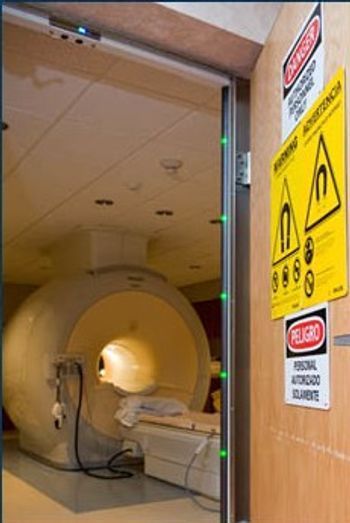
KOPP Development Inc. FerrAlert™ Halo Entry
 KOPP Development Inc. · Model FerrAlert™ Halo Entry
Instantly PINPOINTS location of the ferromagnetic object, allowing Technologist to quickly identify and remove the ferromagnetic threat - NO invasive PAT-DOWN required. Limits alarm fatigue – Patented technology suppresses irrelevant warnings and false positive alarms caused by hallway traffic. 24 location-accurate sensors for uniform sensitivity, reliability and usability. The ONLY ferromagnetic entryway detector that can operate effectively when used on an outward opening doorway. Fully complies with ACR requirements - Alarms are visible from both inside and outside the magnet room, giving the Technologist full control of the room at all times. Most flexible installation options - Certified to be installed outside or inside the magnet room, accommodating all facility layouts. An intelligent pre-alarm indicator - Distinctive visual indicator provides early warning of ferromagnetic items approaching the doorway. Both visual and audio alarms can be set to trigger up to 3 feet in front of the detector, allowing ample time to react. Unlike independent, dual pillar products, the portal configuration does not require constant re-alignment. Unlike independent, dual pillar products, the portal configuration provides 18 detection zones as both sides communicate, maximizes sensitivity right in the middle. Can be inconspicuously built into the door frame opening. Conforms to ES60601-1-8 international standards for medical device alarms (Does not cause alarm fatigue. No RED alarm lights, as color RED must be used ONLY in life threatening situations). Conforms to IEC 60101-1:2005 medical device specification requirements (Ferromagnetic detectors are not considered to be medical devices; however, they are an integral part of the medical environment. As such, it is highly important that the power supply used in the detectors complies with standards for medical equipment used by the FDA, UL, as well as agencies around the world.).
Key tips
- ·When no category-specific guidance fits, default to the manufacturer's own service manual and the general troubleshooting method in the Engineer's Guide.
- ·Run an incoming and annual electrical safety test regardless of how niche the device is.
Typical Failure Modes
Compiled for this model from its own documentation and established engineering knowledge for this equipment class - not from a verified service record. Confirm against the manufacturer's service manual.
Missed or weak ferromagnetic detection
HighSymptoms: Known ferrous test object passes without alarm, or the alarm threshold has drifted.
Root cause: Sensor / gradiometer degradation, a loose sensor cable, or the detection threshold set too low.
Frequent false alarms
MediumSymptoms: Alarms with no ferrous object present.
Root cause: Nearby electrical noise / moving metal, sensor drift, or grounding issues.
No alarm output (audible / visual)
MediumSymptoms: Detection occurs internally but the light / tone does not sound.
Root cause: Alarm annunciator, speaker, or the alarm-relay wiring.
Unit will not power on
MediumSymptoms: Dead display, no self-test.
Root cause: Power supply, fuse, or wiring.
Serviceable Parts & Consumables
Serviceable items for this model, compiled from its documentation and engineering knowledge for this equipment class. Service class and relative cost are estimates, not manufacturer figures; no part numbers are given. Confirm intervals and pricing against the manufacturer.
Ferromagnetic sensor / gradiometer assembly
Class Major service partRel. cost $$$R&R Difficult
Sensor cable
Class Periodic replacementRel. cost $$R&R Fairly easy
Alarm annunciator / speaker
Class Major service partRel. cost $R&R Fairly easy
Power supply / fuse
Class Major service partRel. cost $R&R Moderate
| Part | Service class | Relative cost | R&R difficulty |
|---|---|---|---|
| Ferromagnetic sensor / gradiometer assembly | Major service part | $$$ | Difficult |
| Sensor cable | Periodic replacement | $$ | Fairly easy |
| Alarm annunciator / speaker | Major service part | $ | Fairly easy |
| Power supply / fuse | Major service part | $ | Moderate |
Relative cost: $ lowest · $$$$ highest service-part cost for this equipment class. Not a price.
PM Checklist
Preventive-maintenance tasks typical of this equipment class. Perform to the manufacturer's procedure and your facility's policy - this is general reference, not a schedule for this specific unit.
- ·Follow the manufacturer's PM schedule
- ·Perform incoming and annual electrical safety testing per facility biomedical program
Troubleshooting Approach
A starting sequence for this model, compiled from its documentation and engineering knowledge for this equipment class. Follow the manufacturer's service documentation for the actual procedure.
Symptom: Missed detection
- Run the daily ferrous-object test at several approach heights and speeds.
- Reseat the sensor cable and check for damage.
- Verify the detection threshold / sensitivity against the commissioning setting.
- Recalibrate per the manufacturer if the tooling is available.
- Escalate a confirmed sensor fault to Kopp - this is an MRI-safety device.
Symptom: False alarms
- Identify nearby sources of moving metal or electrical noise.
- Check the unit's grounding.
- Re-baseline / re-zero the detector per the manual.
- Adjust sensitivity only within the commissioned range.
- Confirm normal behaviour with the test object after adjustment.
Typical Location
Where this class of equipment is typically deployed - general reference, not this unit's own placement record.
- Varies by device - check the unit's own manual for facility placement guidance
Documents & Manuals
Troubleshoot this device with Bio
Describe a symptom or error code. Bio answers from this device's own documented error codes, failure modes, parts, and guides.
Ask Bio