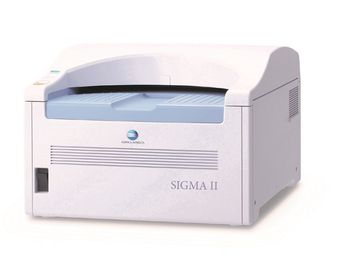
Konica Minolta Regius Sigma II
 Konica Minolta · Model Regius Sigma II
Ultra-compact CR - Konica Minolta's smallest and lightest CR. Environmentally Friendly - nergy consumption has been reduced to 100VA - about the same as a house hold light bulb. High Resolution - supports pixel sizes of 87.5µm and 175µm for all cassette sizes, achieving a maximum resolution of 4020x4892 pixels. Integral Processing - a robust algorithm that produces the optimum diagnostic image automatically [url=https: //www.medwrench.com/equipment/12968/konica-minolta-imagepilot]ImagePilot software[/url]. Combines CR image aquisition and PACS functionality. Supports a multi-touch display for the easiest operation.
Key tips
- ·Never bypass a radiation interlock to "just get the image" - this is one of the few true zero-tolerance rules in BMET work.
- ·Trend image-quality phantom results over time - drift shows up before an outright failure does.
- ·Portable/mobile units take real physical abuse from transport - check wheel locks and cable strain reliefs more often than fixed units.
Typical Failure Modes
Compiled for this model from its own documentation and established engineering knowledge for this equipment class - not from a verified service record. Confirm against the manufacturer's service manual.
Poor image quality / artefacts
HighSymptoms: Banding, streaks, ghost images, non-uniform density, dust artefacts.
Root cause: Dirty light guide / scanning optics, a worn erase-lamp array, imaging-plate wear, or contaminated transport rollers.
Plate / cassette transport jam or mis-feed
MediumSymptoms: Plate jams in the reader, transport error, plate not returned.
Root cause: Worn or contaminated transport rollers / belts, or a sensor fault.
Incomplete erase / residual latent image
MediumSymptoms: A faint previous image appears on the next exposure.
Root cause: Erase-lamp array degradation or a driver fault.
Laser / PMT scanning fault
MediumSymptoms: No or very noisy image, scan-error message.
Root cause: Scanning laser or the photomultiplier / detection chain.
Workstation / DICOM fault
LowSymptoms: Images will not display, annotate or send to PACS.
Root cause: Workstation PC or the DICOM configuration.
Serviceable Parts & Consumables
Serviceable items for this model, compiled from its documentation and engineering knowledge for this equipment class. Service class and relative cost are estimates, not manufacturer figures; no part numbers are given. Confirm intervals and pricing against the manufacturer.
Transport rollers / belts
Class Periodic replacementRel. cost $$R&R Moderate
Erase-lamp array
Class Periodic replacementRel. cost $$$R&R Moderate
Imaging plates / cassettes
Class Periodic replacementRel. cost $$$R&R Easy
Light guide / scanning optics
Class Major service partRel. cost $$$R&R Difficult
Workstation PC
Class Major service partRel. cost $$$R&R Moderate
| Part | Service class | Relative cost | R&R difficulty |
|---|---|---|---|
| Transport rollers / belts | Periodic replacement | $$ | Moderate |
| Erase-lamp array | Periodic replacement | $$$ | Moderate |
| Imaging plates / cassettes | Periodic replacement | $$$ | Easy |
| Light guide / scanning optics | Major service part | $$$ | Difficult |
| Workstation PC | Major service part | $$$ | Moderate |
Relative cost: $ lowest · $$$$ highest service-part cost for this equipment class. Not a price.
PM Checklist
Preventive-maintenance tasks typical of this equipment class. Perform to the manufacturer's procedure and your facility's policy - this is general reference, not a schedule for this specific unit.
- ·Daily QC per modality: image-quality phantom test
- ·Tube and detector inspection
- ·Annual state-required radiation safety survey
- ·Vendor-scheduled preventive maintenance
Error Codes
Extracted directly from this unit's own service manual.
E7413Error Notification to Status Management Task (OFF / High Voltage OFF)
E7000Error Notification to Status Management Task (ON / Tray Ejection)
E7001Error Notification to Status Management Task (OFF / Plate Attached)
E7002Error Notification to Status Management Task
E7003Error Notification to Status Management Task (ON / Plate Attached)
Troubleshooting Approach
A starting sequence for this model, compiled from its documentation and engineering knowledge for this equipment class. Follow the manufacturer's service documentation for the actual procedure.
Symptom: Poor image quality / artefacts (banding, streaks, ghosting, non-uniform density)
- Run the reader's cleaning and calibration / shading procedure.
- Clean the light guide, scanning optics and the transport rollers.
- Erase and re-image a plate to check for a residual latent image (worn erase lamps).
- Rotate in a fresh imaging plate / cassette to rule out plate wear.
- Escalate a scanning-laser / PMT / detector fault to the OEM.
Symptom: Plate / cassette jams or is not returned
- Clear the jammed plate per the manual and note where it hangs up.
- Inspect and clean or replace the transport rollers and belts.
- Check the transport / position sensors.
- Cycle several cassettes.
- Confirm reliable feed and return.
Symptom: Faint previous image on the next exposure (incomplete erase)
- Check the erase-lamp array for failed lamps / segments.
- Run an extended erase and re-image.
- Check the erase-lamp driver.
- Replace the erase-lamp array.
- Confirm a clean plate after a full erase.
Symptom: Images will not display, process or reach PACS
- Confirm the workstation is up and the DICOM store settings are correct.
- Send a test image and read the error.
- Check free disk space and the database.
- Restart the acquisition service.
- Escalate a workstation / network fault to IT.
Technical Specs
- Height
- 355 mm
- Length
- 610 mm
- Weight
- 28 kg
- Width
- 510 mm
Typical Location
Where this class of equipment is typically deployed - general reference, not this unit's own placement record.
- Radiology / Imaging department
- Emergency Department (portable units)
- Operating Room (C-arms)
- Cath lab
- Bedside ICU (portable X-ray)
Documents & Manuals
Safety & Recalls
Synced live from the FDA openFDA API.
- RECALL
If the patient demographic data is entered into the CS-1 manually, and the user fails to enter any data in one of the demographic data fields labeled as Birthday, Sex, Name or Patient Comments, etc, the RIM will populate the fields where no data has been entered with data from the previous patient.
- RECALL
One feature of the software on some of the devices which permits assembling three digital images into one image has occasionally had problems aligning the three images exactly.
Troubleshoot this device with Bio
Describe a symptom or error code. Bio answers from this device's own documented error codes, failure modes, parts, and guides.
Ask Bio