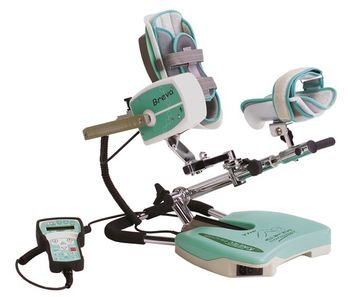
Kinetec Breva
 Kinetec · Model Breva
Two dimensional movements possible: > Plantar Flexion 40° to Dorsiflexion 30° > Eversion 25° to Inversion 25°. Advanced hand control to maximise programs and protocols. Passive mobilisation of the following fractures after internal fixation: > Malleolar fractures > Tibial pilon fractures > Talar fractures > Calcaneal fractures. Warm-Up: Offers the patient a gradual progression to the pre-set full ROM. Modulation: Allows manual setting of the ROM end-point based on patient tolerance. ROM By Pass: Allows bypassing the pre-set ROM end points during the current treatment session. Programme: Allows set-up of up to 16 customised programmes. Timer: Adjustment of the session time. Force: Work out of Concentric / Eccentric. Pause: Adjustable in extension or flexion limit. Allowing the rest or the posture. Mobilisation of the joints of the foot after operative or conservative treatment of lesions of the: > Achilles tendon > Lateral collateral ligament > Medial collateral ligament > Surgical lengthening of the Achilles tendon for post-traumatic stiffness.
Key tips
- ·Most "no output" stim-unit complaints are cable-side - check electrode/lead continuity before assuming a unit fault.
- ·Frame and strap wear on mechanical rehab equipment is a real fall/injury risk - don't defer it as cosmetic.
Typical Failure Modes
Compiled for this model from its own documentation and established engineering knowledge for this equipment class - not from a verified service record. Confirm against the manufacturer's service manual.
Motor / actuator / drive will not run or is weak
HighSymptoms: Traction force not applied, CPM carriage will not move or stalls, drive assist weak, motion one direction only.
Root cause: Worn drive motor / leadscrew / actuator, a hand-control fault, or a control-board fault.
Force / range / position inaccuracy
MediumSymptoms: Set traction force or CPM angle not reached, load cell drifts, carriage overshoots or stalls short.
Root cause: Load-cell / position-sensor drift, a potentiometer fault, or a limit-switch fault.
Hand control / patient-control fault
MediumSymptoms: Hand control unresponsive, the patient stop / reverse button does not work.
Root cause: Worn hand control or a damaged cable.
Frame / bearing / cable wear
MediumSymptoms: Rough or noisy travel, play in the carriage, frayed traction cord or rope.
Root cause: Worn bearings / slides or a frayed cable / cord.
Power / battery fault
LowSymptoms: Will not power on, short battery run time.
Root cause: Power supply / fuse or an aged battery.
Serviceable Parts & Consumables
Serviceable items for this model, compiled from its documentation and engineering knowledge for this equipment class. Service class and relative cost are estimates, not manufacturer figures; no part numbers are given. Confirm intervals and pricing against the manufacturer.
Drive motor / leadscrew / actuator
Class Major service partRel. cost $$$R&R Difficult
Load cell / position sensor / potentiometer
Class Major service partRel. cost $$R&R Moderate
Hand control
Class Periodic replacementRel. cost $$R&R Fairly easy
Bearings / slides / traction cord
Class Periodic replacementRel. cost $$R&R Moderate
Power supply / fuse / battery
Class Major service partRel. cost $R&R Moderate
| Part | Service class | Relative cost | R&R difficulty |
|---|---|---|---|
| Drive motor / leadscrew / actuator | Major service part | $$$ | Difficult |
| Load cell / position sensor / potentiometer | Major service part | $$ | Moderate |
| Hand control | Periodic replacement | $$ | Fairly easy |
| Bearings / slides / traction cord | Periodic replacement | $$ | Moderate |
| Power supply / fuse / battery | Major service part | $ | Moderate |
Relative cost: $ lowest · $$$$ highest service-part cost for this equipment class. Not a price.
PM Checklist
Preventive-maintenance tasks typical of this equipment class. Perform to the manufacturer's procedure and your facility's policy - this is general reference, not a schedule for this specific unit.
- ·Frame and strap wear inspection
- ·Electrode lead continuity check
- ·Annual electrical safety test
Troubleshooting Approach
A starting sequence for this model, compiled from its documentation and engineering knowledge for this equipment class. Follow the manufacturer's service documentation for the actual procedure.
Symptom: Motor / actuator will not run
- Confirm mains / battery and that any e-stop / patient stop is released.
- Try the hand control and, if fitted, the unit buttons to isolate the control.
- Listen for the drive motor and check the leadscrew is not jammed.
- Replace the hand control, motor or control board as isolated.
- Verify the achieved force / range against a reference after repair.
Symptom: Force or range not reached
- Run the calibration / homing routine.
- Check the load-cell / position sensor and the limit switches.
- Verify with a known weight (traction) or a goniometer (CPM).
- Replace the sensor if it drifts.
- Re-verify and confirm the patient stop works.
Technical Specs
- Height
- 56 cm
- Length
- 45 cm
- Weight
- 12.5 kg
- Width
- 37 cm
Typical Location
Where this class of equipment is typically deployed - general reference, not this unit's own placement record.
- Physical therapy / rehab gym
- Outpatient rehab clinic
- Sports medicine
Documents & Manuals
No documents available for this device yet.
Troubleshoot this device with Bio
Describe a symptom or error code. Bio answers from this device's own documented error codes, failure modes, parts, and guides.
Ask Bio