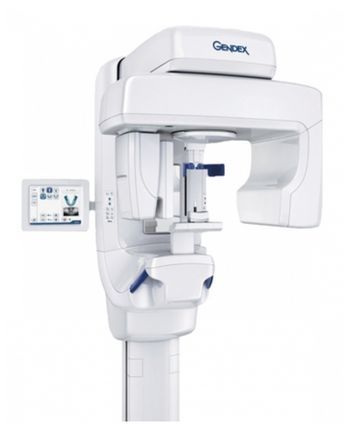
KaVo Gendex GXDP-700 PANOREX
 KaVo · Model Gendex GXDP-700 PANOREX
Panoramic The Gendex GXDP-700 panoramic x-ray system delivers 33 different panoramic programs - 11 options for three different patient sizes - including bitewing and TMJ, orthogonals, frontal dentition, sinus, and more. SmartLogic Technology stores the most frequently used settings, reducing set up time and optimizing workflow. Bitewing Program Gendex GXDP-700 panoramic system features a bitewing-like view for a quick and easy alternative to intraoral bitewing x-rays. (NOTE: Subject to Availability) CEPH Upgradeable As your practice grows, the Gendex GXDP-700 can be upgraded with a cephalometric arm for premium cephalometric imaging. Single or dual sensor models are available for this Gendex x-ray model. (NOTE: Subject to Availability) High Quality Images With powerful imaging tools such as EasyPosition, which automatically adjusts the x-ray beam based on the patient's anatomy and SmartMotion that reduces spinal artifacts, any member of your team can easily acquire clear, detailed dental radiography images each and every time. Premium System The top-of-the-line model in the Gendex x-ray product portfolio, the Gendex GXDP-700 panoramic x-ray system delivers superior image quality, reliability, and ease of use. 3d Upgradeable Gendex GXDP-700 offers two upgradeable 3D field of view (FOV) options. Focused FOV (6 x 4 cm) is optimized for local diagnostics such as single implant planning, third molar extractions, and endodontic procedures. The system's mid-FOV (6 x 8 cm) includes the complete dental arch for multiple implant placement and procedures requiring surgical guides. (NOTE: Subject to Availability) Twain Integration Images captured with Gendex GXDP-700 can be easily integrated into almost any dental imaging software.
Key tips
- ·Biological-indicator verification applies to dental sterilizers exactly the same as hospital CSSD - no exception for smaller units.
- ·"Sounds different" is often the first real report of handpiece bearing wear, not an outright failure - investigate early rather than waiting.
Typical Failure Modes
Compiled for this model from its own documentation and established engineering knowledge for this equipment class - not from a verified service record. Confirm against the manufacturer's service manual.
No or inconsistent exposure
HighSymptoms: No image, exposure will not trigger, images consistently under- or over-exposed, error code.
Root cause: Tube-head fault, an exposure-switch / timer fault, HV / generator fault, or a sensor / PSP-plate fault.
Sensor / imaging-plate fault (digital)
MediumSymptoms: Dead lines, artefacts, no image from the sensor, PSP plate scratched / fogged.
Root cause: Damaged intraoral sensor / cable, or worn PSP plates.
Pano / CBCT motion or reconstruction fault
MediumSymptoms: Blurred or distorted panoramic image, layer / focal-trough errors, reconstruction fails.
Root cause: Rotation drive / belt / encoder, patient-positioning error, or the reconstruction PC.
Tube-arm / balance fault
MediumSymptoms: Tube head drifts, will not stay positioned, arm joints loose.
Root cause: Worn arm springs / friction joints.
Software / acquisition fault
LowSymptoms: Images will not acquire, save or display in the practice-management software.
Root cause: TWAIN / driver, the acquisition PC, or the software.
Serviceable Parts & Consumables
Serviceable items for this model, compiled from its documentation and engineering knowledge for this equipment class. Service class and relative cost are estimates, not manufacturer figures; no part numbers are given. Confirm intervals and pricing against the manufacturer.
Intraoral sensor & cable / PSP plates
Class Periodic replacementRel. cost $$$R&R Fairly easy
Tube head / HV components
Class Major service partRel. cost $$$$R&R Difficult
Exposure switch / timer board
Class Major service partRel. cost $$R&R Moderate
Pano rotation drive / belt / encoder
Class Major service partRel. cost $$$R&R Difficult
Tube-arm spring / friction-joint kit
Class Major service partRel. cost $$R&R Moderate
| Part | Service class | Relative cost | R&R difficulty |
|---|---|---|---|
| Intraoral sensor & cable / PSP plates | Periodic replacement | $$$ | Fairly easy |
| Tube head / HV components | Major service part | $$$$ | Difficult |
| Exposure switch / timer board | Major service part | $$ | Moderate |
| Pano rotation drive / belt / encoder | Major service part | $$$ | Difficult |
| Tube-arm spring / friction-joint kit | Major service part | $$ | Moderate |
Relative cost: $ lowest · $$$$ highest service-part cost for this equipment class. Not a price.
PM Checklist
Preventive-maintenance tasks typical of this equipment class. Perform to the manufacturer's procedure and your facility's policy - this is general reference, not a schedule for this specific unit.
- ·Daily handpiece lubrication and autoclave cycle verification
- ·Compressor moisture-trap draining
- ·Annual full PM
Troubleshooting Approach
A starting sequence for this model, compiled from its documentation and engineering knowledge for this equipment class. Follow the manufacturer's service documentation for the actual procedure.
Symptom: No or inconsistent exposure
- Confirm the exposure switch is held for the full exposure and the door / warning light works.
- Check the selected technique factors and any error code.
- Test the sensor / plate on a phantom.
- Verify tube output and timer accuracy with a dental X-ray meter.
- Escalate a confirmed tube-head / HV fault to the OEM.
Symptom: Poor sensor or pano image
- Swap in a known-good sensor / fresh PSP plate.
- Inspect the sensor cable for kinks / breaks.
- For pano, confirm patient positioning and the focal trough / layer selection.
- Run any image-calibration routine.
- Replace the sensor or refer the pano drive as isolated.
Typical Location
Where this class of equipment is typically deployed - general reference, not this unit's own placement record.
- Dental operatory
- Oral surgery suite
- CSSD (dental sterilizers)
Documents & Manuals
No documents available for this device yet.
Troubleshoot this device with Bio
Describe a symptom or error code. Bio answers from this device's own documented error codes, failure modes, parts, and guides.
Ask Bio