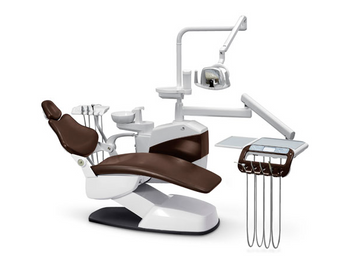
JOINCHAMP ZC-S400
 JOINCHAMP · Model ZC-S400
Equipped with 9 memory positions, the dental unit can be set by three dentists A, B and C. Every dentist can set three commonly-used chair positions Spitting position: During the treatment, when the patient needs to spit saliva or dirt, just press the "spitting" button, the dental chair will switch from the treatment position to the spit position, which is very convenient. The light will automatically turn off (if it is on) and the flushing water will turn on automatically; after spitting, press the "spitting" button again, the dental chair will return to the treatment position. At this time, the light will turn on and the flushing water will stop automatically. Chair interlock system: During treatment, when the dentist uses a handpiece or a scaler, all movements of the dental chair are locked to prevent accidental injury due to the malfunction of the dental chair. Pads on the tray can be removed and disinfected, convenient and hygienic. Top-mounted doctor table with hided air lock valve can be adjusted to the height as you need. Precise design of the rod can be easily pulled out and put back without any traction force, more flexible to operate at large angles, avoiding the dropping of handpieces and giving the best operational experience to dentist. Handpiece pad can be removed and disinfected, easy for cleaning. It¼s convenient to remove the stainless steel tray for disinfection and cleaning.
Key tips
- ·Biological-indicator verification applies to dental sterilizers exactly the same as hospital CSSD - no exception for smaller units.
- ·"Sounds different" is often the first real report of handpiece bearing wear, not an outright failure - investigate early rather than waiting.
Typical Failure Modes
Compiled for this model from its own documentation and established engineering knowledge for this equipment class - not from a verified service record. Confirm against the manufacturer's service manual.
Output / performance below spec
HighSymptoms: Compressor will not build pressure / cycles constantly; vacuum weak; curing light low irradiance; scanner poor scans.
Root cause: Wear in the core mechanism (compressor head, vacuum pump, LED / lamp, scanner optics) or a control fault.
Water / moisture / drain fault (compressor)
MediumSymptoms: Water in the air lines, drain not working, desiccant exhausted.
Root cause: Auto-drain fault or an exhausted air-dryer / desiccant.
Overheating / thermal cut-out
MediumSymptoms: Unit stops after a period, hot, restarts when cool.
Root cause: Cooling-fan fault, a blocked intake, or a worn motor.
Control / switch / timer fault
MediumSymptoms: Will not start / stop on demand, timer or mode selection unresponsive.
Root cause: Pressure switch, timer, or control board.
Noise / vibration
LowSymptoms: Loud operation, rattling, walking across the floor.
Root cause: Worn mounts, bearings, or loose panels.
Serviceable Parts & Consumables
Serviceable items for this model, compiled from its documentation and engineering knowledge for this equipment class. Service class and relative cost are estimates, not manufacturer figures; no part numbers are given. Confirm intervals and pricing against the manufacturer.
Core mechanism rebuild kit (compressor head / pump / LED)
Class Periodic replacementRel. cost $$R&R Moderate
Air-dryer / desiccant / auto-drain (compressor)
Class Frequent wear itemRel. cost $R&R Fairly easy
Cooling fan
Class Periodic replacementRel. cost $R&R Fairly easy
Pressure switch / timer / control board
Class Major service partRel. cost $$R&R Moderate
Anti-vibration mounts / bearings
Class Periodic replacementRel. cost $R&R Moderate
| Part | Service class | Relative cost | R&R difficulty |
|---|---|---|---|
| Core mechanism rebuild kit (compressor head / pump / LED) | Periodic replacement | $$ | Moderate |
| Air-dryer / desiccant / auto-drain (compressor) | Frequent wear item | $ | Fairly easy |
| Cooling fan | Periodic replacement | $ | Fairly easy |
| Pressure switch / timer / control board | Major service part | $$ | Moderate |
| Anti-vibration mounts / bearings | Periodic replacement | $ | Moderate |
Relative cost: $ lowest · $$$$ highest service-part cost for this equipment class. Not a price.
PM Checklist
Preventive-maintenance tasks typical of this equipment class. Perform to the manufacturer's procedure and your facility's policy - this is general reference, not a schedule for this specific unit.
- ·Daily handpiece lubrication and autoclave cycle verification
- ·Compressor moisture-trap draining
- ·Annual full PM
Troubleshooting Approach
A starting sequence for this model, compiled from its documentation and engineering knowledge for this equipment class. Follow the manufacturer's service documentation for the actual procedure.
Symptom: Output below spec
- Measure the actual output (pressure / vacuum / irradiance) against the spec.
- Inspect the core mechanism for wear.
- Check filters, intakes and drains.
- Rebuild or replace the core mechanism.
- Re-verify output after service.
Symptom: Overheats or will not start on demand
- Confirm airflow and clean the intake / fan.
- Check the pressure switch / timer operates.
- Let it cool and check the thermal cut-out.
- Replace the switch, fan or motor as isolated.
- Confirm normal duty-cycle operation.
Typical Location
Where this class of equipment is typically deployed - general reference, not this unit's own placement record.
- Dental operatory
- Oral surgery suite
- CSSD (dental sterilizers)
Documents & Manuals
No documents available for this device yet.
Troubleshoot this device with Bio
Describe a symptom or error code. Bio answers from this device's own documented error codes, failure modes, parts, and guides.
Ask Bio