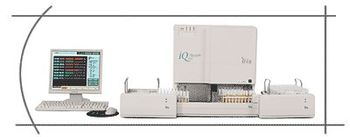
Iris Diagnostics iQ200 Sprint
 Iris Diagnostics · Model iQ200 Sprint
Specimen preparation and sampling Image recognition and classification Auto-Particle Recognition (APR™) counts and classifies 12 particles RBC WBC WBC clumps Squamous epithelial cells Non-squamous epithelial cells Hyaline casts Unclassified Casts Crystals Yeast Bacteria Sperm Mucus Quantitative report collates Chemistry and Microscopy results on the monitor screen Review/Release Options Auto-release based on user-defined criteria Operator review of an on-screen visual display of results based on user-defined threshold values prior to release Operator review of images for sub-classification, if necessary Pathological casts Non-squamous epithelial cells Crystals Yeast Other Images Maybe exported for remote consultation May be copied to CD disk for training purposes May be sub-classified, if necessary Unclassified casts Granular Cellular Waxy Broad RBC WBC Epithelial cell Fatty Crystals Calcium oxalate Triple phosphate Calcium phosphate Uric acid Calcium carbonate Leucine Cystine Tyrosine Amorphous Non-squamous Epithelial Cells Renal epithelial Transitional epithelial Yeast Budding yeast Yeast with pseudohyphae Other RBC Clumps Fat Oval fat bodies Trichomonas.
Key tips
- ·Run QC controls before trusting any repair - an analyzer that passes self-test can still report clinically wrong results.
- ·Rule out a reagent lot change before opening the instrument - it can look exactly like a hardware fault.
- ·Centrifuge rotors have a hard retirement age/cycle limit regardless of visible condition - don't eyeball it.
Typical Failure Modes
Compiled for this model from its own documentation and established engineering knowledge for this equipment class - not from a verified service record. Confirm against the manufacturer's service manual.
Result / QC failure
HighSymptoms: Strip results flagged or biased, QC out of range, colour blocks misread.
Root cause: Expired or mishandled strips, a dirty / aged optics head, or a calibration issue.
Strip transport / feed fault
MediumSymptoms: Strip not transported, jams, or read at the wrong position.
Root cause: Worn strip-transport belt / tray or a position-sensor fault.
Optics / reflectance-head fault
MediumSymptoms: Repeated optics errors, non-uniform reads across the pads.
Root cause: Contaminated or aged reflectance LEDs / optics.
Sediment / microscopy module fault (if fitted)
MediumSymptoms: Poor particle images, flow-cell or camera errors.
Root cause: Flow-cell contamination, a pump fault, or the camera / focus.
Printer / LIS fault
LowSymptoms: No printout, results not sent to the LIS.
Root cause: Printer or the interface configuration.
Serviceable Parts & Consumables
Serviceable items for this model, compiled from its documentation and engineering knowledge for this equipment class. Service class and relative cost are estimates, not manufacturer figures; no part numbers are given. Confirm intervals and pricing against the manufacturer.
Strip transport belt / tray
Class Periodic replacementRel. cost $$R&R Moderate
Optics / reflectance head
Class Major service partRel. cost $$R&R Moderate
Calibration strips / QC
Class Frequent wear itemRel. cost $R&R Easy
Sediment flow cell / pump tubing (if fitted)
Class Frequent wear itemRel. cost $$R&R Moderate
Printer / paper
Class Periodic replacementRel. cost $R&R Fairly easy
| Part | Service class | Relative cost | R&R difficulty |
|---|---|---|---|
| Strip transport belt / tray | Periodic replacement | $$ | Moderate |
| Optics / reflectance head | Major service part | $$ | Moderate |
| Calibration strips / QC | Frequent wear item | $ | Easy |
| Sediment flow cell / pump tubing (if fitted) | Frequent wear item | $$ | Moderate |
| Printer / paper | Periodic replacement | $ | Fairly easy |
Relative cost: $ lowest · $$$$ highest service-part cost for this equipment class. Not a price.
PM Checklist
Preventive-maintenance tasks typical of this equipment class. Perform to the manufacturer's procedure and your facility's policy - this is general reference, not a schedule for this specific unit.
- ·Daily QC controls run and reviewed
- ·Calibration verification per assay
- ·Routine cleaning and decontamination
- ·Scheduled reagent-path and pump-tubing maintenance
Error Codes
Extracted directly from this unit's own service manual.
MC State 153 Sequence 6Focus dial not moving
Troubleshooting Approach
A starting sequence for this model, compiled from its documentation and engineering knowledge for this equipment class. Follow the manufacturer's service documentation for the actual procedure.
Symptom: QC / calibration failure across a channel or the whole system
- Run fresh controls at all levels and note which analytes fail.
- Confirm reagents are in date, correctly loaded, mixed and not bubbled.
- Run the photometer / lamp-energy check and replace the lamp if energy is low.
- Clean the sample and reagent probes, the mixers and the wash / cuvette-wash stations.
- Recalibrate the affected assay / ISE module and re-run QC.
Symptom: Sample or reagent probe clog / crash / short aspiration
- Inspect the probe for a bend or blockage and clear it (wire / sonicate per the manual).
- Run the fluidics prime and the probe-wash cycle.
- Check for a clot or fibrin in the sample and the liquid-level sensing.
- Verify probe positioning / alignment.
- Replace the probe if aspiration is still short.
Symptom: ISE electrolyte results biased or noisy / ISE calibration fails
- Run the ISE calibration and check the slope / drift against spec.
- Replace an ISE electrode or the reference that is at end of life.
- Check the ISE pinch valves and tubing for wear or air.
- Confirm the ISE standard packs are in date.
- Re-run ISE QC before releasing electrolyte results.
Symptom: High cuvette blanks / position-dependent results
- Run the cuvette blank / photometric check.
- Clean or replace worn / scratched cuvettes or the reaction segment.
- Check the cuvette-wash station nozzles and drying.
- Confirm the water / DI supply quality.
- Recalibrate and re-run QC.
Typical Location
Where this class of equipment is typically deployed - general reference, not this unit's own placement record.
- Central / core laboratory
- Point-of-care testing stations
- Blood bank
- Microbiology lab
Documents & Manuals
Safety & Recalls
Synced live from the FDA openFDA API.
- RECALL
The firm initiated this recall because complaints from customers reported that the recovery compared to assigned assay values is significantly below specification. This results in the instrument not passing controls and the customer not being able to run patient samples.
- RECALL
The firm recalled after it received complaints of IRISpec CA/CB two part Urine Chemistry Control, 101131-12, where the nitrite results read negative for the part B control, which should be positive.
Troubleshoot this device with Bio
Describe a symptom or error code. Bio answers from this device's own documented error codes, failure modes, parts, and guides.
Ask Bio