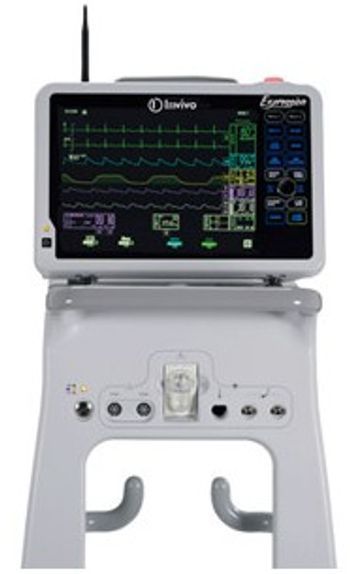
Invivo Expression
 Invivo · Model Expression
Express Service module exchange reduces system down time to about an hour. Express Wireless ECG with enhanced electrode positioning. Express Wireless OR quality SpO2 with Neo, Infnant, Pediatric and Adult Quick Connect Sensors. Ultra Advanced Gradient Removal algorithms provide stable traces even during Perfusion, SWI and Diffusion MRI sequences. Enhancing MRI Safety - FDA rated at 5,000 Gauss, 3.0 Tesla and 4 W/Kg SAR. Direct Wireless Communication does not require the installation of any expensive and restrictive wireless networks. Continuous Temperature for Esophageal, Rectal, Nasal and surface temperature. Disposable sensors for all vital signs optimizes infection control. Reusable sensors help reduce operating costs. Precision EtCO2 with OR traces. Express Dual Anesthetic Agent technology with automatic identification is fully functional in less than 30 seconds. 360 Degree Alarm Light notifies you of an alarm condition when traditional alarms are compromised. Active Trend Arrows adds depth to each vital signs helping you identify patient conditions earlier. Perfusion Index provides confidence in the SpO2 saturation levels helping you setup and treat the patient faster. Easy Read Wireless Displays feature a new vivid LCD, tilting for glare free viewing and illuminated buttons. Individual Electrode Indicator increases safety and efficiency by alerting you to a compromised individual electrode location. User enabled T Wave Suppression allows you to normalize the waveform from the control room for unparalleled gating efficiency. Custom Labeled Setups with Express Recall buttons on each display. Battery Life Indicators on every display provides information down to the minute for all Expression components. Printing capabilities in the MRI suite and control room. Every component features user replaceable batteries allowing for continuous monitoring from each component. Express Workflow Bastet enables quick patient setup. Express gating enables wireless communication between Expression and MRI Systems. Quick Connect Non Invasive Blood Pressure with 11 new sizes of blood pressure cuffs.
Key tips
- ·A no-signal/flatline alarm gets checked on the patient first, not the monitor - rule out a real clinical event before troubleshooting.
- ·Recalibrate NIBP against a reference manometer, not just a self-test pass.
- ·Reused patient cables (SpO2, ECG leads) are a common source of intermittent-fault complaints - swap the cable before the module.
Typical Failure Modes
Compiled for this model from its own documentation and established engineering knowledge for this equipment class - not from a verified service record. Confirm against the manufacturer's service manual.
A parameter drops out or reads wrong
HighSymptoms: ECG, IBP, SpO2, temperature, CO2 or CO intermittently drops or is implausible.
Root cause: Worn patient cable / sensor, or a parameter-module / input-board fault.
NIBP will not measure or is inaccurate
MediumSymptoms: NIBP times out, cuff will not inflate / hold, readings implausible.
Root cause: Internal NIBP pump or valve, a cuff / hose leak, or a pressure-transducer fault.
Module / parameter not recognised
MediumSymptoms: The host does not display a plugged-in module or a built-in parameter.
Root cause: Docking / connector fault or an internal board fault.
Display / touchscreen fault
MediumSymptoms: Blank, dim or distorted display; unresponsive touchscreen.
Root cause: Display, backlight, or controller fault.
Battery / power fault
MediumSymptoms: Short battery run time, will not hold charge, will not power on.
Root cause: Aged battery pack or a power-supply fault.
Network / central-station connectivity fault
LowSymptoms: Monitor not shown at the central station, admit fails, intermittent drop.
Root cause: Wired / Wi-Fi network configuration or a communication board.
Serviceable Parts & Consumables
Serviceable items for this model, compiled from its documentation and engineering knowledge for this equipment class. Service class and relative cost are estimates, not manufacturer figures; no part numbers are given. Confirm intervals and pricing against the manufacturer.
Patient cable set (ECG / IBP / SpO2 / temp)
Class Frequent wear itemRel. cost $$R&R Easy
NIBP cuff and hose
Class Frequent wear itemRel. cost $R&R Easy
Internal NIBP pump / valve
Class Major service partRel. cost $$$R&R Difficult
Parameter module / input board
Class Major service partRel. cost $$$R&R Difficult
Battery pack
Class Periodic replacementRel. cost $$R&R Fairly easy
Display / touchscreen assembly
Class Major service partRel. cost $$$R&R Moderate
| Part | Service class | Relative cost | R&R difficulty |
|---|---|---|---|
| Patient cable set (ECG / IBP / SpO2 / temp) | Frequent wear item | $$ | Easy |
| NIBP cuff and hose | Frequent wear item | $ | Easy |
| Internal NIBP pump / valve | Major service part | $$$ | Difficult |
| Parameter module / input board | Major service part | $$$ | Difficult |
| Battery pack | Periodic replacement | $$ | Fairly easy |
| Display / touchscreen assembly | Major service part | $$$ | Moderate |
Relative cost: $ lowest · $$$$ highest service-part cost for this equipment class. Not a price.
PM Checklist
Preventive-maintenance tasks typical of this equipment class. Perform to the manufacturer's procedure and your facility's policy - this is general reference, not a schedule for this specific unit.
- ·Routine cable and lead-wire inspection for fraying/wear
- ·Battery conditioning cycle
- ·NIBP calibration check against a reference manometer
- ·ECG / SpO2 accuracy verification against a patient simulator
- ·Annual electrical safety test
Error Codes
Extracted directly from this unit's own service manual.
NOT INFLATINGerror message displayed in the NIBP menu when the pump shuts off within 6 seconds 1.5 seconds during leak test with PATIENT mode set to NEO and all cuff connections removed and all NIBP ports open
CALIB messagemessage appears within 30 seconds when the unit is not in STANDBY mode and 15mmHg pressure is applied and the NIBP START/STOP key is pushed
OVRreading out of tolerance for 250 mmHg in Table 4 pressure transducer simulator test
change the simulator and cable, then repeat the test. If the test fails a total of 3 times after 3 unique simulators and cables, the IBP module is faulty
CO2 OCCLUSIONmessage displayed within 30 seconds when the sample line input is blocked during agents flow test or ETCO2 flow test
READJUSTING CO2 ZEROdisplayed at the top center of the DCU screen during ETCO2 flow test verification when ZERO CAL is selected
Troubleshooting Approach
A starting sequence for this model, compiled from its documentation and engineering knowledge for this equipment class. Follow the manufacturer's service documentation for the actual procedure.
Symptom: A parameter drops out or reads wrong (ECG / IBP / SpO2 / temp / CO2 / CO)
- Reseat the patient cable at the module and at the monitor.
- Swap in a known-good cable / sensor for that parameter and re-test.
- Move the module to another host or slot to tell module from host.
- Inspect the module docking connector for bent or recessed pins.
- Verify against a patient simulator; replace the cable, or refer the parameter module / input board if the fault stays with it.
Symptom: NIBP will not measure or is inaccurate
- Leak-test the cuff and hose (occlude and watch for pressure decay).
- Run the monitor's NIBP calibration-verification against a calibrated manometer.
- Confirm correct cuff size and placement and check for a kinked hose.
- Verify against a NIBP simulator at several pressures.
- Refer the monitor for internal pump / valve service if it still fails.
Symptom: Blank / dim / frozen display or unresponsive touchscreen
- Power-cycle the monitor fully (mains removed, battery out where possible).
- Check the display backlight and the display / touchscreen cable.
- Note any boot or self-test error code.
- Re-calibrate the touchscreen if the touch offset is the issue.
- Replace the display / touchscreen assembly or refer the main board.
Symptom: Not shown at the central station / network dropout
- Confirm the wired drop or Wi-Fi settings and that other monitors on that segment are online.
- Check the monitor's network address / unit-bed assignment and re-admit.
- Reseat the network card / cable.
- Restart the monitor's network interface.
- Escalate a whole-unit outage to the central-station server / IT.
Typical Location
Where this class of equipment is typically deployed - general reference, not this unit's own placement record.
- ICU / CCU
- Emergency Department
- OR / PACU
- General med-surg floors
- Step-down units
- Telemetry units
Documents & Manuals
Safety & Recalls
Synced live from the FDA openFDA API.
- RECALL
The MR 200 devices failed the initial power up test due to capacitor short and hi-pot testing; possible loss of Patient Monitoring or User/Service Electrical Shock.
- RECALL
Frozen Display Numerics and Disabled Menu Keys after extended run time. This customer notification was sent August 22, 2014.
- RECALL
During production, excess metal (aluminum) debris was found stuck to the cling plastic that covers the device's pole assembly. The metallic debris could affect system performance due to the potential for a failure to power up or loss of power. This could result in the loss of monitoring and a delay in diagnosis of the patient.
- RECALL
Failure to produce the Non-Invasive Blood Pressure (NIBP) Measurement.
- RECALL
The wireless function of the IP5 radio could be interrupted causing loss of wireless communication between the IP5 and host monitoring system.
- RECALL
Invivo Corporation located at 12151 Research Parkway, Orlando, FL 32826 is recalling the Expression Information Portal (Model IP5). Upon power up, the IP5 may fail to produce audio.
- RECALL
Invivo Corporation located at 12151 Research Parkway, Orlando, FL 32826 is recalling their Expression Information Portal (Model IP5). Three different IP5 devices lost audio during use.
- RECALL
Invivo Corporation located at 12151 Research Parkway, Orlando, FL 32826 is recalling the Expression MRI Patient Monitoring System because during transport of the systems cart with a docked Display Controller Unit (DCU), a caster (wheel) may become detached. If this occurs, the cart can become unbalanced and may fall.
- RECALL
Philips Invivo Corporation of Orlando, FL is recalling their Expression MRI Patient Monitoring System. During transport of the system's cart with a docked Display Controller Unit (DCU), a front caster (wheel) may become loose and fall off causing the cart to become unbalanced and fall.
Troubleshoot this device with Bio
Describe a symptom or error code. Bio answers from this device's own documented error codes, failure modes, parts, and guides.
Ask Bio