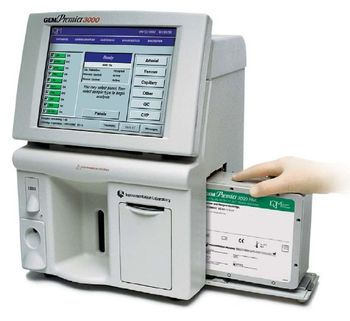
Instrumentation Laboratory GEM Premier 3000
 Instrumentation Laboratory · Model GEM Premier 3000
Flexible test menu includes pH, pO2, pCO2, hematocrit, electrolytes and metabolites. Disposable multi-use cartridge contains everything you need: sensors, solutions, waste bag, tubing, even the sampler. Maintenance-free - just replace the cartridge every three weeks iQM, IL's proprietary Intelligent Quality Management system, performs continuous quality control. GEMweb® software provides access to any networked analyzer to view results, monitor performance and deploy standard configurations.
Key tips
- ·Run QC controls before trusting any repair - an analyzer that passes self-test can still report clinically wrong results.
- ·Rule out a reagent lot change before opening the instrument - it can look exactly like a hardware fault.
- ·Centrifuge rotors have a hard retirement age/cycle limit regardless of visible condition - don't eyeball it.
Typical Failure Modes
Compiled for this model from its own documentation and established engineering knowledge for this equipment class - not from a verified service record. Confirm against the manufacturer's service manual.
Sensor / electrode fault or drift
HighSymptoms: pH, pCO2, pO2, electrolyte, glucose / lactate or CO-oximetry results flagged, QC fails, stability / response errors.
Root cause: An electrode / membrane at end of life, an air bubble or protein in the measuring path, or a calibration fault.
Sample-path / inlet clog or clot
MediumSymptoms: Sample not aspirated, clot detected, inlet / preheater alarm.
Root cause: Clot in the inlet probe / preheater, or a worn inlet gasket.
Solution / cartridge / gas / waste fault
MediumSymptoms: Reagent-empty, gas-supply or waste-full alarm, calibration fails.
Root cause: Empty or expired solution pack / cartridge, an empty / expired gas cylinder, or a full waste container.
Pump / valve / pneumatic fault
MediumSymptoms: Poor sample transport, calibration or rinse failures, pressure alarms.
Root cause: Worn peristaltic pump tubing, a pinch-valve fault, or a pneumatic-pressure fault.
CO-oximetry / optical fault
MediumSymptoms: tHb, sO2 or dyshaemoglobin results implausible, optics / lamp error.
Root cause: Optics contamination, a lamp fault, or the haemolyser.
Serviceable Parts & Consumables
Serviceable items for this model, compiled from its documentation and engineering knowledge for this equipment class. Service class and relative cost are estimates, not manufacturer figures; no part numbers are given. Confirm intervals and pricing against the manufacturer.
Sensor cassette / individual electrodes & membranes
Class Frequent wear itemRel. cost $$$R&R Fairly easy
Solution pack / reagent cartridge
Class ConsumableRel. cost $$R&R Easy
Calibration gas cylinder
Class Frequent wear itemRel. cost $$R&R Easy
Peristaltic pump tubing / pinch valves
Class Frequent wear itemRel. cost $R&R Moderate
Inlet probe / preheater gasket
Class Frequent wear itemRel. cost $R&R Fairly easy
| Part | Service class | Relative cost | R&R difficulty |
|---|---|---|---|
| Sensor cassette / individual electrodes & membranes | Frequent wear item | $$$ | Fairly easy |
| Solution pack / reagent cartridge | Consumable | $$ | Easy |
| Calibration gas cylinder | Frequent wear item | $$ | Easy |
| Peristaltic pump tubing / pinch valves | Frequent wear item | $ | Moderate |
| Inlet probe / preheater gasket | Frequent wear item | $ | Fairly easy |
Relative cost: $ lowest · $$$$ highest service-part cost for this equipment class. Not a price.
PM Checklist
Preventive-maintenance tasks typical of this equipment class. Perform to the manufacturer's procedure and your facility's policy - this is general reference, not a schedule for this specific unit.
- ·Daily QC controls run and reviewed
- ·Calibration verification per assay
- ·Routine cleaning and decontamination
- ·Scheduled reagent-path and pump-tubing maintenance
Troubleshooting Approach
A starting sequence for this model, compiled from its documentation and engineering knowledge for this equipment class. Follow the manufacturer's service documentation for the actual procedure.
Symptom: Sensor / electrode fault or drift / QC failure
- Run the relevant calibration and check the sensor / electrode status screen.
- De-bubble / rinse the measuring path and check for protein deposits.
- Replace an electrode / membrane / sensor cassette at end of life or that fails calibration.
- Confirm the solution pack / reagent cartridge and calibration gas are in date and not empty.
- Re-run QC at the relevant levels before releasing results.
Symptom: Sample not aspirated / clot / inlet alarm
- Run the inlet / preheater clot-removal or rinse routine.
- Inspect the inlet probe and gasket.
- Replace the inlet gasket or probe.
- Confirm free sample aspiration with a QC sample.
- Replace worn peristaltic pump tubing if transport is still poor.
Symptom: Result flagged / questionable vs the clinical picture
- Repeat with a fresh sample / strip / cassette from correctly stored, in-date stock.
- Run the QC controls at each level.
- Confirm the meter / analyzer is coded / calibrated to the current lot.
- Clean the measurement chamber / strip port and the optics per the manual.
- Quarantine the lot if QC fails; refer the analyzer if QC passes but a result still looks wrong.
Symptom: Will not power on / short battery life / strip-port fault (handhelds)
- Fit fresh batteries or confirm the charger / dock.
- Clean the strip-port contacts / optics.
- Try several strips from a fresh vial.
- Replace the battery.
- Replace the meter if it will not read known-good strips.
Technical Specs
- Height
- 43.2 cm
- Length
- 30.7 cm
- Weight
- 13.4 kg
- Width
- 30.5 cm
Typical Location
Where this class of equipment is typically deployed - general reference, not this unit's own placement record.
- Central / core laboratory
- Point-of-care testing stations
- Blood bank
- Microbiology lab
Documents & Manuals
Safety & Recalls
Synced live from the FDA openFDA API.
- RECALL
The active ingredient concentration in the lysing bag solution of specific GEM Premier 7000 with iQM3 PAK lots did not meet established manufacturing specifications. The malfunction could result in delayed recognition and management of Co-Oximetry and total bilirubin abnormalities and their sequelae.
- RECALL
BCR wands that received a configuration update (released under Service Information No. 2026-07 on or after April 8, 2026) may assign patient results to an incorrect patient ID. The root cause is a race condition introduced when the "price check" feature was disabled to reduce excess current draw. This causes buffered data from a previous scan to be transmitted instead of the most recent scan, populating a prior patient ID instead of the current one. This can result in erroneous results being attributed to the wrong patient, potentially leading to inappropriate clinical management.
- RECALL
Confirmed customer complaints indicating that GEM PAKs (cartridges) for the GEM Premier 5000 may experience an increased incidence of Process Control Solution Not Detected (PCSND) errors during warm-up, including consecutive occurrences, resulting in GEM PAK ejection and requiring insertion of a new GEM PAK. iQM2 is an active quality process control program designed to provide continuous monitoring of the entire testing process. Thus, if a GEM PAK completes AutoPAK Validation following warm-up, it may remain in use. Consecutive GEM PAK ejections during warm-up may prolong turnaround times, potentially delaying results. In such cases, patient management may require reassessment once results are available. While many GEM PAKs continue to perform as intended, consecutive ejections may increase the likelihood of operational disruption, highlighting the importance of advance planning where
- RECALL
Internal testing identified that the GEM Premier PAKs (cartridges) may exhibit an over-recovery (i.e., positive bias) of pO2 results in the low range (at pO2 levels less than 60 mmHg) that are outside of labeled performance specifications for pO2. The positive bias may lead to false positive for medical decision levels at pO2 < 60 mmHg, which may result in failure to detect and/or adequately treat hypoxemia and lead to a delay in treatment. The quality control procedures for the Non-iQM GEM Premier 3000 may not detect the non-conformance.
- RECALL
K+ results on the GEM Premier 4000 are too low when compared to a reference analyzer, with biases exceeding allowable error claim of a 0.5 moUL
- RECALL
Software upgrade: misuse of the barcode gun by repeatedly clicking can cause the instrument to attach test results to an incorrect patient ID.
- RECALL
Measurement (amperometric) spike can occur early in cartridge life on the glucose and lactate sensors during patient blood analysis, leading to erroneously high results
- RECALL
Instrument in Micro Sampling Mode failed to aspirate and no error code was generated and an incorrect patient report could result
- RECALL
Software error may report higher results for glucose and lactate
- RECALL
Incorrect bar code applied to cartridges could result in inaccurate pO2 value
Troubleshoot this device with Bio
Describe a symptom or error code. Bio answers from this device's own documented error codes, failure modes, parts, and guides.
Ask Bio