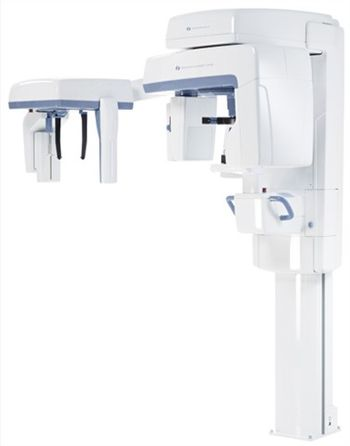
Instrumentarium ORTHOPANTOMOGRAPH OP300
 Instrumentarium · Model ORTHOPANTOMOGRAPH OP300
Complete versatility ORTHOPANTOMOGRAPH® OP300 is the most comprehensive 3-in-1 platform designed for today and tomorrow. OP300 combines an advanced panoramic imaging system with either cephalometric or cone beam 3D or a combination of both, giving you a truly adaptable platform. In addition, all of these options can be upgraded in the field after the initial purchase.
Key tips
- ·Biological-indicator verification applies to dental sterilizers exactly the same as hospital CSSD - no exception for smaller units.
- ·"Sounds different" is often the first real report of handpiece bearing wear, not an outright failure - investigate early rather than waiting.
Typical Failure Modes
Compiled for this model from its own documentation and established engineering knowledge for this equipment class - not from a verified service record. Confirm against the manufacturer's service manual.
No or inconsistent exposure
HighSymptoms: No image, exposure will not trigger, images consistently under- or over-exposed, error code.
Root cause: Tube-head fault, an exposure-switch / timer fault, HV / generator fault, or a sensor / PSP-plate fault.
Sensor / imaging-plate fault (digital)
MediumSymptoms: Dead lines, artefacts, no image from the sensor, PSP plate scratched / fogged.
Root cause: Damaged intraoral sensor / cable, or worn PSP plates.
Pano / CBCT motion or reconstruction fault
MediumSymptoms: Blurred or distorted panoramic image, layer / focal-trough errors, reconstruction fails.
Root cause: Rotation drive / belt / encoder, patient-positioning error, or the reconstruction PC.
Tube-arm / balance fault
MediumSymptoms: Tube head drifts, will not stay positioned, arm joints loose.
Root cause: Worn arm springs / friction joints.
Software / acquisition fault
LowSymptoms: Images will not acquire, save or display in the practice-management software.
Root cause: TWAIN / driver, the acquisition PC, or the software.
Serviceable Parts & Consumables
Serviceable items for this model, compiled from its documentation and engineering knowledge for this equipment class. Service class and relative cost are estimates, not manufacturer figures; no part numbers are given. Confirm intervals and pricing against the manufacturer.
Intraoral sensor & cable / PSP plates
Class Periodic replacementRel. cost $$$R&R Fairly easy
Tube head / HV components
Class Major service partRel. cost $$$$R&R Difficult
Exposure switch / timer board
Class Major service partRel. cost $$R&R Moderate
Pano rotation drive / belt / encoder
Class Major service partRel. cost $$$R&R Difficult
Tube-arm spring / friction-joint kit
Class Major service partRel. cost $$R&R Moderate
| Part | Service class | Relative cost | R&R difficulty |
|---|---|---|---|
| Intraoral sensor & cable / PSP plates | Periodic replacement | $$$ | Fairly easy |
| Tube head / HV components | Major service part | $$$$ | Difficult |
| Exposure switch / timer board | Major service part | $$ | Moderate |
| Pano rotation drive / belt / encoder | Major service part | $$$ | Difficult |
| Tube-arm spring / friction-joint kit | Major service part | $$ | Moderate |
Relative cost: $ lowest · $$$$ highest service-part cost for this equipment class. Not a price.
PM Checklist
Preventive-maintenance tasks typical of this equipment class. Perform to the manufacturer's procedure and your facility's policy - this is general reference, not a schedule for this specific unit.
- ·Daily handpiece lubrication and autoclave cycle verification
- ·Compressor moisture-trap draining
- ·Annual full PM
Troubleshooting Approach
A starting sequence for this model, compiled from its documentation and engineering knowledge for this equipment class. Follow the manufacturer's service documentation for the actual procedure.
Symptom: No or inconsistent exposure / generator or tube-head error
- Note the exact error code and whether it is a kV / mA / preheat / interface failure.
- Check the mains supply, the dedicated circuit and the fuses.
- Check the tube-head and detector / sensor interface cable connections.
- Confirm the exposure switch is held for the full exposure and the warning light works.
- Escalate a confirmed tube-head / HV / generator fault; verify output with a dental X-ray meter after any repair.
Symptom: Blurred or distorted panoramic image / layer or focal-trough errors
- Confirm patient positioning (bite block, chin rest, light guides).
- Check the rotation drive belt, motor and encoder for wear or slip.
- Run any image-calibration / geometry routine.
- Verify the focal-trough / layer selection.
- Escalate a drive / reconstruction fault to the OEM.
Symptom: Sensor / CCD / CBCT detector fault (dead lines, artefacts, no image)
- Swap in a known-good sensor if available.
- Inspect the sensor cable for kinks or breaks.
- Run the detector calibration / dead-pixel map.
- Expose a phantom and check uniformity.
- Replace or refer the detector as isolated.
Symptom: Software / acquisition fault (image will not acquire, save or display)
- Check the TWAIN / driver and the acquisition PC.
- Restart the acquisition software and the unit.
- Confirm the practice-management link.
- Update to compatible driver / software versions.
- Escalate a persistent acquisition fault to the OEM.
Typical Location
Where this class of equipment is typically deployed - general reference, not this unit's own placement record.
- Dental operatory
- Oral surgery suite
- CSSD (dental sterilizers)
Documents & Manuals
Troubleshoot this device with Bio
Describe a symptom or error code. Bio answers from this device's own documented error codes, failure modes, parts, and guides.
Ask Bio