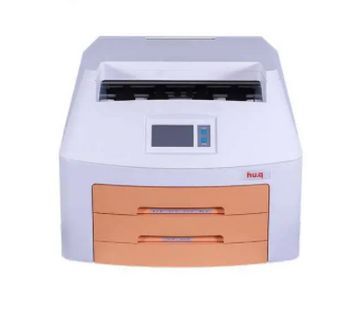
hu.q HQ-450DY DRY IMAGER
 hu.q · Model HQ-450DY DRY IMAGER
Dry thermal technology Daylight load film cartridges Double tray, supports 4 film sizes Speed printing, higher efficiency Economical, stable, reliable Compact design, easy installation Straight forward operation, user-friendly.
Key tips
- ·Never bypass a radiation interlock to "just get the image" - this is one of the few true zero-tolerance rules in BMET work.
- ·Trend image-quality phantom results over time - drift shows up before an outright failure does.
- ·Portable/mobile units take real physical abuse from transport - check wheel locks and cable strain reliefs more often than fixed units.
Typical Failure Modes
Compiled for this model from its own documentation and established engineering knowledge for this equipment class - not from a verified service record. Confirm against the manufacturer's service manual.
Poor film quality (fog / streaks / light films)
HighSymptoms: Fogged, streaked, mottled or under-developed films; density drift on the sensitometric strip.
Root cause: Exhausted or wrongly mixed chemistry, wrong developer temperature, or dirty / worn rollers.
Film transport jam / mis-feed
MediumSymptoms: Film jams between racks, does not advance, or comes out crumpled.
Root cause: Worn or misaligned transport rollers / racks, worn drive gears, or a crossover-rack fault.
Developer temperature / heater fault
MediumSymptoms: Developer not at set temperature, density varies through the day.
Root cause: Heater, thermostat / sensor, or recirculation-pump fault.
Replenishment pump fault
MediumSymptoms: Chemistry not replenished, developer / fixer levels drift, films degrade over a batch.
Root cause: Worn replenishment-pump tubing or a pump fault.
Dryer fault
LowSymptoms: Films come out damp.
Root cause: Dryer heater or blower fault.
Serviceable Parts & Consumables
Serviceable items for this model, compiled from its documentation and engineering knowledge for this equipment class. Service class and relative cost are estimates, not manufacturer figures; no part numbers are given. Confirm intervals and pricing against the manufacturer.
Transport / crossover rollers & gears
Class Periodic replacementRel. cost $$R&R Moderate
Replenishment-pump tubing
Class Frequent wear itemRel. cost $R&R Fairly easy
Developer heater / thermostat
Class Major service partRel. cost $$R&R Moderate
Recirculation / replenishment pump
Class Periodic replacementRel. cost $$R&R Moderate
Dryer heater / blower
Class Major service partRel. cost $$R&R Moderate
| Part | Service class | Relative cost | R&R difficulty |
|---|---|---|---|
| Transport / crossover rollers & gears | Periodic replacement | $$ | Moderate |
| Replenishment-pump tubing | Frequent wear item | $ | Fairly easy |
| Developer heater / thermostat | Major service part | $$ | Moderate |
| Recirculation / replenishment pump | Periodic replacement | $$ | Moderate |
| Dryer heater / blower | Major service part | $$ | Moderate |
Relative cost: $ lowest · $$$$ highest service-part cost for this equipment class. Not a price.
PM Checklist
Preventive-maintenance tasks typical of this equipment class. Perform to the manufacturer's procedure and your facility's policy - this is general reference, not a schedule for this specific unit.
- ·Daily QC per modality: image-quality phantom test
- ·Tube and detector inspection
- ·Annual state-required radiation safety survey
- ·Vendor-scheduled preventive maintenance
Troubleshooting Approach
A starting sequence for this model, compiled from its documentation and engineering knowledge for this equipment class. Follow the manufacturer's service documentation for the actual procedure.
Symptom: Fogged / streaked / light films
- Run a sensitometric strip and read Dmin / speed / contrast against control.
- Confirm the developer temperature and that chemistry is fresh and correctly mixed.
- Clean the rollers and crossover racks.
- Check the replenishment rates and pump operation.
- Change the chemistry and re-run the strip.
Symptom: Film transport jam
- Open the racks and clear the film; note where it hangs up.
- Inspect the rollers, guide shoes and drive gears for wear.
- Check rack seating and alignment.
- Run several test films.
- Replace worn rollers / gears as found.
Typical Location
Where this class of equipment is typically deployed - general reference, not this unit's own placement record.
- Radiology / Imaging department
- Emergency Department (portable units)
- Operating Room (C-arms)
- Cath lab
- Bedside ICU (portable X-ray)
Documents & Manuals
Troubleshoot this device with Bio
Describe a symptom or error code. Bio answers from this device's own documented error codes, failure modes, parts, and guides.
Ask Bio