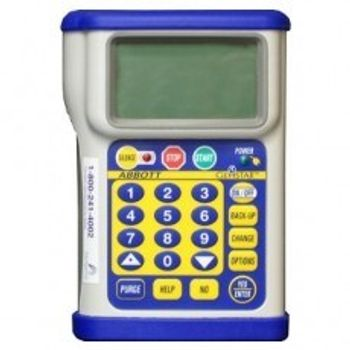
Hospira Gemstar Blue
 Hospira · Model Gemstar Blue
Pain Management. TPN. Continuous. Variable Time. Weight Dosed. Intermittent. ML/hr Only.
Key tips
- ·Free-flow protection must be verified on every PM - a failed anti-free-flow clamp is a direct overdose risk.
- ·Test occlusion alarms in both directions - failing to alarm when it should is more dangerous than a false alarm.
- ·Battery run-time complaints are the most common real-world nuisance call - a full charge/discharge cycle test catches most of them.
Typical Failure Modes
Compiled for this model from its own documentation and established engineering knowledge for this equipment class - not from a verified service record. Confirm against the manufacturer's service manual.
Failure / error message stops delivery
HighSymptoms: The pump alarms and displays an error message / code and stops.
Root cause: A subsystem fault indexed in the service manual - motor / drive, a sensor, set-detection, or a board.
Occlusion alarm / pressure fault
MediumSymptoms: Repeated occlusion alarms, delivery stops, or an occlusion is missed.
Root cause: Kinked or clamped line, a closed roller clamp, a positional patient tube, pressure-sensor drift, or an improperly loaded set.
Air-in-line alarm
MediumSymptoms: Frequent air-in-line alarms, delivery stops.
Root cause: Air in the set, an improperly loaded set, or an ultrasonic air-detector fault.
Flow-rate accuracy drift
MediumSymptoms: Delivered volume outside tolerance on the annual test, especially at low rates.
Root cause: Worn pumping mechanism / plunger drive.
Battery will not hold charge
MediumSymptoms: Short run time, low-battery early after a full charge.
Root cause: Aged battery pack.
Door / plunger / sensor mechanical wear
LowSymptoms: Set will not load, door will not latch, plunger grip poor.
Root cause: Worn door latch, plunger jaws, or anti-free-flow mechanism.
Serviceable Parts & Consumables
Serviceable items for this model, compiled from its documentation and engineering knowledge for this equipment class. Service class and relative cost are estimates, not manufacturer figures; no part numbers are given. Confirm intervals and pricing against the manufacturer.
Battery pack
Class Periodic replacementRel. cost $$R&R Fairly easy
Pumping mechanism / rotor / plunger drive
Class Major service partRel. cost $$$R&R Difficult
Pressure / air-detector sensor assembly
Class Major service partRel. cost $$R&R Moderate
Door / latch / anti-free-flow assembly
Class Major service partRel. cost $$R&R Moderate
Drive motor / gearbox
Class Major service partRel. cost $$$R&R Difficult
| Part | Service class | Relative cost | R&R difficulty |
|---|---|---|---|
| Battery pack | Periodic replacement | $$ | Fairly easy |
| Pumping mechanism / rotor / plunger drive | Major service part | $$$ | Difficult |
| Pressure / air-detector sensor assembly | Major service part | $$ | Moderate |
| Door / latch / anti-free-flow assembly | Major service part | $$ | Moderate |
| Drive motor / gearbox | Major service part | $$$ | Difficult |
Relative cost: $ lowest · $$$$ highest service-part cost for this equipment class. Not a price.
PM Checklist
Preventive-maintenance tasks typical of this equipment class. Perform to the manufacturer's procedure and your facility's policy - this is general reference, not a schedule for this specific unit.
- ·Occlusion pressure and flow-rate accuracy verification
- ·Battery conditioning cycle
- ·Door latch and air-in-line sensor inspection
- ·Post-drop functional check before return to service
- ·Annual PM per manufacturer schedule
Error Codes
Extracted directly from this unit's own service manual.
AIR IN LINEThe specified volume of air has been detected in the line distal to the cassette while infusing.
1 Press [SILENCE] to quiet the alarm for 1 minute. 2 Press [STOP] to clear the alarm. 3 Disconnect the patient from the pump set. 4 Press and hold [PURGE]. Note: Purge rate is 250 mL/hr. The pump purges for up to 2 minutes each time you press and hold [PURGE]. Purge volume may be limited in a Pain Management program. 5 Reconnect the pump set to the patient-access device. 6 Press [START] to begin infusion.
CHANGE BATTERIESThe pump has entered the STOP mode due to battery voltage below acceptable levels.
1 Replace both disposable batteries with fresh AA batteries and press to restart the pump; OR connect the pump to the AC mains adaptor and the pump will automatically restart. Replace both batteries as soon as possible. 2 After power-on, resume the current program. Refer to Accessing the Programming Menu in Chapter 2 Basic Operation for more information.
Troubleshooting Approach
A starting sequence for this model, compiled from its documentation and engineering knowledge for this equipment class. Follow the manufacturer's service documentation for the actual procedure.
Symptom: Alarm with an error message / code, delivery stopped
- Note the exact error message or code from the display.
- Look it up in the pump's technical service manual troubleshooting section.
- Run the biomed diagnostics / service utilities to exercise the named subsystem (motor / drive, a sensor, set-detection, a board).
- Follow the manual's parts-replacement procedure for that fault.
- Run the full scheduled-maintenance test set, including a flow-accuracy check, after any repair.
Symptom: Occlusion alarm / pressure fault (or a missed occlusion)
- Check the line for kinks, closed clamps and a closed roller clamp; check the patient site and cannula.
- Reload the administration set correctly, clearing all air.
- Confirm the set is an approved type for this pump.
- Run the pressure-sensor / force-sensor test in the service menu.
- Replace the set; refer the pump if the pressure sensor or pumping mechanism is indicated.
Symptom: Air-in-line alarm / free-flow or feed not delivering
- Prime the set fully and reload it; tap out micro-bubbles at the drip chamber.
- Confirm the set seats correctly against the air-in-line detector / rotor.
- Clean the ultrasonic air-detector window.
- Run the air-detector (or rotor / cassette) test in diagnostics.
- Replace a worn pumping mechanism / anti-free-flow assembly if flow accuracy or detection is out.
Symptom: Battery will not hold charge / short run time
- Fully charge, then run a battery run-down / capacity test in the service menu.
- Check the charging circuit and contacts.
- Replace the battery pack when capacity is below the service limit.
- Recalibrate the battery gauge if the pump supports it.
- Confirm run time meets spec after replacement.
Technical Specs
- Height
- 5.5 in
- Length
- 2 in
- Weight
- 17 oz
- Width
- 3.8 in
Typical Location
Where this class of equipment is typically deployed - general reference, not this unit's own placement record.
- Patient care floors
- ICU
- OR
- Oncology / infusion centers
- Home health (portable pumps)
Documents & Manuals
Safety & Recalls
Synced live from the FDA openFDA API.
- RECALL
There are two situations that may occur when using the GemStar Docking Station, List Number 13075-XX-XX, in conjunction with the GemStar infusion pump: 1) when the Docking Station is used in conjunction with a GemStar Phase 3 pump (List 13000-XX, 13100-XX, or 13150-XX) the potential exists for the GemStar Phase 3 pump to fail to power up while connected to the Docking Station, and 2) when either a GemStar Phase 3 (List 13000-XX, 13100-XX, or 13150-XX)or GemStar Phase 4 pump (List 13086-XX, 13087-XX, or 13088-XX) is used in conjunction with both a Docking Station and an External Battery Pack accessory (List 13073-XX) there exists a possibility that the GemStar pump will display error code 11/003 and give an audible alarm indicating excessive input voltage from the external sources. If the GemStar pump detects what is perceived to be more than 3.6 Volts measured on the external voltage inp
- RECALL
The GemStar Infusion pump may not receive direct current (DC) power from the power supply. In one instance, smoke was observed and the GemStar pump was operating on battery power while connected to the 3 volt DC power supply.
- RECALL
The connection between the beeper subassembly and the pump may fail. The GemStar infusion pump will identify this failure during the "self-test" while powering up which will result in a Beeper Error ("code 10/001/000"). This Beeper Error (code 10/001/000) is a service alarm that places the pump in an inoperable mode and requires service before it can be returned to service.
- RECALL
Some patients are obtaining access to the dosage reset codes required to change the settings on GemStar infusion pumps and are subsequently changing the infusion rate set by their doctors. Patients are obtaining access to these codes via website sponsors by downloading the GemStar User/Service Manual featured on the sponsors' websites. The GemStar User/Service Manual should be removed from these w
- RECALL
Hospira has received customer reports of bolus delivery failures when using the GemStar bolus cord. Possible failures may be a result of cracked or damaged bolus cords which may result in an open or short circuit of the Bolus Cord.
- RECALL
Hospira has received reports of sparking, smoking, charring and electrical shock when using the GemStar Docking Station due to fluid ingress into the docking station.
- RECALL
There is a potential for the air filter at the distal end of the set to become detached. This could result in the contamination of the sterile fluid path inside the tubing.
- RECALL
The software enables programming of the GemStar device for a Bolus Lower Lockout Limit outside of the hard limits entered into the GemStar SP Infusion Suite Database PC application.
- RECALL
Underdelivery of infusion during clinical use at low rate settings (less than 10 mL/hour). Patient may not receive the intended amount of medication.
Related calculators
From BioLab, for work done with this kind of equipment.
Troubleshoot this device with Bio
Describe a symptom or error code. Bio answers from this device's own documented error codes, failure modes, parts, and guides.
Ask Bio