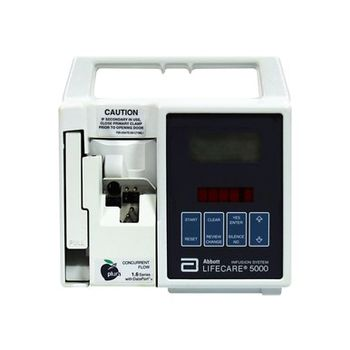
Hospira Abbott Lifecare 5000 Plum
 Hospira · Model Abbott Lifecare 5000 Plum
The maximum pressure is user-selectable from 1 to 10 psig, via the front panel touch switches For dual-channel delivery, a single dose of a secondary fluid may be administered. For multidose delivery, 1 to 24 doses of a secondary fluid may be administered at intervals from 15 minutes to 24 hours Distal: The distal occlusion alarm sounds within two pumping cycles after the distal set tubing or set outlet fitting becomes occluded Proximal: The proximal occlusion alarm sounds within five pumping cycles if the tubing proximal to the cassette becomes occluded The stopped air in distal line alarm will sound if a bubble 100 uL or larger passes the distal air-in-line sensors. The alarm may actually sound at detection of a bubble as small as 50 uL) The stopped air in proximal line alarm will sound if approximately 1200 uL or more passes through the proximal air-in-line sensors.
Key tips
- ·Free-flow protection must be verified on every PM - a failed anti-free-flow clamp is a direct overdose risk.
- ·Test occlusion alarms in both directions - failing to alarm when it should is more dangerous than a false alarm.
- ·Battery run-time complaints are the most common real-world nuisance call - a full charge/discharge cycle test catches most of them.
Typical Failure Modes
Compiled for this model from its own documentation and established engineering knowledge for this equipment class - not from a verified service record. Confirm against the manufacturer's service manual.
Failure / error message stops delivery
HighSymptoms: The pump alarms and displays an error message / code and stops.
Root cause: A subsystem fault indexed in the service manual - motor / drive, a sensor, set-detection, or a board.
Occlusion alarm / pressure fault
MediumSymptoms: Repeated occlusion alarms, delivery stops, or an occlusion is missed.
Root cause: Kinked or clamped line, a closed roller clamp, a positional patient tube, pressure-sensor drift, or an improperly loaded set.
Air-in-line alarm
MediumSymptoms: Frequent air-in-line alarms, delivery stops.
Root cause: Air in the set, an improperly loaded set, or an ultrasonic air-detector fault.
Flow-rate accuracy drift
MediumSymptoms: Delivered volume outside tolerance on the annual test, especially at low rates.
Root cause: Worn pumping mechanism / plunger drive.
Battery will not hold charge
MediumSymptoms: Short run time, low-battery early after a full charge.
Root cause: Aged battery pack.
Door / plunger / sensor mechanical wear
LowSymptoms: Set will not load, door will not latch, plunger grip poor.
Root cause: Worn door latch, plunger jaws, or anti-free-flow mechanism.
Serviceable Parts & Consumables
Serviceable items for this model, compiled from its documentation and engineering knowledge for this equipment class. Service class and relative cost are estimates, not manufacturer figures; no part numbers are given. Confirm intervals and pricing against the manufacturer.
Battery pack
Class Periodic replacementRel. cost $$R&R Fairly easy
Pumping mechanism / rotor / plunger drive
Class Major service partRel. cost $$$R&R Difficult
Pressure / air-detector sensor assembly
Class Major service partRel. cost $$R&R Moderate
Door / latch / anti-free-flow assembly
Class Major service partRel. cost $$R&R Moderate
Drive motor / gearbox
Class Major service partRel. cost $$$R&R Difficult
| Part | Service class | Relative cost | R&R difficulty |
|---|---|---|---|
| Battery pack | Periodic replacement | $$ | Fairly easy |
| Pumping mechanism / rotor / plunger drive | Major service part | $$$ | Difficult |
| Pressure / air-detector sensor assembly | Major service part | $$ | Moderate |
| Door / latch / anti-free-flow assembly | Major service part | $$ | Moderate |
| Drive motor / gearbox | Major service part | $$$ | Difficult |
Relative cost: $ lowest · $$$$ highest service-part cost for this equipment class. Not a price.
PM Checklist
Preventive-maintenance tasks typical of this equipment class. Perform to the manufacturer's procedure and your facility's policy - this is general reference, not a schedule for this specific unit.
- ·Occlusion pressure and flow-rate accuracy verification
- ·Battery conditioning cycle
- ·Door latch and air-in-line sensor inspection
- ·Post-drop functional check before return to service
- ·Annual PM per manufacturer schedule
Troubleshooting Approach
A starting sequence for this model, compiled from its documentation and engineering knowledge for this equipment class. Follow the manufacturer's service documentation for the actual procedure.
Symptom: Error message or code
- Note the exact error message / code.
- Look it up in the pump's technical service manual troubleshooting section.
- Use the biomed diagnostics / utilities to test the affected subsystem.
- Follow the manual's parts-replacement procedure.
- Run the scheduled-maintenance test set (including flow accuracy) after any repair.
Symptom: Occlusion or delivery problem
- Check the line for kinks, clamps and a closed roller clamp; check the patient site.
- Reload the set correctly, clearing all air.
- Confirm an approved set for this pump.
- Run the pressure / air-detector (or rotor) test in diagnostics.
- Replace the set; refer the pump if a sensor / mechanism fault is indicated.
Technical Specs
- Height
- 9 in
- Length
- 7 in
- Weight
- 13 lbs with battery
- Infusion Pump Type
- General-Purpose
- Width
- 9 in
Typical Location
Where this class of equipment is typically deployed - general reference, not this unit's own placement record.
- Patient care floors
- ICU
- OR
- Oncology / infusion centers
- Home health (portable pumps)
Documents & Manuals
Safety & Recalls
Synced live from the FDA openFDA API.
- RECALL
Depleted Battery alarm shows instead of Replace Battery. On battery power, ongoing therapy stops, alarms show and sound, pump shuts down after 3 minutes. On AC power, the pump reboots (takes about 25 seconds). Therapy can resume. AC power interruption of 3-7 seconds prompts an incorrect E323 alarm, ongoing therapy stop, and pump reboot. Longer power loss results in battery power operation.
- RECALL
Firm's investigation determined that the Proximal Occlusion Alarms observed in the field were attributed to the mechanism calibration process being performed with an out of specification metal cassette, resulting in an offset in proximal pressure.
- RECALL
One lot of alarm assemblies used in Plum A+ and Plum A+3 infusion pumps may fail to sound at all volume levels.
- RECALL
Plum A+ infusion system pole clamp assemblies were discovered to be cracked. If the knob on the pole clamp assembly is cracked, the infuser cannot be attached to the IV pole since the knob is used to tighten and loosen the grip of the pole clamp to the pole.
- RECALL
Hospira identified an incorrect lower lid (set component) had been supplied and was being used during the manufacturing process of list number 11241-03, a HemoSet containing a burette and blood filter, intended for infusion of blood/blood products. In a gravity delivery, the correct lower lid dispenses 15 drops per mL and the incorrect lower lid found dispenses 10 drops per mL.
- RECALL
There is the potential for the door roller assembly on the Plum LifeCare 5000 Series and Plum XL families of infusers to break. In the event of a broken door roller pin, the door cannot appropriately lock the cassette in the right position. Depending on the conditions of a broken door roller pin, a number of events can occur. The door cannot be closed or a cassette/door alarm or a false occlusion
- RECALL
Hospira has received customer reports of broken door assemblies on the Hospira/Abbott Acclaim Encore infusion pumps. If the door assembly breaks, it may prevent the door from closing properly and unrestricted flow may occur. If the door cannot be closed, the pump cannot be used which can result in a delay in therapy.
- RECALL
The fluid shield diaphragm for the Plum A+ Infusion pumps was undersized, possibly resulting in alarms and delay or interruption of therapy.
- RECALL
Plum A+ infusers have the potential for the distal (occlusion) press sensor pin to break. The distal pressure sensor pin is a part of the overall subsystem that measures the pressure within the distal line of the administration set and indicates the presence of a full or partial distal occlusion. A broken distal pin can only be detected via a visual inspection of the distal pressure pin. A broken
- RECALL
The door roller assembly on the Plum A+/A+3 infuser family of infusers has the potential to break which can lead to possible unrestricted flow and/or over-delivery during the removal of the IV administration set's cassette from the pump.
- RECALL
The volume control knob on some Plum A+ single channel infusers (located on the back of the infuser) may not function as described in the System Operating Manual - the direction for Loud and Quiet may be reversed. The manual indicates a clockwise rotation of the knob decreases the volume; however, on some of the devices the alarm volume increases when the knob is turned clockwise.
- RECALL
Hospira has received reports of distal pressure sensor calibration drift on Plum A+ Infusers. The following error codes may be displayed during setup or infusion signifying possible calibration drift: E180/N180, E181/N181, E186/N186, E187/N187 or E346. Additionally, if the pressure sensor calibration has drifted, users may experience false distal occlusion alarms or distal occlusions that may not
- RECALL
Hospira has received reports of continuous recycling and/or rebooting of Plum A+ infusion pumps when the backlight intensity and/or display contrast settings for the LED display has been adjusted from the original default setting. This condition could cause a delay in therapy if the clinician is unable to start the device due to the continuous recycling and/or rebooting.
- RECALL
Hospira has received reports of incorrect seating of the regulator closer on the Plum A+ Infusion Pumps. If the regulator closer does not close the flow regulator actuator when the pump door is opened, and if the clinician has not engaged the clamp prior to opening the cassette door, unrestricted flow may occur.
- RECALL
Hospira has received reports of the Plum XL, XLM and XLD Infusion Pumps with no audible alarm at the low audio level setting.
- RECALL
Hospira has received customer reports of the Plum A+ infusion pumps with no audible alarm conditions, which have been associated with failure of the piezoelectric assembly due to component quality issues.
- RECALL
Fire/Shock hazard-- A component used in the device may cause sparks/flashes and poses a fire and shock hazard.
- RECALL
Incorrect values for dosage, dose limit, concentration or rate of delivery may display on screen.
- RECALL
Inlet and outlet tubing on the cassette may be reversed, which would result in reverse flow.
- RECALL
The pump may shut-off prematurely during battery operation without providing adequate response time when 'E320' service warning message appears.
- RECALL
The batteries in Plum A+ and Plum A+3 I.V. infusion pumps may fail prematurely when the pump is operating solely on battery power.
Related calculators
From BioLab, for work done with this kind of equipment.
Troubleshoot this device with Bio
Describe a symptom or error code. Bio answers from this device's own documented error codes, failure modes, parts, and guides.
Ask Bio