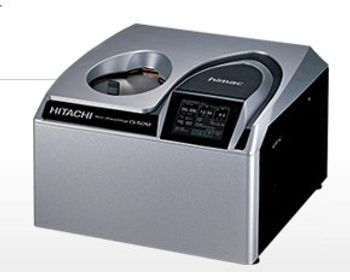
Hitachi Medical Systems Himac CS150NX
 Hitachi Medical Systems · Model Himac CS150NX
Features The Most Compact Body - CS150NX carries the world greatest performance and many attractive and useful functions in its the most compact body*. Rotor chamber is allocated in a front part of the body with smooth sliding door, so that it is easy for operators to place a rotor. Touch-sensitive LCD panel with wide view angle is placed at a position and an angle for easy operation. PWM (pulse width modulation) motor control has realized substantial reduction in acceleration and deceleration time. Powerful Imbalance Protection - Samples need to be balanced within 5mm by visual check only. Non-contact imbalance sensor always monitors vibration of the rotor and drive shaft. In case of abnormal vibration, the sensor activates and stops operation immediately. Easy Operation with Touch-Sensitive LCD - Colour touch-sensitive LCD and GUI (graphic user interface) with high contrast against back screen in black color enable users to easily operate the system or select various menus and functions by touching the icon on the display. Of course, operation status is identified at a glance by intelligible screen design. Quiet Operating Sound 45dBA - This unusually quiet operating sound was realized by newly developed rigid-cotrol drive system and sound absorbing structure design. It does not disturb your researching works in the laboratory. Quick Start-Up - It takes just 8 seconds(minimum) to be ready for operation since power switch is turn on. Initial screen is displayed on the LCD panel during booting up the system. Powerful Vacuum Pump - Reaching time to high-vacuum status is reduced to half by optimized control of the oil diffusion pump. Easy Timer Setting - himac original RTC (real-time control) function makes timer setting easy. What you need to do is simply set start time or finish time with running time. It is easier than conventional delay time setting timer. Accurate Control of Net Run-Time - The timer starts when the set speed is attained by himac original actual run timer function (PAT.). It helps to precisely control of the net run-time and obtain high-reproducibility separation. Of course, conventional run timer is selectable. USB Interface (compatible to GLP/GMP) - USB port is equipped as standard specification. Operating data can be output in CSV format. RCF Calculation and Display - CS150NX eliminates many troublesome and time-consuming manual calculation. Also, you can start operation by entering g value, instead of running speed.
Key tips
- ·Run QC controls before trusting any repair - an analyzer that passes self-test can still report clinically wrong results.
- ·Rule out a reagent lot change before opening the instrument - it can look exactly like a hardware fault.
- ·Centrifuge rotors have a hard retirement age/cycle limit regardless of visible condition - don't eyeball it.
Typical Failure Modes
Compiled for this model from its own documentation and established engineering knowledge for this equipment class - not from a verified service record. Confirm against the manufacturer's service manual.
Will not start / error at start
HighSymptoms: Error code, run will not begin, or aborts shortly after start.
Root cause: Set speed exceeds the rotor maximum, an imbalanced load, the lid / door not locked, an unapproved rotor, or a drive / control fault.
Will not reach speed / excessive noise or vibration
MediumSymptoms: Slow spin-up, rumble, or vibration during a run.
Root cause: Load imbalance, worn drive / motor bearings, a worn drive coupling, or (older units) worn motor brushes.
Timer / speed inconsistency
MediumSymptoms: Run ends early / late, or RPM does not match the setting.
Root cause: Tacho / speed-sensor drift or a control-board fault.
Lid / door will not open or lock
MediumSymptoms: Lid-lock error, will not open after a run, or will not lock to start.
Root cause: Lid-lock solenoid / switch fault, or a run still winding down.
Rotor / bucket wear or corrosion
MediumSymptoms: Visible corrosion, cracks, or a bucket that will not swing; imbalance trips.
Root cause: Rotor / bucket ageing - a safety-critical wear item with a use-life limit.
Serviceable Parts & Consumables
Serviceable items for this model, compiled from its documentation and engineering knowledge for this equipment class. Service class and relative cost are estimates, not manufacturer figures; no part numbers are given. Confirm intervals and pricing against the manufacturer.
Drive / motor bearings & coupling
Class Major service partRel. cost $$$R&R Difficult
Lid-lock solenoid / switch
Class Major service partRel. cost $$R&R Moderate
Speed sensor / control board
Class Major service partRel. cost $$R&R Moderate
Motor brushes (older units)
Class Periodic replacementRel. cost $R&R Moderate
Rotor / bucket set & O-rings
Log rotor runs; retire per the manufacturer's rotor-life programme.
Class Major service partRel. cost $$$R&R Easy
| Part | Service class | Relative cost | R&R difficulty |
|---|---|---|---|
| Drive / motor bearings & coupling | Major service part | $$$ | Difficult |
| Lid-lock solenoid / switch | Major service part | $$ | Moderate |
| Speed sensor / control board | Major service part | $$ | Moderate |
| Motor brushes (older units) | Periodic replacement | $ | Moderate |
| Rotor / bucket set & O-rings Log rotor runs; retire per the manufacturer's rotor-life programme. | Major service part | $$$ | Easy |
Relative cost: $ lowest · $$$$ highest service-part cost for this equipment class. Not a price.
PM Checklist
Preventive-maintenance tasks typical of this equipment class. Perform to the manufacturer's procedure and your facility's policy - this is general reference, not a schedule for this specific unit.
- ·Daily QC controls run and reviewed
- ·Calibration verification per assay
- ·Routine cleaning and decontamination
- ·Scheduled reagent-path and pump-tubing maintenance
Troubleshooting Approach
A starting sequence for this model, compiled from its documentation and engineering knowledge for this equipment class. Follow the manufacturer's service documentation for the actual procedure.
Symptom: Will not start or errors at start
- Confirm the set speed does not exceed the fitted rotor's maximum and the rotor is approved and seated.
- Rebalance the load - opposing positions evenly loaded and paired.
- Confirm the lid / door latches and the lock engages.
- Look the fault code up in the manual and follow the remedy.
- Functional-check speed and timer after any repair.
Symptom: Noisy / vibrates / will not reach speed
- Rebalance and re-run empty to confirm.
- Spin the rotor by hand and feel for bearing roughness.
- Inspect the drive coupling and (older units) the motor brushes.
- Replace the worn component.
- Verify speed with a tachometer and confirm smooth running.
Technical Specs
- Height
- 408 mm
- Length
- 582 mm
- Weight
- 97 kg
- Maximum Speed
- 150000 rpm
- Width
- 590 mm
Typical Location
Where this class of equipment is typically deployed - general reference, not this unit's own placement record.
- Central / core laboratory
- Point-of-care testing stations
- Blood bank
- Microbiology lab
Documents & Manuals
No documents available for this device yet.
Related calculators
From BioLab, for work done with this kind of equipment.
Troubleshoot this device with Bio
Describe a symptom or error code. Bio answers from this device's own documented error codes, failure modes, parts, and guides.
Ask Bio