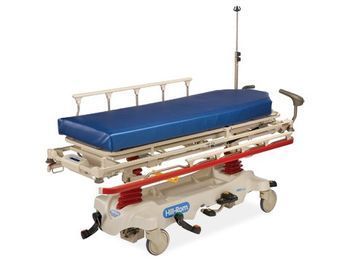
Hillrom Trauma Stretcher
 Hillrom · Model Trauma Stretcher
Mobility. Why struggle to steer and stop? An optional active hand brake reduces strain of going down ramps and sudden stops. Our integrated IV pole transport device option helps you to maneuver the Trauma Stretcher and IV pole stands with ease. The next generation Steering Plus™ system allows crisp cornering and control. Convenience. Save time and help reduce injury risk with the emergency stretcher’s head-to-toe x-ray capabilities. The full-length platform accepts all standard x-ray cassettes and grids. Mounts for drainage bags and chest tube suction are located at all four corners. Quality. The Trauma Stretcher’s reinforced frames are made of heavy-gauge, automotive-grade steel for long-lasting quality - and a 700 lbs. weight capacity to handle higher patient weights, even under harsh conditions. Nickel-plated push handles, IV poles, side rails and other components offer superior rust resistance, even in harsh environments.
Key tips
- ·Casters and the wheel-lock brake take the most day-to-day wear - check both every PM, not just on complaint.
- ·A cracked weld or loose frame joint is a safety-critical finding - pull the unit from service until it's repaired.
Typical Failure Modes
Compiled for this model from its own documentation and established engineering knowledge for this equipment class - not from a verified service record. Confirm against the manufacturer's service manual.
Hydraulic height / Trendelenburg will not lift or holds poorly
HighSymptoms: Pump will not raise the deck, or the deck settles under load.
Root cause: Worn hydraulic pump / seals, an internal valve leak, or low hydraulic fluid.
Brake / steer castor fault
MediumSymptoms: Brake will not hold, fifth-wheel steer ineffective, castor shimmy.
Root cause: Worn brake linkage, castors, or the fifth-wheel mechanism.
Backrest / Fowler mechanism fault
MediumSymptoms: Backrest will not raise / hold, gas strut weak, pneumatic assist failed.
Root cause: Worn gas spring / strut or the release mechanism.
Siderail / IV pole / accessory fault
LowSymptoms: Siderails will not latch or drop, IV pole loose, litter attachments worn.
Root cause: Worn latches, detents, or accessory sockets.
Powered drive fault (powered stretchers)
MediumSymptoms: Drive assist will not engage or is weak, drive-fault code.
Root cause: Drive battery, motor / controller, or the throttle.
Serviceable Parts & Consumables
Serviceable items for this model, compiled from its documentation and engineering knowledge for this equipment class. Service class and relative cost are estimates, not manufacturer figures; no part numbers are given. Confirm intervals and pricing against the manufacturer.
Hydraulic pump / seal kit
Class Major service partRel. cost $$R&R Moderate
Castor / brake-linkage set
Class Periodic replacementRel. cost $$R&R Moderate
Backrest gas spring / strut
Class Periodic replacementRel. cost $$R&R Fairly easy
Siderail latch / accessory sockets
Class Major service partRel. cost $$R&R Fairly easy
Drive battery (powered stretchers)
Class Periodic replacementRel. cost $$R&R Fairly easy
| Part | Service class | Relative cost | R&R difficulty |
|---|---|---|---|
| Hydraulic pump / seal kit | Major service part | $$ | Moderate |
| Castor / brake-linkage set | Periodic replacement | $$ | Moderate |
| Backrest gas spring / strut | Periodic replacement | $$ | Fairly easy |
| Siderail latch / accessory sockets | Major service part | $$ | Fairly easy |
| Drive battery (powered stretchers) | Periodic replacement | $$ | Fairly easy |
Relative cost: $ lowest · $$$$ highest service-part cost for this equipment class. Not a price.
PM Checklist
Preventive-maintenance tasks typical of this equipment class. Perform to the manufacturer's procedure and your facility's policy - this is general reference, not a schedule for this specific unit.
- ·Caster / wheel and brake function check
- ·Frame, weld, and mounting-hardware inspection
- ·Upholstery / surface condition check
- ·Annual full PM
Troubleshooting Approach
A starting sequence for this model, compiled from its documentation and engineering knowledge for this equipment class. Follow the manufacturer's service documentation for the actual procedure.
Symptom: Will not lift or settles under load
- Check the hydraulic fluid level.
- Pump the deck up under load and time how fast it settles.
- Inspect the pump and cylinder for external leaks.
- Rebuild the pump with the seal kit or bleed the system per the manual.
- Confirm it holds at full height under the rated load.
Symptom: Brake will not hold or castor shimmy
- Inspect the brake linkage and each castor.
- Adjust the central-brake linkage.
- Replace worn castors and the fifth-wheel components.
- Confirm the brake holds on an incline.
- Check steer-lock engagement.
Technical Specs
- Height
- 24.5 to 37 inches
- Length
- 83 in
- Patient Weight Capacity
- 700 lbs
- Width
- 32 in with siderails up
Typical Location
Where this class of equipment is typically deployed - general reference, not this unit's own placement record.
- Ambulance / transport vehicles
- Emergency Department
- Inter-facility transport teams
Documents & Manuals
Troubleshoot this device with Bio
Describe a symptom or error code. Bio answers from this device's own documented error codes, failure modes, parts, and guides.
Ask Bio