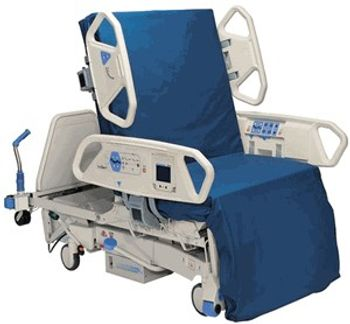
Hillrom TotalCare Connect
 Hillrom · Model TotalCare Connect
Head-Of-Bed (HOB)Alarm sounds automatically when the bed angle falls below 30 degrees, the angle called for in VAP prevention protocols. Line of Site® Head Angle Indicators work in any siderail position, making it easy to see that the bed is at the correct angle. Graphic Head-Of-Bed Angle History can be used to improve processes by capturing the data you need. Continuous Rotation Therapy helps mobilize pulmonary secretions and other body fluids.
Key tips
- ·Casters and the wheel-lock brake take the most day-to-day wear - check both every PM, not just on complaint.
- ·A cracked weld or loose frame joint is a safety-critical finding - pull the unit from service until it's repaired.
Typical Failure Modes
Compiled for this model from its own documentation and established engineering knowledge for this equipment class - not from a verified service record. Confirm against the manufacturer's service manual.
A powered bed function will not run
HighSymptoms: Backrest, knee, height, Trendelenburg or the boost / turn assist will not move from the siderail or caregiver controls.
Root cause: Failed linear actuator, a control-board fault, a control-panel fault, or a pinched / damaged control cable.
Brake / castor-lock fault
MediumSymptoms: Bed will not brake or release, drifts, central brake pedal ineffective.
Root cause: Worn central-brake linkage or castor.
Integrated scale / bed-exit fault
MediumSymptoms: Weight reads implausibly or will not zero, bed-exit alarm false-triggers or fails.
Root cause: Load-cell drift or damage, or a scale-control fault.
Battery back-up fault
MediumSymptoms: Functions and alarms do not work during a power interruption, battery-fault indicator.
Root cause: Aged back-up battery or a charger fault.
Siderail / CPR-release / mechanical fault
LowSymptoms: Siderail will not latch, rattles, or the CPR release is slow / stiff.
Root cause: Worn siderail latch or the CPR mechanism.
Serviceable Parts & Consumables
Serviceable items for this model, compiled from its documentation and engineering knowledge for this equipment class. Service class and relative cost are estimates, not manufacturer figures; no part numbers are given. Confirm intervals and pricing against the manufacturer.
Linear actuator (backrest / knee / height)
Class Major service partRel. cost $$$R&R Difficult
Central-brake / castor assembly
Class Major service partRel. cost $$R&R Difficult
Load cell / scale sensor set
Recalibrate the scale after replacement.
Class Major service partRel. cost $$$R&R Difficult
Back-up battery
Class Periodic replacementRel. cost $$R&R Fairly easy
Siderail control panel / control board
Class Major service partRel. cost $$$R&R Moderate
| Part | Service class | Relative cost | R&R difficulty |
|---|---|---|---|
| Linear actuator (backrest / knee / height) | Major service part | $$$ | Difficult |
| Central-brake / castor assembly | Major service part | $$ | Difficult |
| Load cell / scale sensor set Recalibrate the scale after replacement. | Major service part | $$$ | Difficult |
| Back-up battery | Periodic replacement | $$ | Fairly easy |
| Siderail control panel / control board | Major service part | $$$ | Moderate |
Relative cost: $ lowest · $$$$ highest service-part cost for this equipment class. Not a price.
PM Checklist
Preventive-maintenance tasks typical of this equipment class. Perform to the manufacturer's procedure and your facility's policy - this is general reference, not a schedule for this specific unit.
- ·Caster / wheel and brake function check
- ·Frame, weld, and mounting-hardware inspection
- ·Upholstery / surface condition check
- ·Annual full PM
Troubleshooting Approach
A starting sequence for this model, compiled from its documentation and engineering knowledge for this equipment class. Follow the manufacturer's service documentation for the actual procedure.
Symptom: A powered function will not run (backrest / knee / height / Trendelenburg / boost)
- Confirm the bed is plugged in and the battery is charged, and that no function lock-out is set on the caregiver panel.
- Try the function from both the siderail control and the caregiver control to separate the control from the actuator.
- Inspect the control cable / harness for pinch damage along the articulating frame.
- Listen for the actuator; measure its supply at the control box.
- Replace the actuator or the control board as isolated, then load-test to the rated capacity.
Symptom: Brake / castor-lock will not hold or release / bed drifts
- Check the central brake pedal travel and the linkage to each castor.
- Adjust the central-brake linkage per the manual.
- Replace worn castors and the fifth-wheel / steer components.
- Confirm the brake holds on a slope with a load.
- Check all castors engage evenly.
Symptom: Integrated scale reads wrong / bed-exit alarm false-triggers or fails
- Remove all load and confirm the scale zeros and can be tared.
- Place a known reference weight and check the reading.
- Inspect the load-cell mounts for binding, debris or a pinched cable.
- Recalibrate the scale per the service procedure.
- Replace the load-cell set if it will not hold calibration; re-test the bed-exit zones.
Symptom: Functions / alarms dead on a power interruption (battery back-up)
- Check the battery-fault indicator and the charge state.
- Run a battery test if the bed supports one.
- Inspect the battery connector and charger.
- Replace the back-up battery.
- Confirm functions and alarms work on battery after replacement.
Technical Specs
- Height
- 34 in High, Low-15
- Bed Type
- Electric
- Length
- 94 in Fully extrated
- Patient Weight Capacity
- 500 lbs
- Width
- 40 in with siderails up
Typical Location
Where this class of equipment is typically deployed - general reference, not this unit's own placement record.
- Ambulance / transport vehicles
- Emergency Department
- Inter-facility transport teams
Documents & Manuals
Troubleshoot this device with Bio
Describe a symptom or error code. Bio answers from this device's own documented error codes, failure modes, parts, and guides.
Ask Bio