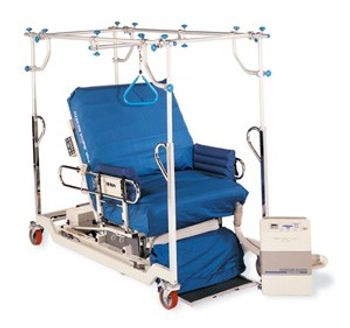
Hillrom Magnum II
 Hillrom · Model Magnum II
Built-in Scales - Weigh the patient while in bed via one-touch scale reading without moving patient. Patient/Caregiver Pendant Control - Using the intuitive control unit, both patients and caregivers can adjust positioning, including conforming the bed into a chair, to enhance comfort. Powered Leg Elevation - With an adjustable Lymphedema section, the LE can be raised up for better patient positioning, contributing to nursing safety and efficiency. Full Chair Egress - In the full chair position, the patient may use the corner posts to assist egress from the foot of the bed to help improve patient well-being and independent mobility. Heavy Duty Frame - Accommodates patients up to 800 lbs, enabling staff to deliver increased levels of care to an expanding population group. Battery Backup - Provides battery power to help ensure operation in case of power failure. Optional Flexicair Eclipse Ultra Bariatric Low Airloss Therapy System – A five-zoned, multi-layered system for obese and morbidly obese patients at high risk for pressure ulcer development, including immobile, malnourished and incontinent.
Key tips
- ·Mounting and securement hardware takes real fatigue from vibration and road shock - inspect it as carefully as the device itself.
- ·Post-call battery and function checks catch transport-induced faults that a scheduled PM would miss for months.
Typical Failure Modes
Compiled for this model from its own documentation and established engineering knowledge for this equipment class - not from a verified service record. Confirm against the manufacturer's service manual.
A powered bed function will not run
HighSymptoms: Backrest, knee, height, Trendelenburg or the boost / turn assist will not move from the siderail or caregiver controls.
Root cause: Failed linear actuator, a control-board fault, a control-panel fault, or a pinched / damaged control cable.
Brake / castor-lock fault
MediumSymptoms: Bed will not brake or release, drifts, central brake pedal ineffective.
Root cause: Worn central-brake linkage or castor.
Integrated scale / bed-exit fault
MediumSymptoms: Weight reads implausibly or will not zero, bed-exit alarm false-triggers or fails.
Root cause: Load-cell drift or damage, or a scale-control fault.
Battery back-up fault
MediumSymptoms: Functions and alarms do not work during a power interruption, battery-fault indicator.
Root cause: Aged back-up battery or a charger fault.
Siderail / CPR-release / mechanical fault
LowSymptoms: Siderail will not latch, rattles, or the CPR release is slow / stiff.
Root cause: Worn siderail latch or the CPR mechanism.
Serviceable Parts & Consumables
Serviceable items for this model, compiled from its documentation and engineering knowledge for this equipment class. Service class and relative cost are estimates, not manufacturer figures; no part numbers are given. Confirm intervals and pricing against the manufacturer.
Linear actuator (backrest / knee / height)
Class Major service partRel. cost $$$R&R Difficult
Central-brake / castor assembly
Class Major service partRel. cost $$R&R Difficult
Load cell / scale sensor set
Recalibrate the scale after replacement.
Class Major service partRel. cost $$$R&R Difficult
Back-up battery
Class Periodic replacementRel. cost $$R&R Fairly easy
Siderail control panel / control board
Class Major service partRel. cost $$$R&R Moderate
| Part | Service class | Relative cost | R&R difficulty |
|---|---|---|---|
| Linear actuator (backrest / knee / height) | Major service part | $$$ | Difficult |
| Central-brake / castor assembly | Major service part | $$ | Difficult |
| Load cell / scale sensor set Recalibrate the scale after replacement. | Major service part | $$$ | Difficult |
| Back-up battery | Periodic replacement | $$ | Fairly easy |
| Siderail control panel / control board | Major service part | $$$ | Moderate |
Relative cost: $ lowest · $$$$ highest service-part cost for this equipment class. Not a price.
PM Checklist
Preventive-maintenance tasks typical of this equipment class. Perform to the manufacturer's procedure and your facility's policy - this is general reference, not a schedule for this specific unit.
- ·Post-call function and battery check
- ·Mounting / securement inspection
- ·Annual full PM and vibration-tolerance check
Troubleshooting Approach
A starting sequence for this model, compiled from its documentation and engineering knowledge for this equipment class. Follow the manufacturer's service documentation for the actual procedure.
Symptom: A powered function is dead
- Confirm the bed is plugged in and the battery is charged, and any function lock-out is off.
- Try the function from both the siderail and caregiver controls to isolate the control from the actuator.
- Check the control cable / harness for pinch damage along the articulation.
- Replace the actuator or control board as isolated.
- Load-test the function to the rated capacity.
Symptom: Scale or bed-exit inaccurate
- Remove all load and confirm the scale reads zero and can be tared.
- Hang / place a known reference weight and confirm the reading.
- Inspect the load-cell mounts for binding or debris.
- Recalibrate per the service manual.
- Replace the load-cell set if it will not calibrate.
Technical Specs
- Bed Type
- Birthing
- Patient Weight Capacity
- 800 lbs
Typical Location
Where this class of equipment is typically deployed - general reference, not this unit's own placement record.
- Ambulance / transport vehicles
- Emergency Department
- Inter-facility transport teams
Documents & Manuals
Troubleshoot this device with Bio
Describe a symptom or error code. Bio answers from this device's own documented error codes, failure modes, parts, and guides.
Ask Bio