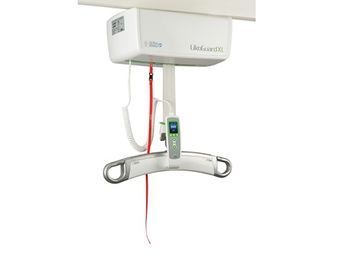
Hillrom LikoGuard L/XL Overhead Lift
 Hillrom · Model LikoGuard L/XL Overhead Lift
Innovative Sling bar The SlingGuard accessory is designed for secure attachment and application of the sling. Patented Emergency Lowering The unique emergency stop & manual emergency lowering mechanism is reachable from the floor and easy to engage and operate. High SWL (Safe Working Load) 600 lb / 272 kg (LikoGuard L lift), 800lb / 363 kg (LikoGuard XL lift). The LikoGuard lift supports the transfer and movement of patients in various sizes, including bariatric patients, contributing to fewer patient handling injuries among healthcare workers. Hand Control 2 choices of hand controls: Easy to use control with batter, service and overload indicators. Advanced & intuitive hand control with graphical user interface offering tracking of user service and data. Li-Ion Battery Technology Environmental friendly with high performance. Lift Strap Lift interval: 91in / 230cm Supports both Quick Release Hook, fixed sling bars and stretchers. Charging Choice of on wall charger or In Rail Charging (IRC) Compatibility Compatible with existing sling portfolio and most lifting accessories through the use of adapter kits.
Key tips
- ·Mounting and securement hardware takes real fatigue from vibration and road shock - inspect it as carefully as the device itself.
- ·Post-call battery and function checks catch transport-induced faults that a scheduled PM would miss for months.
Typical Failure Modes
Compiled for this model from its own documentation and established engineering knowledge for this equipment class - not from a verified service record. Confirm against the manufacturer's service manual.
Hand control not responding / no powered movement
HighSymptoms: Lift / lower / (Sara/Sabina) seat or leg functions do not respond to the hand control.
Root cause: Discharged or mis-inserted battery, an active emergency stop, an obstruction or overload, or a faulty hand control / cable.
Actuator / drive fault
MediumSymptoms: One movement will not run, runs one direction only, noisy or slow.
Root cause: Worn linear actuator or a limit-switch fault.
Battery will not hold charge
MediumSymptoms: Short run time, frequent low-battery, unit dies mid-transfer.
Root cause: Aged battery pack or a charger / charging-contact fault.
Sling / attachment-point / seat-belt wear
HighSymptoms: Sling loops fraying, sling bar hook worn, seat belt frayed, attachment not secure.
Root cause: Wear - inspect before every use and retire per Hillrom / Arjo guidance.
Caster / brake fault
LowSymptoms: Hard to move, a caster seized, brake will not hold.
Root cause: Debris or a worn caster / brake.
Serviceable Parts & Consumables
Serviceable items for this model, compiled from its documentation and engineering knowledge for this equipment class. Service class and relative cost are estimates, not manufacturer figures; no part numbers are given. Confirm intervals and pricing against the manufacturer.
Rechargeable battery pack
Class Periodic replacementRel. cost $$R&R Easy
Hand control
Class Periodic replacementRel. cost $$R&R Easy
Linear actuator
Class Major service partRel. cost $$$R&R Difficult
Caster set
Class Periodic replacementRel. cost $R&R Fairly easy
Slings / seat belts / lifting accessories
Inspect before every use; retire per Hillrom / Arjo guidance.
Class Periodic replacementRel. cost $$R&R Easy
| Part | Service class | Relative cost | R&R difficulty |
|---|---|---|---|
| Rechargeable battery pack | Periodic replacement | $$ | Easy |
| Hand control | Periodic replacement | $$ | Easy |
| Linear actuator | Major service part | $$$ | Difficult |
| Caster set | Periodic replacement | $ | Fairly easy |
| Slings / seat belts / lifting accessories Inspect before every use; retire per Hillrom / Arjo guidance. | Periodic replacement | $$ | Easy |
Relative cost: $ lowest · $$$$ highest service-part cost for this equipment class. Not a price.
PM Checklist
Preventive-maintenance tasks typical of this equipment class. Perform to the manufacturer's procedure and your facility's policy - this is general reference, not a schedule for this specific unit.
- ·Post-call function and battery check
- ·Mounting / securement inspection
- ·Annual full PM and vibration-tolerance check
Troubleshooting Approach
A starting sequence for this model, compiled from its documentation and engineering knowledge for this equipment class. Follow the manufacturer's service documentation for the actual procedure.
Symptom: Hand control not responding
- Confirm a charged, correctly inserted battery.
- Clear any obstruction and check the load is within the rated limit.
- Confirm the emergency stop is inactivated.
- Reseat the hand-control plug; try the buttons on the unit if fitted.
- If the unit buttons work, replace the hand control; if not, use the emergency lowering and call qualified personnel.
Symptom: One movement will not run
- Test the movement from the control panel to isolate the hand control.
- Check that motion's limit switches and wiring.
- Listen for the actuator motor.
- Replace the actuator if it will not run under command.
- Load-test to the rated limit and confirm all safety stops work.
Typical Location
Where this class of equipment is typically deployed - general reference, not this unit's own placement record.
- Ambulance / transport vehicles
- Emergency Department
- Inter-facility transport teams
Documents & Manuals
Troubleshoot this device with Bio
Describe a symptom or error code. Bio answers from this device's own documented error codes, failure modes, parts, and guides.
Ask Bio