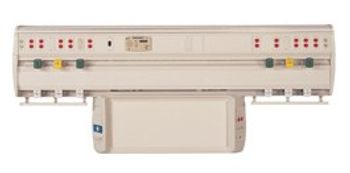
Hillrom Integris 2002B headwall system
 Hillrom · Model Integris 2002B headwall system
Headwall System Hill-Rom is one of the largest hospital headwall manufacturers, offering several types of medical headwall systems and designs with different features and capabilities. The Integris® 2002B headwall system is available with multiple rails to extend its versatility to the positioning of electrical receptacles, low voltage devices and accessories. Moveable Gas Outlets – Gas outlet position and service can be customized with this medical gas headwall depending on changing needs. Standard 14-port Manifold – This headwall’s construction enables versatility. The manifold, which is located behind the gas panel, can accommodate a maximum of (4) oxygen outlets, (4) medical air outlets, and (6) vacuum outlets. Optional Integrated Bed Locator – The hospital headwall’s optional bed locator helps protect walls and equipment from damage.
Key tips
- ·Always leak-test under load - a regulator that reads correctly at rest can still leak and fail in real use.
- ·Canister and tubing changes are an infection-control issue as much as a mechanical one.
Typical Failure Modes
Failure patterns typical of this equipment class - general BMET reference, not verified against this exact unit's own service history unless flagged. Severity is a category-level estimate.
Canister / float valve fault
LowSymptoms: Leak, loss of vacuum.
Root cause: Cracked canister / stuck float.
Filter clog
LowSymptoms: Reduced flow, overheats.
Root cause: Inline filter saturated.
Pump / diaphragm wear
MediumSymptoms: Low vacuum, slow recovery.
Root cause: Diaphragm/motor fatigue.
Serviceable Parts & Consumables
The parts a BMET typically services on this class of equipment. Service class and relative cost are general engineering estimates for the category, not figures from this unit's documentation. Part numbers appear only when pulled from this unit's own service manual. Always confirm intervals and pricing against the manufacturer.
Collection canister & float
Consumable.
Class ConsumableRel. cost $R&R Easy
Inline bacterial filter
Consumable.
Class ConsumableRel. cost $R&R Easy
Diaphragm pump kit
Most-replaced wear kit.
Class Periodic replacementRel. cost $$$R&R Moderate
| Part | Service class | Relative cost | R&R difficulty |
|---|---|---|---|
| Collection canister & float Consumable. | Consumable | $ | Easy |
| Inline bacterial filter Consumable. | Consumable | $ | Easy |
| Diaphragm pump kit Most-replaced wear kit. | Periodic replacement | $$$ | Moderate |
Relative cost: $ lowest · $$$$ highest service-part cost for this equipment class. Not a price.
PM Checklist
Preventive-maintenance tasks typical of this equipment class. Perform to the manufacturer's procedure and your facility's policy - this is general reference, not a schedule for this specific unit.
- ·Regulator calibration and leak check
- ·Canister / tubing replacement
- ·Annual full PM
Troubleshooting Approach
A structured starting point derived from the failure modes above. Follow the manufacturer's service documentation for the actual procedure.
Symptom: Pump / diaphragm wear
- Confirm the presentation - typically low vacuum, slow recovery - and note the exact alarm or message and the conditions when it occurs.
- Check the most likely cause first: diaphragm/motor fatigue.
- Isolate the affected subsystem using the manufacturer's functional check or self-test, where one is provided.
- If the fault is confirmed and not a field adjustment, service or replace the diaphragm pump kit per the manufacturer's service documentation.
- Return the device to service only after the manufacturer's functional and applicable electrical-safety checks pass.
- Record the findings, any parts used, and the verification results in the maintenance history.
Symptom: Canister / float valve fault
- Confirm the presentation - typically leak, loss of vacuum - and note the exact alarm or message and the conditions when it occurs.
- Check the most likely cause first: cracked canister / stuck float.
- Isolate the affected subsystem using the manufacturer's functional check or self-test, where one is provided.
- If the fault is confirmed and not a field adjustment, service or replace the collection canister & float per the manufacturer's service documentation.
- Return the device to service only after the manufacturer's functional and applicable electrical-safety checks pass.
- Record the findings, any parts used, and the verification results in the maintenance history.
Typical Location
Where this class of equipment is typically deployed - general reference, not this unit's own placement record.
- Operating Room
- Emergency Department
- Patient floors (wall suction regulators)
- Central vacuum plant
Documents & Manuals
Troubleshoot this device with Bio
Describe a symptom or error code. Bio answers from this device's own documented error codes, failure modes, parts, and guides.
Ask Bio