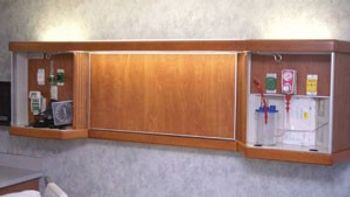
Hillrom First Impression Series Headwalls
 Hillrom · Model First Impression Series Headwalls
First Impression® Series Headwalls Improved Aesthetics - The Impression® series headwall collection offers a solution to the challenge of creating a warmer atmosphere for patients and visitors without compromising the scope of patient care. Safety Interlock Switch - The headwall also features a safety interlock switch that prevents the bed from further movement when contact is made with the light or lower frame of the unit. The bed must be plugged into the appropriate bed outlet for this feature to function. Concealed Services - Tambour doors easily slide open to reveal such necessary services as electric, gases, and nurse call. Integrated Lighting - An integrated light provides abundant lighting directed in front of the page for reading. An indirect wall light provides soft lighting to enhance the room’s overall appearance and create a warmer atmosphere for patients and visitors.
Key tips
- ·Never skip temperature-accuracy verification to save time - it's the one check that directly prevents burns.
- ·Hose/blanket connector wear is the most common real fault and the easiest to miss on a quick visual check.
Typical Failure Modes
Failure patterns typical of this equipment class - general BMET reference, not verified against this exact unit's own service history unless flagged. Severity is a category-level estimate.
Fan / airflow failure
LowSymptoms: Uneven warming, hotspot.
Root cause: Blower wear.
Temperature sensor drift
MediumSymptoms: Setpoint error, alarm.
Root cause: Sensor aging.
Heater / element fault
MediumSymptoms: No heat, overheat alarm.
Root cause: Element or thermal fuse failure.
Serviceable Parts & Consumables
The parts a BMET typically services on this class of equipment. Service class and relative cost are general engineering estimates for the category, not figures from this unit's documentation. Part numbers appear only when pulled from this unit's own service manual. Always confirm intervals and pricing against the manufacturer.
Blower fan
Class Periodic replacementRel. cost $$R&R Fairly easy
Temperature probe
Consumable per patient.
Class Periodic replacementRel. cost $R&R Easy
Heating element / thermal fuse
Common R&R.
Class Periodic replacementRel. cost $$$R&R Moderate
| Part | Service class | Relative cost | R&R difficulty |
|---|---|---|---|
| Blower fan | Periodic replacement | $$ | Fairly easy |
| Temperature probe Consumable per patient. | Periodic replacement | $ | Easy |
| Heating element / thermal fuse Common R&R. | Periodic replacement | $$$ | Moderate |
Relative cost: $ lowest · $$$$ highest service-part cost for this equipment class. Not a price.
PM Checklist
Preventive-maintenance tasks typical of this equipment class. Perform to the manufacturer's procedure and your facility's policy - this is general reference, not a schedule for this specific unit.
- ·Hose / blanket connector inspection
- ·Temperature-accuracy verification
- ·Annual electrical safety test
Troubleshooting Approach
A structured starting point derived from the failure modes above. Follow the manufacturer's service documentation for the actual procedure.
Symptom: Heater / element fault
- Confirm the presentation - typically no heat, overheat alarm - and note the exact alarm or message and the conditions when it occurs.
- Check the most likely cause first: element or thermal fuse failure.
- Isolate the affected subsystem using the manufacturer's functional check or self-test, where one is provided.
- If the fault is confirmed and not a field adjustment, service or replace the heating element / thermal fuse per the manufacturer's service documentation.
- Return the device to service only after the manufacturer's functional and applicable electrical-safety checks pass.
- Record the findings, any parts used, and the verification results in the maintenance history.
Symptom: Fan / airflow failure
- Confirm the presentation - typically uneven warming, hotspot - and note the exact alarm or message and the conditions when it occurs.
- Check the most likely cause first: blower wear.
- Isolate the affected subsystem using the manufacturer's functional check or self-test, where one is provided.
- If the fault is confirmed and not a field adjustment, service or replace the blower fan per the manufacturer's service documentation.
- Return the device to service only after the manufacturer's functional and applicable electrical-safety checks pass.
- Record the findings, any parts used, and the verification results in the maintenance history.
Typical Location
Where this class of equipment is typically deployed - general reference, not this unit's own placement record.
- Operating Room
- PACU
- Emergency Department
- Labor & Delivery
- NICU
Documents & Manuals
- Hill-Rom First Impression Series Headwall brochureBrochure · External
- Hill-Rom First Impression Series Headwall InstallationDocument · External
- Hill-Rom First Impression Series Headwall Private Unit InstallationDocument · External
- Hill-Rom First Impression Series Headwall Semi Private Unit InstallationDocument · External
Troubleshoot this device with Bio
Describe a symptom or error code. Bio answers from this device's own documented error codes, failure modes, parts, and guides.
Ask Bio