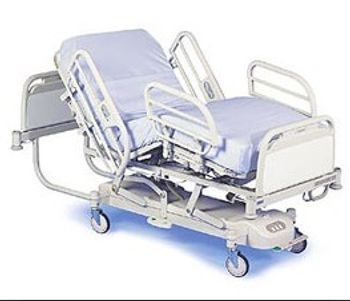
Hillrom Evolution
 Hillrom · Model Evolution
An advanced mattress with two therapies in one product: constant low pressure and alternating pressure. Both features are constantly controlled by the unique automatic pressure control technology, called Deteq ™ bears. The bead area with ultra-light pressure provides improved support for this vulnerable spot. The manual eliminates the need for heavy fans at the foot of the bed. This ergonomic electric bed can be with one press of a button the patient's position, no physical effort for the caregiver. The bed promotes the self-sufficiency of the patient. The unique 3-position adjustable side rails increases the mobility of the patient and meets the safety requirements for electrical high / low beds.
Key tips
- ·Mounting and securement hardware takes real fatigue from vibration and road shock - inspect it as carefully as the device itself.
- ·Post-call battery and function checks catch transport-induced faults that a scheduled PM would miss for months.
Typical Failure Modes
Compiled for this model from its own documentation and established engineering knowledge for this equipment class - not from a verified service record. Confirm against the manufacturer's service manual.
A powered bed function will not run
HighSymptoms: Backrest, knee, height, Trendelenburg or the boost / turn assist will not move from the siderail or caregiver controls.
Root cause: Failed linear actuator, a control-board fault, a control-panel fault, or a pinched / damaged control cable.
Brake / castor-lock fault
MediumSymptoms: Bed will not brake or release, drifts, central brake pedal ineffective.
Root cause: Worn central-brake linkage or castor.
Integrated scale / bed-exit fault
MediumSymptoms: Weight reads implausibly or will not zero, bed-exit alarm false-triggers or fails.
Root cause: Load-cell drift or damage, or a scale-control fault.
Battery back-up fault
MediumSymptoms: Functions and alarms do not work during a power interruption, battery-fault indicator.
Root cause: Aged back-up battery or a charger fault.
Siderail / CPR-release / mechanical fault
LowSymptoms: Siderail will not latch, rattles, or the CPR release is slow / stiff.
Root cause: Worn siderail latch or the CPR mechanism.
Serviceable Parts & Consumables
Serviceable items for this model, compiled from its documentation and engineering knowledge for this equipment class. Service class and relative cost are estimates, not manufacturer figures; no part numbers are given. Confirm intervals and pricing against the manufacturer.
Linear actuator (backrest / knee / height)
Class Major service partRel. cost $$$R&R Difficult
Central-brake / castor assembly
Class Major service partRel. cost $$R&R Difficult
Load cell / scale sensor set
Recalibrate the scale after replacement.
Class Major service partRel. cost $$$R&R Difficult
Back-up battery
Class Periodic replacementRel. cost $$R&R Fairly easy
Siderail control panel / control board
Class Major service partRel. cost $$$R&R Moderate
| Part | Service class | Relative cost | R&R difficulty |
|---|---|---|---|
| Linear actuator (backrest / knee / height) | Major service part | $$$ | Difficult |
| Central-brake / castor assembly | Major service part | $$ | Difficult |
| Load cell / scale sensor set Recalibrate the scale after replacement. | Major service part | $$$ | Difficult |
| Back-up battery | Periodic replacement | $$ | Fairly easy |
| Siderail control panel / control board | Major service part | $$$ | Moderate |
Relative cost: $ lowest · $$$$ highest service-part cost for this equipment class. Not a price.
PM Checklist
Preventive-maintenance tasks typical of this equipment class. Perform to the manufacturer's procedure and your facility's policy - this is general reference, not a schedule for this specific unit.
- ·Post-call function and battery check
- ·Mounting / securement inspection
- ·Annual full PM and vibration-tolerance check
Troubleshooting Approach
A starting sequence for this model, compiled from its documentation and engineering knowledge for this equipment class. Follow the manufacturer's service documentation for the actual procedure.
Symptom: A powered function will not run (backrest / knee / height / Trendelenburg / boost)
- Confirm the bed is plugged in and the battery is charged, and that no function lock-out is set on the caregiver panel.
- Try the function from both the siderail control and the caregiver control to separate the control from the actuator.
- Inspect the control cable / harness for pinch damage along the articulating frame.
- Listen for the actuator; measure its supply at the control box.
- Replace the actuator or the control board as isolated, then load-test to the rated capacity.
Symptom: Brake / castor-lock will not hold or release / bed drifts
- Check the central brake pedal travel and the linkage to each castor.
- Adjust the central-brake linkage per the manual.
- Replace worn castors and the fifth-wheel / steer components.
- Confirm the brake holds on a slope with a load.
- Check all castors engage evenly.
Symptom: Integrated scale reads wrong / bed-exit alarm false-triggers or fails
- Remove all load and confirm the scale zeros and can be tared.
- Place a known reference weight and check the reading.
- Inspect the load-cell mounts for binding, debris or a pinched cable.
- Recalibrate the scale per the service procedure.
- Replace the load-cell set if it will not hold calibration; re-test the bed-exit zones.
Symptom: Functions / alarms dead on a power interruption (battery back-up)
- Check the battery-fault indicator and the charge state.
- Run a battery test if the bed supports one.
- Inspect the battery connector and charger.
- Replace the back-up battery.
- Confirm functions and alarms work on battery after replacement.
Typical Location
Where this class of equipment is typically deployed - general reference, not this unit's own placement record.
- Ambulance / transport vehicles
- Emergency Department
- Inter-facility transport teams
Documents & Manuals
Troubleshoot this device with Bio
Describe a symptom or error code. Bio answers from this device's own documented error codes, failure modes, parts, and guides.
Ask Bio